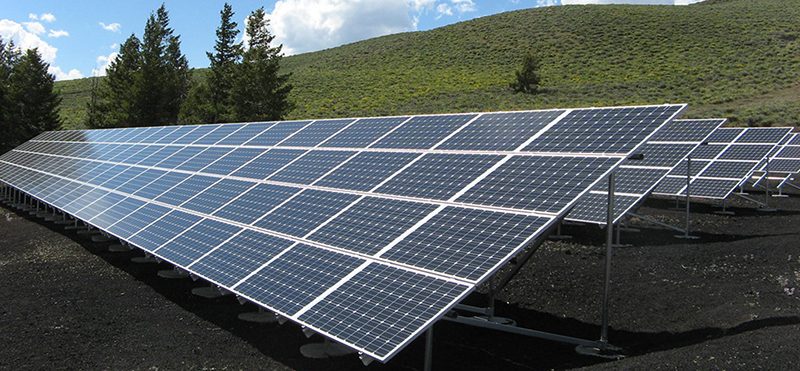
Figure 13.8Solar panels harness the sun's energy to power homes, businesses, and various methods of transportation.Solar panels harness the sun's energy to power homes, businesses, and various methods of transportation. (credit: modification of work “Craters of the Moon solar array” by NPS Climate Change Response/Flickr, Public Domain Mark 1.0)
Learning Objectives
After completing this section, you should be able to:
Compute how conserving water can positively impact climate change.
Discuss the history of solar energy.
Compute power needs for common devices in a home.
Explore advantages of solar power as it applies to home use.
Climate change and emissions management have been debated topics in recent years. However, more and more people are recognizing the impacts that have resulted in temperature changes and are seeking timely and effective action. The World Meteorological Organization shared in a June 2021 publication that “2021 is a make-or-break year for climate action, with the window to prevent the worst impacts of climate change—which include ever more frequent more intense droughts, floods and storms—closing rapidly.” The problem no longer belongs to a few countries or regions but rather is a worldwide concern measured with increasing temperatures leading to decreased glacier coverage and resulting rise in sea levels.
The good news is, there are small steps that each of us can do that collectively can positively impact climate change.
Making a Positive Impact on Climate Change—Water Usage
Our use of water is one element that impacts climate change. Having access to clean, potable water is critical for not only our health but also for the health of our ecosystem. About 1 out of 10 people on our planet do not have easy access to clean water to drink. As each of us conserves water, we prolong the life span of fresh water from our lakes and rivers and also reduce the impact on sewer systems and drainage in our communities. Additionally, as we conserve water, we also conserve electricity that is used to bring water to and in our homes. So, what can we do to help conserve water?
History of Solar Energy
In the mid-1800s, Willoughby Smith discovered photoconductive responsiveness in selenium. Shortly thereafter, William Grylls Adams and Richard Evans Day discovery that selenium can produce electricity if exposed to the sun was a major breakthrough. Less than 10 years later, Charles Fritts invented the first solar cells using selenium. Jumping a mere 100 years later, Bell Labs in the United States produced the first practical photovoltaic cells in the mid-1950s and developed versions used to power satellites in the same decade.
Solar panel use has exploded in recent decades and is now used by residences, organizations, businesses, and government buildings such as the White House, space to power satellites, and various methods of transportation. One reason for the expansion is a continuing drop in cost combined with an increase in performance and durability. In the mid-1950s, the cost of a solar panel was around $300 per watt capability. Twenty years later, the cost was a third of the 1950s’ cost. Currently, solar panel cost has dropped to less than $1 per watt while decreasing in size as well as increasing in longevity. The dropping price and improved performance has moved solar to a modest investment that can pay for itself in less than half the time of systems from 15 years ago.
Compute Power Needs for Common Home Devices
A kilowatt (kW) is 1,000 watts (W). A kilowatt-hour (kWh) is a measurement of energy use, which is the amount of energy used by a 1,000-watt device to run for an hour. Using the definition of a kilowatt-hour, to calculate how long it would take to consume 1 kWh of power, we divide 1,000 by the watts use of a device.
For example, a 75 W bulb would take to use 1 kW of power.
Solar Advantages
There are multiple advantages that solar power can offer us today including reducing greenhouse gas and CO2 emissions, powering vehicles, reducing water pollution, reducing strain on limited supply of other power options such as fossil fuels. We will look further at reducing greenhouse gas and CO2 emissions.
Any gas that prevents infrared radiation from escaping Earth's atmosphere is a greenhouse gas. There are 24 currently identified greenhouse gases of which carbon dioxide is one. When measuring the impact of any of the greenhouse gases, the measurements are given in units of carbon dioxide emissions. For this reason, greenhouse gas and carbon dioxide have become interchangeable in discussions.
Key Terms
greenhouse gas
CO2 emissions
watt
kilowatt (kW)
Key Concepts
Recognize how water conservation by one person, family, community, or nation can positively impact the world’s freshwater supply.
Recall components from the history of solar use by mankind.
Calculate electrical demand given watts.
Recognize advantages of residential solar power.
Formulas
Adapted from Contemporary Mathematics by OpenStax (openstax.org), licensed under CC BY-NC-SA 4.0. Changes were made. License: CC-BY-NC-SA-4.0.
These eBooks are a prerelease and are not yet certified conformant with WCAG 2.1 AA or ADA Title II. Every page is built against an automated accessibility gate, and the published editions will meet ADA Title II requirements when they release in late September 2026. If something is unusable, please tell us.