
10.1 Points, Lines, and Planes
Learning Objectives
After completing this section, you should be able to:
- Identify and describe points, lines, and planes.
- Express points and lines using proper notation.
- Determine union and intersection of sets.
In this section, we will begin our exploration of geometry by looking at the basic definitions as defined by Euclid. These definitions form the foundation of the geometric theories that are applied in everyday life.
In The Elements, Euclid summarized the geometric principles discovered earlier and created an axiomatic system, a system composed of postulates. A postulate is another term for axiom, which is a statement that is accepted as truth without the need for proof or verification. There were no formal geometric definitions before Euclid, and when terms could not be defined, they could be described. In order to write his postulates, Euclid had to describe the terms he needed and he called the descriptions “definitions.” Ultimately, we will work with theorems, which are statements that have been proved and can be proved.
Points and Lines
The first definition Euclid wrote was that of a point. He defined a point as “that which has no part.” It was later expanded to “an indivisible location which has no width, length, or breadth.” Here are the first two of the five postulates, as they are applicable to this first topic:
- Postulate 1: A straight line segment can be drawn joining any two points.
- Postulate 2: Any straight line segment can be extended indefinitely in a straight line.
Before we go further, we will define some of the symbols used in geometry in Figure 10.3:

From Figure 10.3, we see the variations in lines, such as line segments, rays, or half-lines. What is consistent is that two collinear points (points that lie on the same line) are required to form a line. Notice that a line segment is defined by its two endpoints showing that there is a definite beginning and end to a line segment. A ray is defined by two points on the line; the first point is where the ray begins, and the second point gives the line direction. A half-line is defined by two points, one where the line starts and the other to give direction, but an open circle at the starting point indicates that the starting point is not part of the half-line. A regular line is defined by any two points on the line and extends infinitely in both directions. Regular lines are typically drawn with arrows on each end.
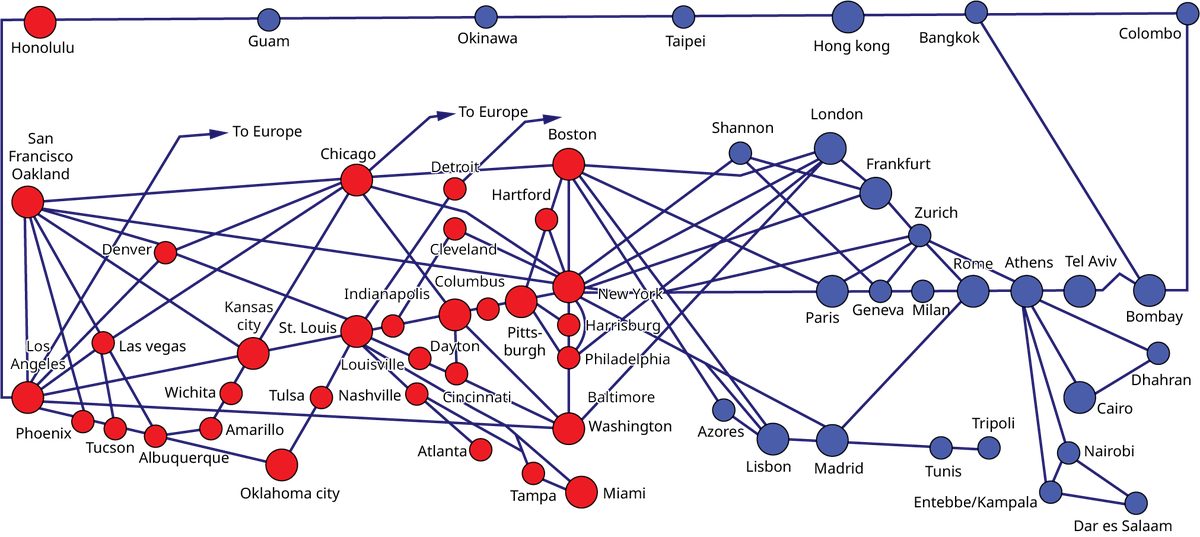
There are numerous applications of line segments in daily life. For example, airlines working out routes between cities, where each city’s airport is a point, and the points are connected by line segments. Another example is a city map. Think about the intersection of roads, such that the center of each intersection is a point, and the points are connected by line segments representing the roads. See Figure 10.5.
Parallel Lines
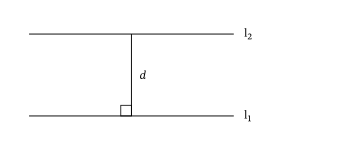
Parallel lines are lines that lie in the same plane and move in the same direction, but never intersect. To indicate that the line and the line are parallel we often use the symbol The distance between parallel lines remains constant as the lines extend infinitely in both directions. See Figure 10.7.
Perpendicular Lines
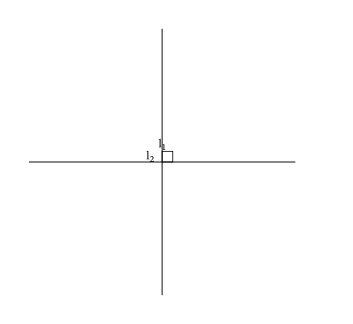
Two lines that intersect at a angle are perpendicular lines and are symbolized by . If and are perpendicular, we write When two lines form a right angle, a angle, we symbolize it with a little square See Figure 10.8.
Defining Union and Intersection of Sets
Union and intersection of sets is a topic from set theory that is often associated with points and lines. So, it seems appropriate to introduce a mini-version of set theory here. First, a set is a collection of objects joined by some common criteria. We usually name sets with capital letters. For example, the set of odd integers between 0 and 10 looks like this: When it involves sets of lines, line segments, or points, we are usually referring to the union or intersection of set.
The union of two or more sets contains all the elements in either one of the sets or elements in all the sets referenced, and is written by placing this symbol in between each of the sets. For example, let set and let set Then, the union of sets A and B is
The intersection of two or more sets contains only the elements that are common to each set, and we place this symbol in between each of the sets referenced. For example, let’s say that set and let set Then, the intersection of sets and is
Planes
A plane, as defined by Euclid, is a “surface which lies evenly with the straight lines on itself.” A plane is a two-dimensional surface with infinite length and width, and no thickness. We also identify a plane by three noncollinear points, or points that do not lie on the same line. Think of a piece of paper, but one that has infinite length, infinite width, and no thickness. However, not all planes must extend infinitely. Sometimes a plane has a limited area.
We usually label planes with a single capital letter, such as Plane , as shown in Figure 10.16, or by all points that determine the edges of a plane. In the following figure, Plane contains points and , which are on the same line, and point , which is not on that line. By definition, is a plane. We can move laterally in any direction on a plane.
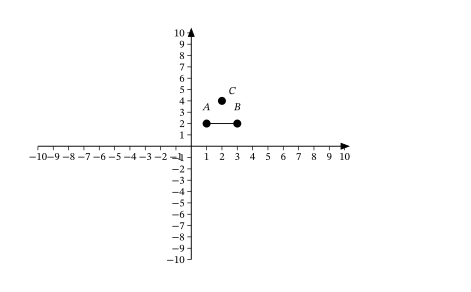
One way to think of a plane is the Cartesian coordinate system with the -axis marked off in horizontal units, and -axis marked off in vertical units. In the Cartesian plane, we can identify the different types of lines as they are positioned in the system, as well as their locations. See Figure 10.17.
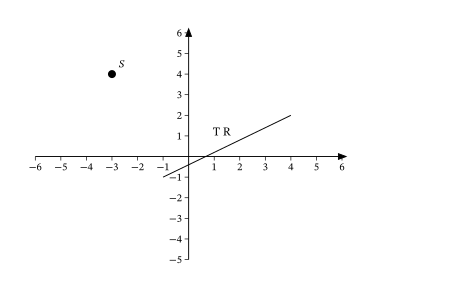
This plane contains points , , and . Points and are colinear and form a line segment. Point is not on that line segment. Therefore, this represents a plane.
To give the location of a point on the Cartesian plane, remember that the first number in the ordered pair is the horizontal move and the second number is the vertical move. Point is located at point is located at and point is located at We can also identify the line segment as
Two other concepts to note: Parallel planes do not intersect and the intersection of two planes is a straight line. The equation of that line of intersection is left to a study of three-dimensional space. See Figure 10.18.
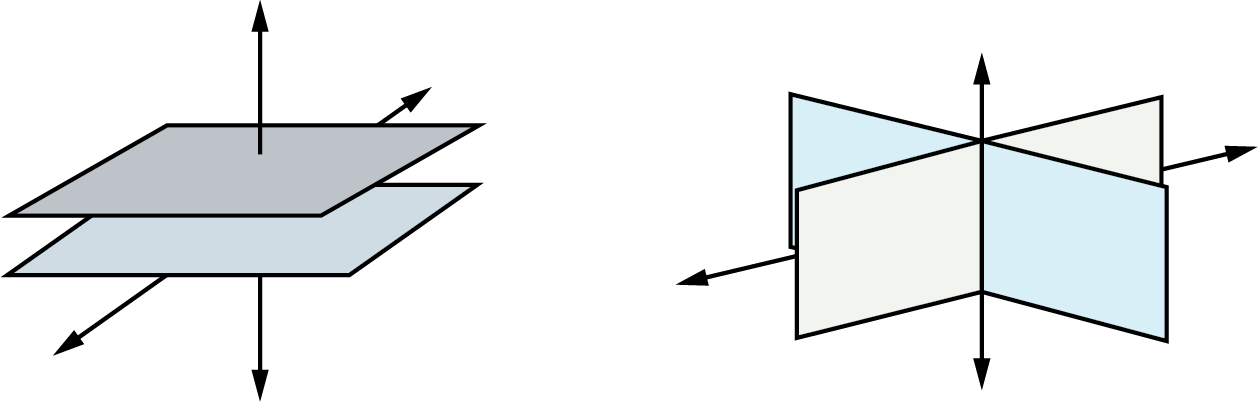
To summarize, some of the properties of planes include:
- Three points including at least one noncollinear point determine a plane.
- A line and a point not on the line determine a plane.
- The intersection of two distinct planes is a straight line.
Key Terms
- line segment
- plane
- union
- intersection
- parallel
- perpendicular
Key Concepts
- Modern-day geometry began in approximately 300 BCE with Euclid’s Elements, where he defined the principles associated with the line, the point, and the plane.
- Parallel lines have the same slope. Perpendicular lines have slopes that are negative reciprocals of each other.
- The union of two sets, and , contains all points that are in both sets and is symbolized as
- The intersection of two sets and includes only the points common to both sets and is symbolized as
Adapted from Contemporary Mathematics by OpenStax (openstax.org), licensed under CC BY-NC-SA 4.0. Changes were made. License: CC-BY-NC-SA-4.0.