
10.2 Angles

Learning Objectives
After completing this section, you should be able to:
- Identify and express angles using proper notation.
- Classify angles by their measurement.
- Solve application problems involving angles.
- Compute angles formed by transversals to parallel lines.
- Solve application problems involving angles formed by parallel lines.
Unusual perspectives on architecture can reveal some extremely creative images. For example, aerial views of cities reveal some exciting and unexpected angles. Add reflections on glass or steel, lighting, and impressive textures, and the structure is a work of art. Understanding angles is critical to many fields, including engineering, architecture, landscaping, space planning, and so on. This is the topic of this section.
We begin our study of angles with a description of how angles are formed and how they are classified. An angle is the joining of two rays, which sweep out as the sides of the angle, with a common endpoint. The common endpoint is called the vertex. We will often need to refer to more than one vertex, so you will want to know the plural of vertex, which is vertices.
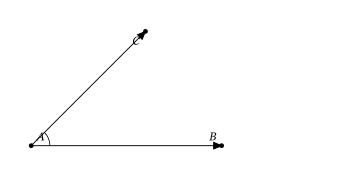
In Figure 10.22, let the ray stay put. Rotate the second ray in a counterclockwise direction to the size of the angle you want. The angle is formed by the amount of rotation of the second ray. When the ray continues to rotate in a counterclockwise direction back to its original position coinciding with ray the ray will have swept out We call the rays the “sides” of the angle.
Classifying Angles
Angles are measured in radians or degrees. For example, an angle that measures radians, or 3.14159 radians, is equal to the angle measuring An angle measuring radians, or 1.570796 radians, measures To translate degrees to radians, we multiply the angle measure in degrees by For example, to write in radians, we have
To translate radians to degrees, we multiply by For example, to write radians in degrees, we have
Another example of translating radians to degrees and degrees to radians is To write in degrees, we have To write in radians, we have . However, we will use degrees throughout this chapter.
Several angles are referred to so often that they have been given special names. A straight angle measures ; a right angle measures an acute angle is any angle whose measure is less than and an obtuse angle is any angle whose measure is between and See Figure 10.23.

An easy way to measure angles is with a protractor (Figure 10.24). A protractor is a very handy little tool, usually made of transparent plastic, like the one shown here.
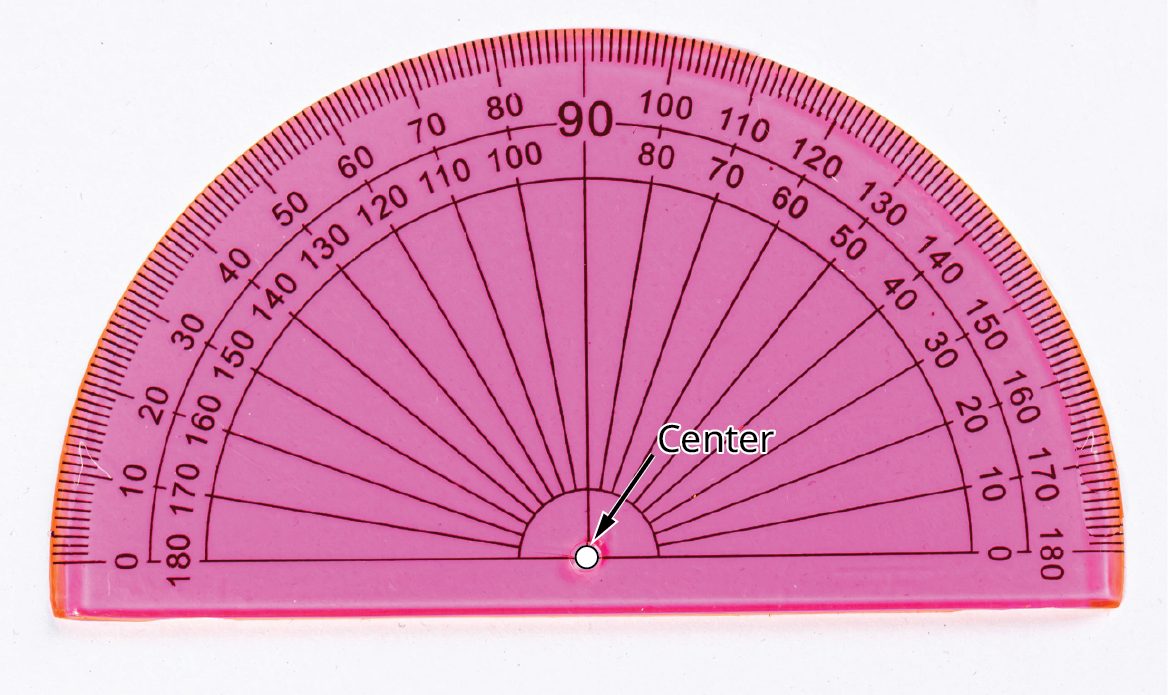
With a protractor, you line up the straight bottom with the horizontal straight line of the angle. Be sure to have the center hole lined up with the vertex of the angle. Then, look for the mark on the protractor where the second ray lines up. As you can see from the image, the degrees are marked off. Where the second ray lines up is the measurement of the angle.
Notation
Naming angles can be done in couple of ways. We can name the angle by three points, one point on each of the sides and the vertex point in the middle, or we can name it by the vertex point alone. Also, we can use the symbols or before the points. When we are referring to the measure of the angle, we use the symbol . See Figure 10.25.
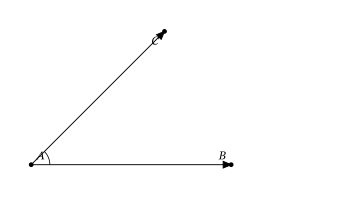
We can name this angle , or , or
Adjacent Angles
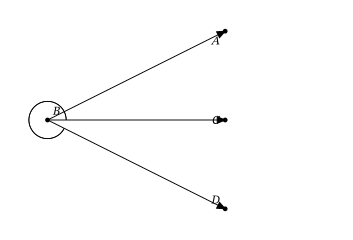
Two angles with the same starting point or vertex and one common side are called adjacent angles. In Figure 10.27, angle is adjacent to . Notice that the way we designate an angle is with a point on each of its two sides and the vertex in the middle.
Supplementary Angles
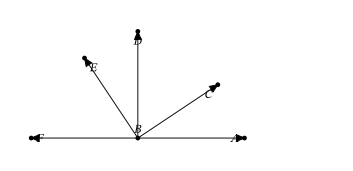
Two angles are supplementary if the sum of their measures equals In Figure 10.28, we are given that so what is These are supplementary angles. Therefore, because , and as we have
Complementary Angles
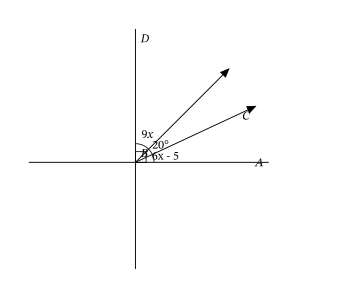
Two angles are complementary if the sum of their measures equals In Figure 10.30, we have and What is the These are complementary angles. Therefore, because the
Vertical Angles
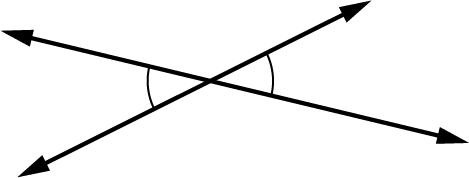
When two lines intersect, the opposite angles are called vertical angles, and vertical angles have equal measure. For example, Figure 10.32 shows two straight lines intersecting each other. One set of opposite angles shows angle markers; those angles have the same measure. The other two opposite angles have the same measure as well.
Transversals
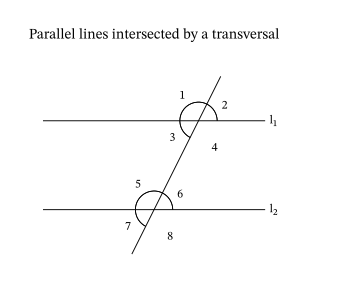
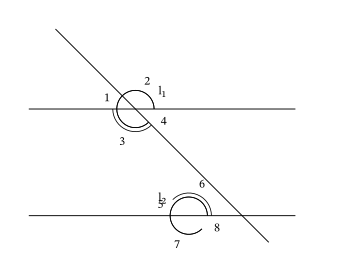
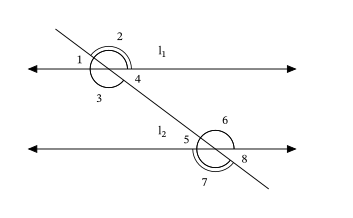
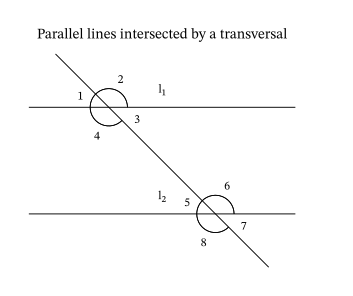
When two parallel lines are crossed by a straight line or transversal, eight angles are formed, including alternate interior angles, alternate exterior angles, corresponding angles, vertical angles, and supplementary angles. See Figure 10.34. Angles 1, 2, 7, and 8 are called exterior angles, and angles 3, 4, 5, and 6 are called interior angles.
Alternate Interior Angles
Alternate interior angles are the interior angles on opposite sides of the transversal. These two angles have the same measure. For example, and are alternate interior angles and have equal measure; and are alternate interior angles and have equal measure as well. See Figure 10.35.
Alternate Exterior Angles
Alternate exterior angles are exterior angles on opposite sides of the transversal and have the same measure. For example, in Figure 10.36, and are alternate exterior angles and have equal measures; and are alternate exterior angles and have equal measures as well.
Corresponding Angles
Corresponding angles refer to one exterior angle and one interior angle on the same side as the transversal, which have equal measures. In Figure 10.37, and are corresponding angles and have equal measures; and are corresponding angles and have equal measures; and are corresponding angles and have equal measures; and are corresponding angles and have equal measures as well.
Key Terms
- vertex
- right angle
- acute angle
- obtuse angle
- straight angle
- complementary
- supplementary
Key Concepts
- Angles are classified as acute if they measure less than obtuse if they measure greater than and less than right if they measure exactly and straight if they measure exactly
- If the sum of angles equals , they are complimentary angles. If the sum of angles equals , they are supplementary.
- A transversal crossing two parallel lines form a series of equal angles: alternate interior angles, alternate exterior angles, vertical angles, and corresponding angles
Formula
To translate an angle measured in degrees to radians, multiply by
To translate an angle measured in radians to degrees, multiply by
Adapted from Contemporary Mathematics by OpenStax (openstax.org), licensed under CC BY-NC-SA 4.0. Changes were made. License: CC-BY-NC-SA-4.0.