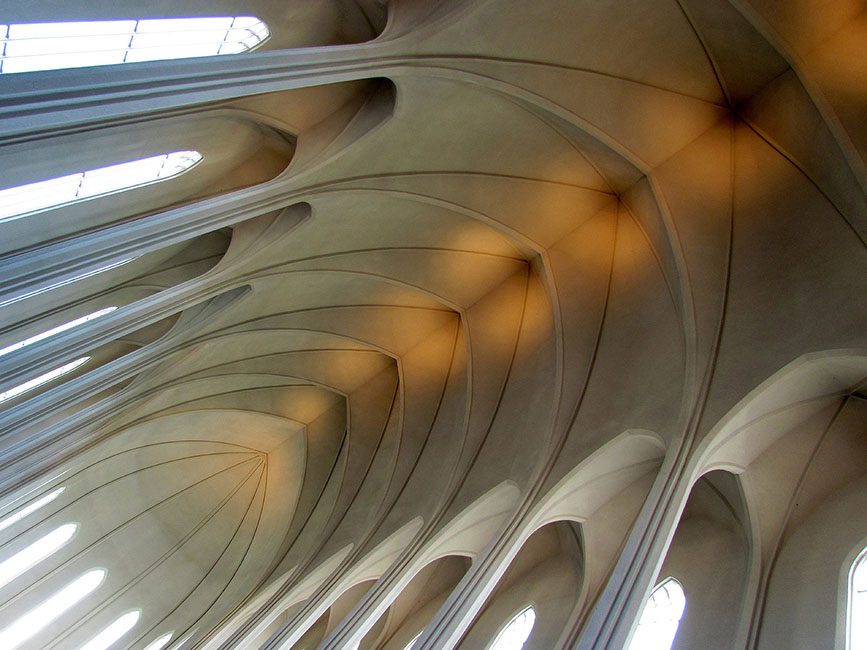
Figure 10.42The appearance of triangles in buildings is part of modern-day architectural design.The appearance of triangles in buildings is part of modern-day architectural design. (credit: "Inside Hallgrímskirkja church, Reykjavik, Iceland" by O Palsson/Flickr, CC BY 2.0)
Learning Objectives
After completing this section, you should be able to:
Identify triangles by their sides.
Identify triangles by their angles.
Determine if triangles are congruent.
Determine if triangles are similar.
Find the missing side of similar triangles.
How were the ancient Greeks able to calculate the radius of Earth? How did soldiers gauge their target? How was it possible centuries ago to estimate the height of a sail at sea? Triangles have always played a significant role in how we find heights of objects too high to measure or distances between objects too far away to calculate. In particular, the concept of similar triangles has countless applications in the real world, and we shall explore some of those applications in this section.
Technology has given us instruments that allow us to find measurements of distant objects with little effort. However, it is all based on the properties of triangles discovered centuries ago. In this section, we will explore the various types of triangles and their special properties, as well as how to measure interior and exterior angles. We will also explore congruence theorems and similarity.
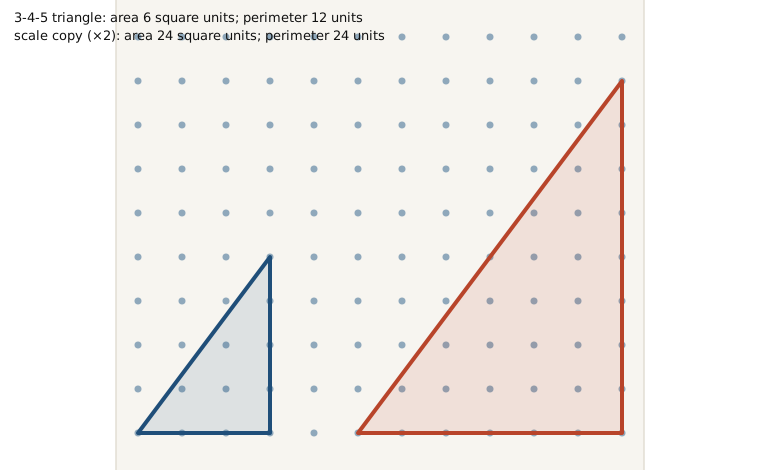
Interactive figureCongruent and similar triangles on the boardDrag inside the figure to pan; scroll to zoom.
XYZ Graph · viewer build 62c52e1
The smaller band is a 3-4-5 right triangle with legs 3 and 4 and hypotenuse 5; the larger band, labelled scale copy (×2), has legs 6 and 8 and hypotenuse 10. The two are labelled rather than styled differently, so they read the same way in any colour scheme. Drag any corner of the larger triangle: its side lengths change one vertex at a time, and you cannot slide it whole onto the original — they are similar, never congruent, because every side of the copy is twice as long.
Identifying Triangles
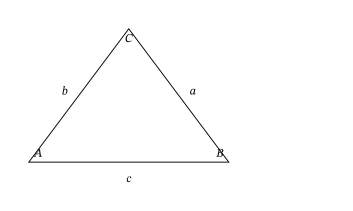
Joining any three noncollinear points with line segments produces a triangle. For example, given points , , and , connected by the line segments and we have a triangle, as shown in Figure 10.43.
Figure 10.43Triangle
Triangles are classified by their angles and their sides. All angles in an acute triangle measure One of the angles in a right triangle measures symbolized by □. One angle in an obtuse triangle measures between and Sides that have equal length are indicated by the same hash marks. Figure 10.44 illustrates the shapes of the basic triangles, their names, and their properties.
A few other facts to remember as we move forward:
The points where the line segments meet are called the vertices (plural for vertex).
We often refer to sides of a triangle by the angle they are opposite. In other words, side is opposite angle , side is opposite angle , and side is opposite angle .
Figure 10.44Types of Triangles
We want to add a special note about right triangles here, as they are referred to more than any other triangle. The side opposite the right angle is its longest side and is called the hypotenuse, and the sides adjacent to the right angle are called the legs.
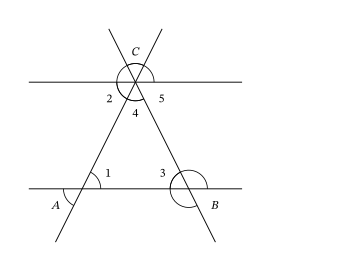
One of the most important properties of triangles is that the sum of the interior angles equals Euclid discovered and proved this property using parallel lines. The completed sketch is shown in Figure 10.45.
Figure 10.45Sum of Interior Angles
This is how the proof goes:
Step 1: Start with a straight line and a point not on the line.
Step 2: Draw a line through point parallel to the line .
Step 3: Construct two transversals (a line crossing the parallel lines), one angled to the right and one angled to the left, to intersect the parallel lines.
Step 4: Because of the property that alternate interior angles inside parallel lines are equal, we have that
Step 5: Notice that by the straight angle property.
Step 6: Therefore, by substitution, and we have that
Therefore, the sum of the interior angles of a
Congruence
If two triangles have equal angles and their sides lengths are equal, the triangles are congruent. In other words, if you can pick up one triangle and place it on top of the other triangle and they coincide, even if you have to rotate one, they are congruent.
The Congruence Theorems
The following theorems are tools you can use to prove that two triangles are congruent. We use the symbol to define congruence. For example, .
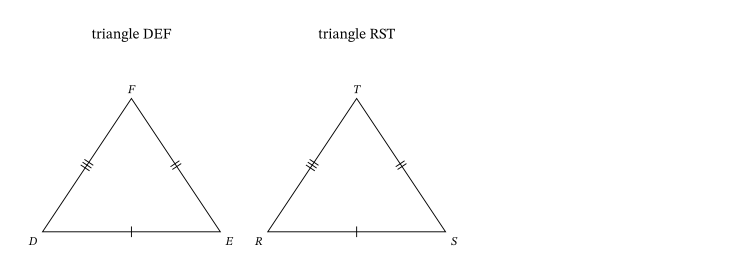
Side-Side-Side (SSS). If three sides of one triangle are equal to the corresponding sides of the second triangle, then the triangles are congruent. See Figure 10.49.
Figure 10.49Side-Side-Side (SSS)
We have that , and then
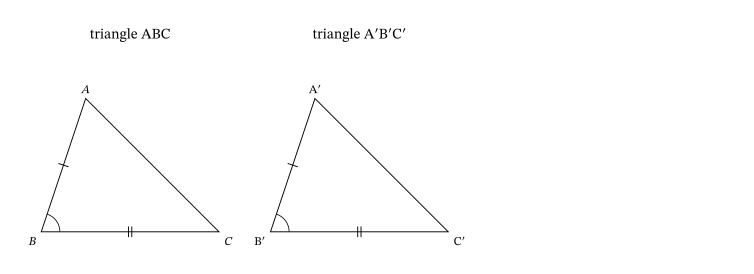
Side-Angle-Side (SAS). If two sides of a triangle and the angle between them are equal to the corresponding two sides and included angle of the second triangle, then the triangles are congruent. See Figure 10.50. We see that and , , then .
Figure 10.50Side-Angle-Side (SAS)
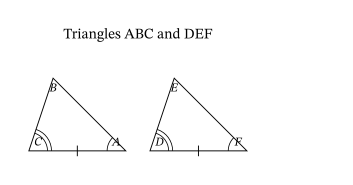
Angle-Side-Angle (ASA). If two angles and the side between them in one triangle are congruent to the two corresponding angles and the side between them in a second triangle, then the two triangles are congruent. See Figure 10.51. Notice that , and , , then
Figure 10.51Angle-Side-Angle (ASA)
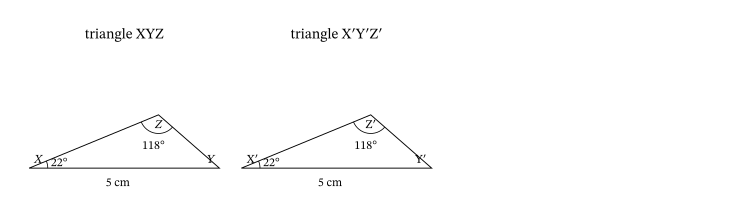
Angle-Angle-Side (AAS). If two angles and a nonincluded side of one triangle are congruent to two angles and the nonincluded corresponding side of a second triangle, then the triangles are congruent.
If two triangles have the same angle measurements and are the same shape but differ in size, the two triangles are similar. The lengths of the sides of one triangle will be proportional to the corresponding sides of the second triangle. Note that a single fraction is called a ratio, but two fractions equal to each other is called a proportion, such as
This rule of similarity applies to all shapes as well as triangles. Another way to view similarity is by applying a scaling factor, which is the ratio of corresponding measurements between an object or representation of the object, to an image that produces the second, similar image.
For example, why are the two images in Figure 10.55 are similar? These two images have the same proportions between elements. Therefore, they are similar.
Figure 10.55Similarity
Key Terms
acute
obtuse
isosceles
equilateral
hypotenuse
congruence
similarity
scaling factor
Key Concepts
The sum of the interior angles of a triangle equals
Two triangles are congruent when the corresponding angles have the same measure and the corresponding side lengths are equal.
The congruence theorems include the following: SAS, two sides and the included angle of one triangle are congruent to the same in a second triangle; ASA, two angles and the included side of one triangle are congruent to the same in a second triangle; SSS, all three side lengths of one triangle are congruent to the same in a second triangle; AAS, two angles and the non-included side of one triangle are congruent to the same in a second triangle.
Two shapes are similar when the proportions between corresponding angles, sides or features of two shapes are equal, regardless of size.
Adapted from Contemporary Mathematics by OpenStax (openstax.org), licensed under CC BY-NC-SA 4.0. Changes were made. License: CC-BY-NC-SA-4.0.
These eBooks are a prerelease and are not yet certified conformant with WCAG 2.1 AA or ADA Title II. Every page is built against an automated accessibility gate, and the published editions will meet ADA Title II requirements when they release in late September 2026. If something is unusable, please tell us.