Figure 10.138In the lower left corner of the fresco The School of Athens by Raphael, the figure in white writing in the book represents Pythagoras. Alongside him, to the right, the figure with the long, light-brown hair is said to depict Archimedes.In the lower left corner of the fresco The School of Athens by Raphael, the figure in white writing in the book represents Pythagoras. Alongside him, to the right, the figure with the long, light-brown hair is said to depict Archimedes. (credit: modification of work “School of Athens” by Raphael (1483–1520), Vatican Museums/Wikimedia, Public Domain)
Learning Objectives
After completing this section, you should be able to:
Apply the Pythagorean Theorem to find the missing sides of a right triangle.
Apply the and right triangle relationships to find the missing sides of a triangle.
Apply trigonometric ratios to find missing parts of a right triangle.
This is another excerpt from Raphael’s The School of Athens. The man writing in the book represents Pythagoras, the namesake of one of the most widely used formulas in geometry, engineering, architecture, and many other fields, the Pythagorean Theorem. However, there is evidence that the theorem was known as early as 1900–1100 BC by the Babylonians. The Pythagorean Theorem is a formula used for finding the lengths of the sides of right triangles.
Born in Greece, Pythagoras lived from 569–500 BC. He initiated a cult-like group called the Pythagoreans, which was a secret society composed of mathematicians, philosophers, and musicians. Pythagoras believed that everything in the world could be explained through numbers. Besides the Pythagorean Theorem, Pythagoras and his followers are credited with the discovery of irrational numbers, the musical scale, the relationship between music and mathematics, and many other concepts that left an immeasurable influence on future mathematicians and scientists.
The focus of this section is on right triangles. We will look at how the Pythagorean Theorem is used to find the unknown sides of a right triangle, and we will also study the special triangles, those with set ratios between the lengths of sides. By ratios we mean the relationship of one side to another side. When you think about ratios, you should think about fractions. A fraction is a ratio, the ratio of the numerator to the denominator. Finally, we will preview trigonometry. We will learn about the basic trigonometric functions, sine, cosine and tangent, and how they are used to find not only unknown sides but unknown angles, as well, with little information.
Pythagorean Theorem
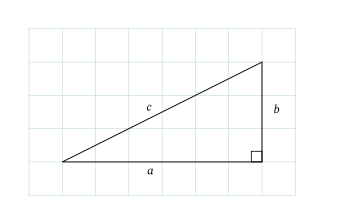
The Pythagorean Theorem is used to find unknown sides of right triangles. The theorem states that the sum of the squares of the two legs of a right triangle equals the square of the hypotenuse (the longest side of the right triangle).
For example, given that side and side we can find the measure of side using the Pythagorean Theorem. Thus,
Distance
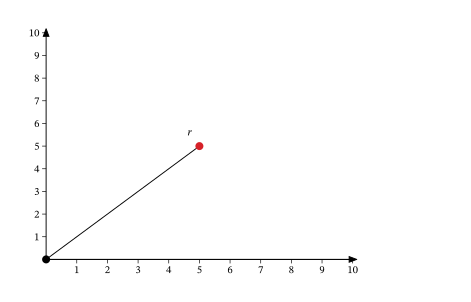
The applications of the Pythagorean Theorem are countless, but one especially useful application is that of distance. In fact, the distance formula stems directly from the theorem. It works like this:
In Figure 10.141, the problem is to find the distance between the points and We call the length from point to point side , and the length from point to point side . To find side , we use the distance formula and we will explain it relative to the Pythagorean Theorem. The distance formula is such that is a substitute for in the Pythagorean Theorem and is equal to and is a substitute for in the Pythagorean Theorem and is equal to When we plug in these numbers to the distance formula, we have
Thus, , the hypotenuse, in the Pythagorean Theorem.
Figure 10.141Distance
Triangles
In geometry, as in all fields of mathematics, there are always special rules for special circumstances. An example is the perfect square rule in algebra. When expanding an expression like we do not have to expand it the long way:
If we know the perfect square formula, given as
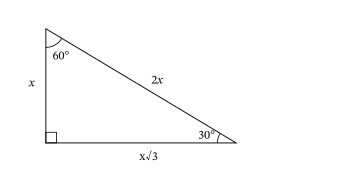
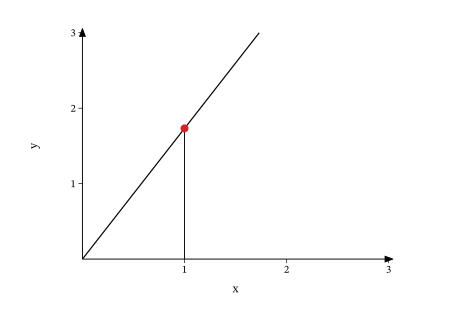
we can skip the middle step and just start writing down the answer. This may seem trivial with problems like However, what if you have a problem like That is a different story. Nevertheless, we use the same perfect square formula. The same idea applies in geometry. There are special formulas and procedures to apply in certain types of problems. What is needed is to remember the formula and remember the kind of problems that fit. Sometimes we believe that because a formula is labeled special, we will rarely have use for it. That assumption is incorrect. So, let us identify the triangle and find out why it is special. See Figure 10.145.
Figure 10.145The
We see that the shortest side is opposite the smallest angle, and the longest side, the hypotenuse, will always be opposite the right angle. There is a set ratio of one side to another side for the triangle given as or Thus, you only need to know the length of one side to find the other two sides in a triangle.
Triangles
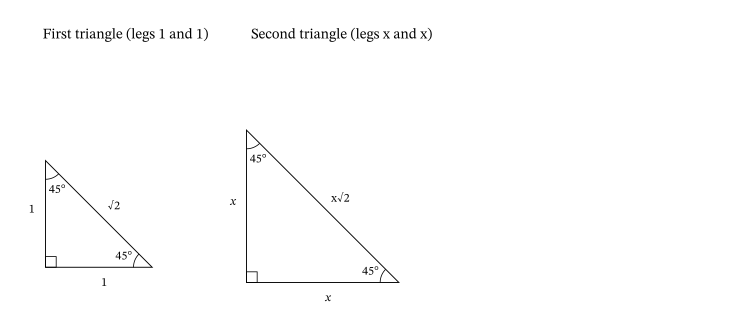
The triangle is another special triangle such that with the measure of one side we can find the measures of all the sides. The two angles adjacent to the angle are equal, and each measures If two angles are equal, so are their opposite sides. The ratio among sides is or as shown in Figure 10.148.
Figure 10.148 Triangles
Trigonometry Functions
Trigonometry developed around 200 BC from a need to determine distances and to calculate the measures of angles in the fields of astronomy and surveying. Trigonometry is about the relationships (or ratios) of angle measurements to side lengths in primarily right triangles. However, trigonometry is useful in calculating missing side lengths and angles in other triangles and many applications.
Trigonometry is based on three functions. We title these functions using the following abbreviations:
Letting which is the hypotenuse of a right triangle, we have Table 10.1. The functions are given in terms of , , and , and in terms of sides relative to the angle, like opposite, adjacent, and the hypotenuse.
Table 10.1
We will be applying the sine function, cosine function, and tangent function to find side lengths and angle measurements for triangles we cannot solve using any of the techniques we have studied to this point. In Figure 10.150, we have an illustration mainly to identify and the sides labeled and .
Figure 10.150Angle
An angle sweeps out in a counterclockwise direction from the positive -axis and stops when the angle reaches the desired measurement. That ray extending from the origin that marks is called the terminal side because that is where the angle terminates. Regardless of the information given in the triangle, we can find all missing sides and angles using the trigonometric functions. For example, in Figure 10.151, we will solve for the missing sides.
Figure 10.151Solving for Missing Sides
Let’s use the trigonometric functions to find the sides and . As long as your calculator mode is set to degrees, you do not have to enter the degree symbol. First, let’s solve for .
We have and Then,
Next, let’s find . This is the cosine function. We have Then,
Now we have all sides, You can also check the sides using the ratio of Table 10.2 is a list of common angles, which you should find helpful.
Table 10.2
To find angle measurements when we have two side measurements, we use the inverse trigonometric functions symbolized as or The –1 looks like an exponent, but it means inverse. For example, in the previous example, we had and To find what angle has these values, enter the values for the inverse cosine function in your calculator:
You can also use the inverse sine function and enter the values of in your calculator given and We have
Finally, we can also use the inverse tangent function. Recall We have
Angle of Elevation and Angle of Depression
Other problems that involve trigonometric functions include calculating the angle of elevation and the angle of depression. These are very common applications in everyday life. The angle of elevation is the angle formed by a horizontal line and the line of sight from an observer to some object at a higher level. The angle of depression is the angle formed by a horizontal line and the line of sight from an observer to an object at a lower level.
Key Terms
right triangle
sine
cosine
tangent
Key Concepts
The Pythagorean Theorem is applied to right triangles and is used to find the measure of the legs and the hypotenuse according the formula where c is the hypotenuse.
To find the measure of the sides of a special angle, such as a triangle, use the ratio where each of the three sides is associated with the opposite angle and 2 is associated with the hypotenuse, opposite the angle.
To find the measure of the sides of the second special triangle, the triangle, use the ratio where each of the three sides is associated with the opposite angle and is associated with the hypotenuse, opposite the angle.
The primary trigonometric functions are and
Trigonometric functions can be used to find either the length of a side or the measure of an angle in a right triangle, and in applications such as the angle of elevation or the angle of depression formed using right triangles.
Formula
The Pythagorean Theorem states
where and are two sides (legs) of a right triangle and is the hypotenuse.
Projects
One of the reasons so many formulas in geometry were discovered was because of the importance in finding measurements of lengths, areas, perimeter, and angles. Find at least five examples of how geometry can be used in practical applications today.
Who were the Pythagoreans? Why did this society exist? Explore what they did and discuss some of their beliefs.
Adapted from Contemporary Mathematics by OpenStax (openstax.org), licensed under CC BY-NC-SA 4.0. Changes were made. License: CC-BY-NC-SA-4.0.
These eBooks are a prerelease and are not yet certified conformant with WCAG 2.1 AA or ADA Title II. Every page is built against an automated accessibility gate, and the published editions will meet ADA Title II requirements when they release in late September 2026. If something is unusable, please tell us.