Figure 10.62Geometric patterns are often used in fabrics due to the interest the shapes create.Geometric patterns are often used in fabrics due to the interest the shapes create. (credit: "Triangles" by Brett Jordan/Flickr, CC BY 2.0)
Learning Objectives
After completing this section, you should be able to:
Identify polygons by their sides.
Identify polygons by their characteristics.
Calculate the perimeter of a polygon.
Calculate the sum of the measures of a polygon’s interior angles.
Calculate the sum of the measures of a polygon’s exterior angles.
Calculate the circumference of a circle.
Solve application problems involving perimeter and circumference.
In our homes, on the road, everywhere we go, polygonal shapes are so common that we cannot count the many uses. Traffic signs, furniture, lighting, clocks, books, computers, phones, and so on, the list is endless. Many applications of polygonal shapes are for practical use, because the shapes chosen are the best for the purpose.
Modern geometric patterns in fabric design have become more popular with time, and they are used for the beauty they lend to the material, the window coverings, the dresses, or the upholstery. This art is not done for any practical reason, but only for the interest these shapes can create, for the pure aesthetics of design.
When designing fabrics, one has to consider the perimeter of the shapes, the triangles, the hexagons, and all polygons used in the pattern, including the circumference of any circular shapes. Additionally, it is the relationship of one object to another and experimenting with different shapes, changing perimeters, or changing angle measurements that we find the best overall design for the intended use of the fabric. In this section, we will explore these properties of polygons, the perimeter, the calculation of interior and exterior angles of polygons, and the circumference of a circle.
Identifying Polygons
A polygon is a closed, two-dimensional shape classified by the number of straight-line sides. See Figure 10.63 for some examples. We show only up to eight-sided polygons, but there are many, many more.
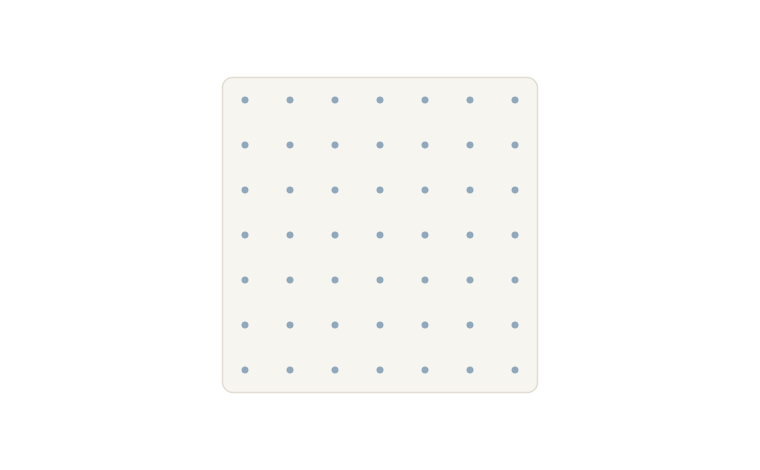
Interactive figureBuild a polygon, measure its perimeterDrag inside the figure to pan; scroll to zoom.
XYZ Graph · viewer build 62c52e1
Stretch a band around three, four, five or more pegs to build a polygon of your own. The board reports the distance around it, whichever polygon you make.Figure 10.63Types of Polygons
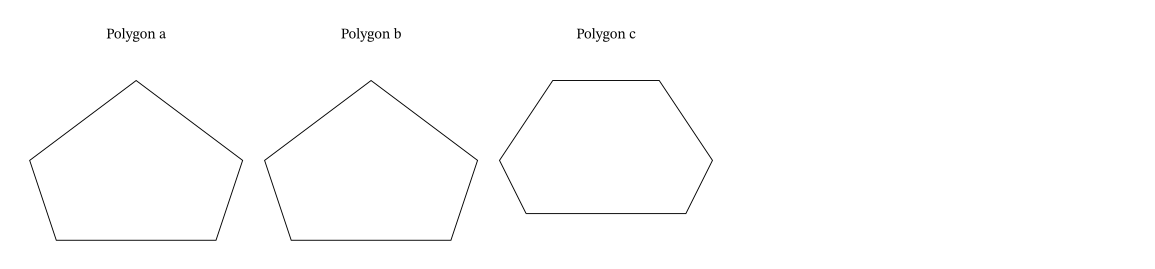
If all the sides of a polygon have equal lengths and all the angles are equal, they are called regular polygons. However, any shape with sides that are line segments can classify as a polygon. For example, the first two shapes, shown in Figure 10.64 and Figure 10.64, are both pentagons because they each have five sides and five vertices. The third shape Figure 10.64 is a hexagon because it has six sides and six vertices. We should note here that the hexagon in Figure 10.64 is a concave hexagon, as opposed to the first two shapes, which are convex pentagons. Technically, what makes a polygon concave is having an interior angle that measures greater than . They are hollowed out, or cave in, so to speak. Convex refers to the opposite effect where the shape is rounded out or pushed out.
Figure 10.64Polygons
While there are variations of all polygons, quadrilaterals contain an additional set of figures classified by angles and whether there are one or more pairs of parallel sides. See Figure 10.65.
Figure 10.65Types of Quadrilaterals
Perimeter
Perimeter refers to the outside measurements of some area or region given in linear units. For example, to find out how much fencing you would need to enclose your backyard, you will need the perimeter. The general definition of perimeter is the sum of the lengths of the sides of an enclosed region. For some geometric shapes, such as rectangles and circles, we have formulas. For other shapes, it is a matter of just adding up the side lengths.
A rectangle is defined as part of the group known as quadrilaterals, or shapes with four sides. A rectangle has two sets of parallel sides with four angles. To find the perimeter of a rectangle, we use the following formula:
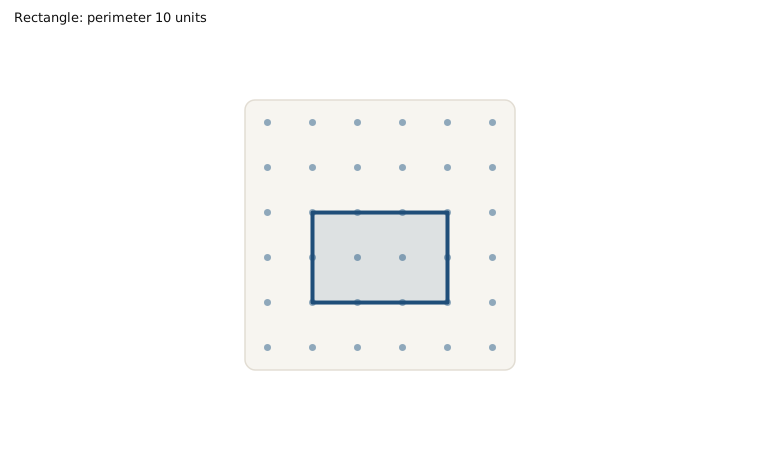
Interactive figureWalk the perimeter of a rectangleDrag inside the figure to pan; scroll to zoom.
XYZ Graph · viewer build 62c52e1
The rectangle formula adds two lengths and two widths. Here the length is 3 and the width is 2, and the board's perimeter readout confirms 10 units. Drag a corner and check the formula against the readout.
For example, to find the length of a rectangle that has a perimeter of 24 inches and a width of 4 inches, we use the formula. Thus,
The length is 8 units.
The perimeter of a regular polygon with sides is given as . For example, the perimeter of an equilateral triangle, a triangle with three equal sides, and a side length of 7 cm is .
Sum of Interior and Exterior Angles
To find the sum of the measurements of interior angles of a regular polygon, we have the following formula.
For example, if we want to find the sum of the interior angles in a parallelogram, we have
Similarly, to find the sum of the interior angles inside a regular heptagon, we have
To find the measure of each interior angle of a regular polygon with sides, we have the following formula.
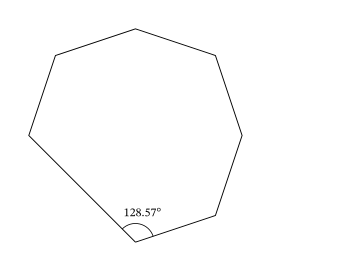
For example, find the measure of an interior angle of a regular heptagon, as shown in Figure 10.69. We have
Figure 10.69Interior Angles
An exterior angle of a regular polygon is an angle formed by extending a side length beyond the closed figure. The measure of an exterior angle of a regular polygon with sides is found using the following formula:
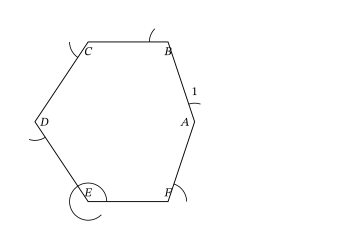
In Figure 10.71, we have a regular hexagon . By extending the lines of each side, an angle is formed on the exterior of the hexagon at each vertex. The measure of each exterior angle is found using the formula, .
Figure 10.71Exterior Angles
Now, an important point is that the sum of the exterior angles of a regular polygon with sides equals This implies that when we multiply the measure of one exterior angle by the number of sides of the regular polygon, we should get For the example in Figure 10.71, we multiply the measure of each exterior angle, , by the number of sides, six. Thus, the sum of the exterior angles is
Circles and Circumference
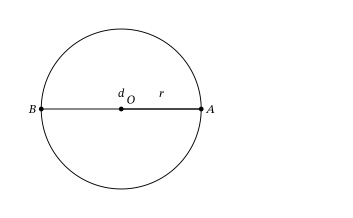
The perimeter of a circle is called the circumference. To find the circumference, we use the formula where is the diameter, the distance across the center, or where is the radius.
The radius is ½ of the diameter of a circle. The symbol is the ratio of the circumference to the diameter. Because this ratio is constant, our formula is accurate for any size circle. See Figure 10.73.
Figure 10.73Circle Diameter and Radius
Let the radius be equal to 3.5 inches. Then, the circumference is
Key Terms
perimeter
polygon
pentagon
hexagon
heptagon
octagon
quadrilateral
trapezoid
parallelogram
circumference
Key Concepts
Regular polygons are closed, two-dimensional figures that have equal side lengths. They are named for the number of their sides.
The perimeter of a polygon is the measure of the outline of the shape. We determine a shape’s perimeter by calculating the sum of the lengths of its sides.
The sum of the interior angles of a regular polygon with sides is found using the formula The measure of a single interior angle of a regular polygon with sides is determined using the formula
The sum of the exterior angles of a regular polygon is The measure of a single exterior angle of a regular polygon with sides is found using the formula
The circumference of a circle is where is the radius, or and is the diameter.
Formulas
The formula for the perimeter of a rectangle is , twice the length plus twice the width .
The sum of the interior angles of a polygon with sides is given by
The measure of each interior angle of a regular polygon with sides is given by
To find the measure of an exterior angle of a regular polygon with sides we use the formula
The circumference of a circle is found using the formula where is the diameter of the circle, or where is the radius.
Adapted from Contemporary Mathematics by OpenStax (openstax.org), licensed under CC BY-NC-SA 4.0. Changes were made. License: CC-BY-NC-SA-4.0.
These eBooks are a prerelease and are not yet certified conformant with WCAG 2.1 AA or ADA Title II. Every page is built against an automated accessibility gate, and the published editions will meet ADA Title II requirements when they release in late September 2026. If something is unusable, please tell us.