
10.7 Volume and Surface Area
Learning Objectives
After completing this section, you should be able to:
- Calculate the surface area of right prisms and cylinders.
- Calculate the volume of right prisms and cylinders.
- Solve application problems involving surface area and volume.
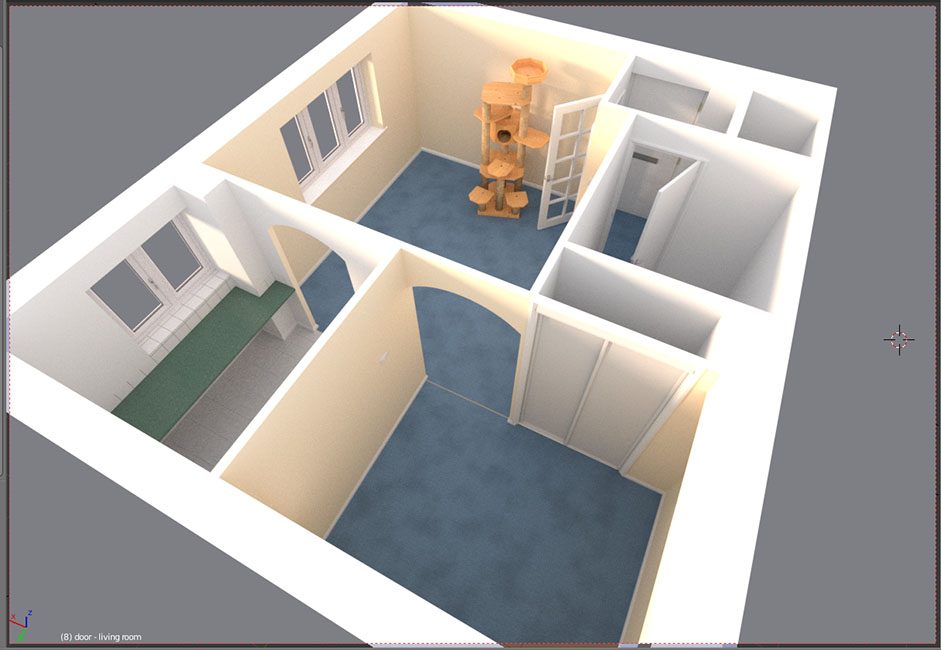
Volume and surface area are two measurements that are part of our daily lives. We use volume every day, even though we do not focus on it. When you purchase groceries, volume is the key to pricing. Judging how much paint to buy or how many square feet of siding to purchase is based on surface area. The list goes on. An example is a three-dimensional rendering of a floor plan. These types of drawings make building layouts far easier to understand for the client. It allows the viewer a realistic idea of the product at completion; you can see the natural space, the volume of the rooms. This section gives you practical information you will use consistently. You may not remember every formula, but you will remember the concepts, and you will know where to go should you want to calculate volume or surface area in the future.
We will concentrate on a few particular types of three-dimensional objects: right prisms and right cylinders. The adjective “right” refers to objects such that the sides form a right angle with the base. We will look at right rectangular prisms, right triangular prisms, right hexagonal prisms, right octagonal prisms, and right cylinders. Although, the principles learned here apply to all right prisms.
Three-Dimensional Objects
In geometry, three-dimensional objects are called geometric solids. Surface area refers to the flat surfaces that surround the solid and is measured in square units. Volume refers to the space inside the solid and is measured in cubic units. Imagine that you have a square flat surface with width and length. Adding the third dimension adds depth or height, depending on your viewpoint, and now you have a box. One way to view this concept is in the Cartesian coordinate three-dimensional space. The -axis and the -axis are, as you would expect, two dimensions and suitable for plotting two-dimensional graphs and shapes. Adding the -axis, which shoots through the origin perpendicular to the -plane, and we have a third dimension. See Figure 10.125.
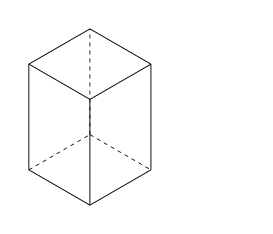
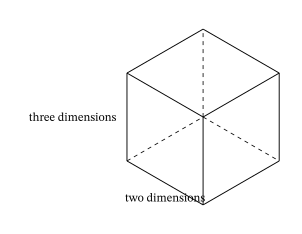
Here is another view taking the two-dimensional square to a third dimension. See Figure 10.126.
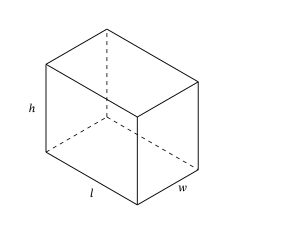
To study objects in three dimensions, we need to consider the formulas for surface area and volume. For example, suppose you have a box (Figure 10.127) with a hinged lid that you want to use for keeping photos, and you want to cover the box with a decorative paper. You would need to find the surface area to calculate how much paper is needed. Suppose you need to know how much water will fill your swimming pool. In that case, you would need to calculate the volume of the pool. These are just a couple of examples of why these concepts should be understood, and familiarity with the formulas will allow you to make use of these ideas as related to right prisms and right cylinders.
Right Prisms
A right prism is a particular type of three-dimensional object. It has a polygon-shaped base and a congruent, regular polygon-shaped top, which are connected by the height of its lateral sides, as shown in Figure 10.128. The lateral sides form a right angle with the base and the top. There are rectangular prisms, hexagonal prisms, octagonal prisms, triangular prisms, and so on.
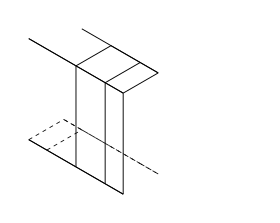
Generally, to calculate surface area, we find the area of each side of the object and add the areas together. To calculate volume, we calculate the space inside the solid bounded by its sides.
In Figure 10.130, we have three views of a right hexagonal prism. The regular hexagon is the base and top, and the lateral faces are the rectangular regions perpendicular to the base. We call it a right prism because the angle formed by the lateral sides to the base is See Figure 10.128.
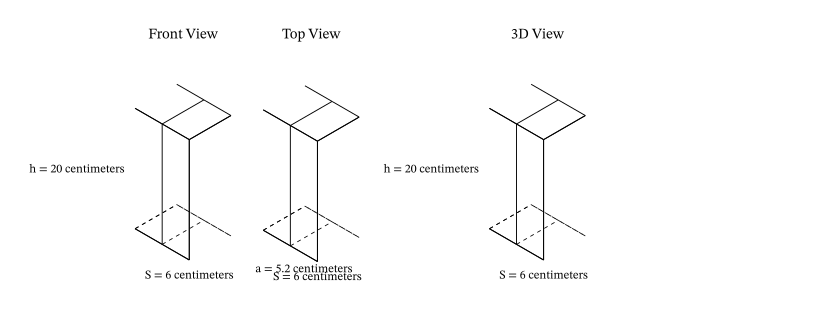
The first image is a view of the figure straight on with no rotation in any direction. The middle figure is the base or the top. The last figure shows you the solid in three dimensions. To calculate the surface area of the right prism shown in Figure 10.130, we first determine the area of the hexagonal base and multiply that by 2, and then add the perimeter of the base times the height. Recall the area of a regular polygon is given as where is the apothem and is the perimeter. We have that
Then, the surface area of the hexagonal prism is
To find the volume of the right hexagonal prism, we multiply the area of the base by the height using the formula The base is and the height is 20 . Thus,
Right Cylinders
There are similarities between a prism and a cylinder. While a prism has parallel congruent polygons as the top and the base, a right cylinder is a three-dimensional object with congruent circles as the top and the base. The lateral sides of a right prism make a angle with the polygonal base, and the side of a cylinder, which unwraps as a rectangle, makes a angle with the circular base.
Right cylinders are very common in everyday life. Think about soup cans, juice cans, soft drink cans, pipes, air hoses, and the list goes on.
In Figure 10.134, imagine that the cylinder is cut down the 12-inch side and rolled out. We can see that the cylinder side when flat forms a rectangle. The formula includes the area of the circular base, the circular top, and the area of the rectangular side. The length of the rectangular side is the circumference of the circular base. Thus, we have the formula for total surface area of a right cylinder.
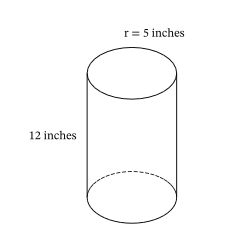
To find the volume of the cylinder, we multiply the area of the base with the height.
Applications of Surface Area and Volume
The following are just a small handful of the types of applications in which surface area and volume are critical factors. Give this a little thought and you will realize many more practical uses for these procedures.
Optimization
Problems that involve optimization are ones that look for the best solution to a situation under some given conditions. Generally, one looks to calculus to solve these problems. However, many geometric applications can be solved with the tools learned in this section. Suppose you want to make some throw pillows for your sofa, but you have a limited amount of fabric. You want to make the largest pillows you can from the fabric you have, so you would need to figure out the dimensions of the pillows that will fit these criteria. Another situation might be that you want to fence off an area in your backyard for a garden. You have a limited amount of fencing available, but you would like the garden to be as large as possible. How would you determine the shape and size of the garden? Perhaps you are looking for maximum volume or minimum surface area. Minimum cost is also a popular application of optimization. Let’s explore a few examples.
Key Terms
- surface area
- volume
- right prism
- right cylinder
Key Concepts
- A right prism is a three-dimensional object that has a regular polygonal face and congruent base such that that lateral sides form a angle with the base and top. The surface area of a right prism is found using the formula where is the area of the base, is the perimeter of the base, and is the height. The volume of a right prism is found using the formula where is the area of the base and is the height.
- A right cylinder is a three-dimensional object with a circle as the top and a congruent circle is the base, and the side forms a angle to the base and top. The surface area of a right cylinder is found using the formula where is the radius and is the height. The volume is found using the formula where is the radius and is the height.
Formulas
The formula for the surface area of a right prism is equal to twice the area of the base plus the perimeter of the base times the height, where is equal to the area of the base and top, is the perimeter of the base, and is the height.
The formula for the volume of a rectangular prism, given in cubic units, is equal to the area of the base times the height, where is the area of the base and is the height.
The surface area of a right cylinder is given as
The volume of a right cylinder is given as
Adapted from Contemporary Mathematics by OpenStax (openstax.org), licensed under CC BY-NC-SA 4.0. Changes were made. License: CC-BY-NC-SA-4.0.