
4.4 Addition and Subtraction in Base Systems
Learning Objectives
After completing this section, you should be able to:
- Add and subtract in bases 2–9 and 12.
- Identify errors in adding and subtracting in bases 2–9 and 12.
Once we decide on a system for counting, we need to establish rules for combining the numbers we’re using. This begins with the rules for addition and subtraction. We are familiar with base 10 arithmetic, such as or . How does that change if we instead use a different base? A larger base? A smaller one? In particular, computers use base 2 for all number representation. When your calculator adds or subtracts, multiplies or divides, it uses base 2. This is because the circuitry recognizes only two things, high current and low current, which means the system is uses only has two symbols. Which is what base 2 is.
In this section, we use addition and subtraction in bases other than 10 by referencing the processes of base 10, but applied to a new base system.
Addition in Bases Other Than Base 10
Now that we understand what it means for numbers to be expressed in a base other than 10, we can look at arithmetic using other bases, starting with addition. When you think back to when you first learned addition, it is very likely you learned the addition table. Once you knew the addition table, you moved on to addition of numbers with more than one digit. The same process holds for addition in other bases. We begin with an addition table, and then move on to adding numbers with two or more digits.
We worked with base 6 earlier, and have the numbers in base 6 up to 1006. Using that table of values, we can create the base 6 addition table.
Here’s the beginning of the base 6 addition table:
| + | 0 | 1 | 2 | 3 | 4 | 5 |
|---|---|---|---|---|---|---|
| 0 | 0 | 1 | 2 | 3 | 4 | 5 |
| 1 | 1 | 2 | 3 | 4 | 5 | ? |
| 2 | 2 | 3 | 4 | 5 | ? | ? |
| 3 | 3 | 4 | 5 | ? | ? | ? |
| 4 | 4 | 5 | ? | ? | ? | ? |
| 5 | 5 | ? | ? | ? | ? | ? |
Many of the cells are not filled out. The ones filled in are values that never get past 5, which is the largest legal symbol in base 6, so they are acceptable symbols. But what do we do with 5 + 3 in base 6? We can’t represent the answer as “8” since “8” is not a symbol available to us. Let’s go back to the list of numbers we have for base 6.
| 0 | 1 | 2 | 3 | 4 | 5 |
|---|---|---|---|---|---|
| 10 | 11 | 12 | 13 | 14 | 15 |
| 20 | 21 | 22 | 23 | 24 | 25 |
| 30 | 31 | 32 | 33 | 34 | 35 |
| 40 | 41 | 42 | 43 | 44 | 45 |
| 50 | 51 | 52 | 53 | 54 | 55 |
So, what is 5 + 1 equal to in base 6? Well, start at the 5, and jump ahead one step. You land on 10.
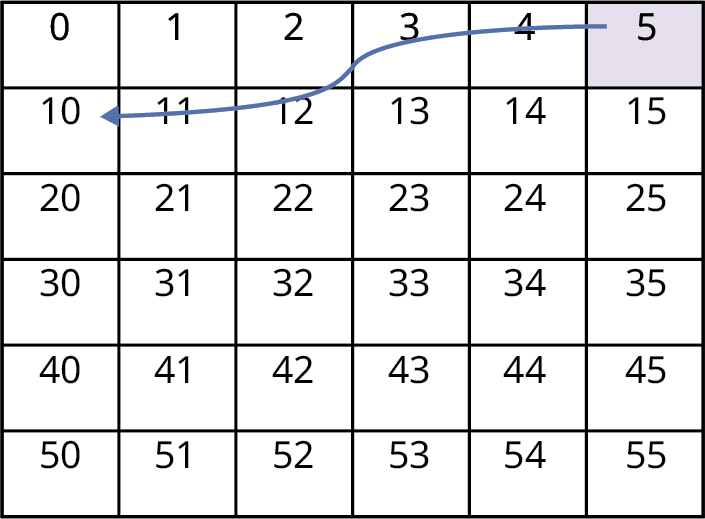
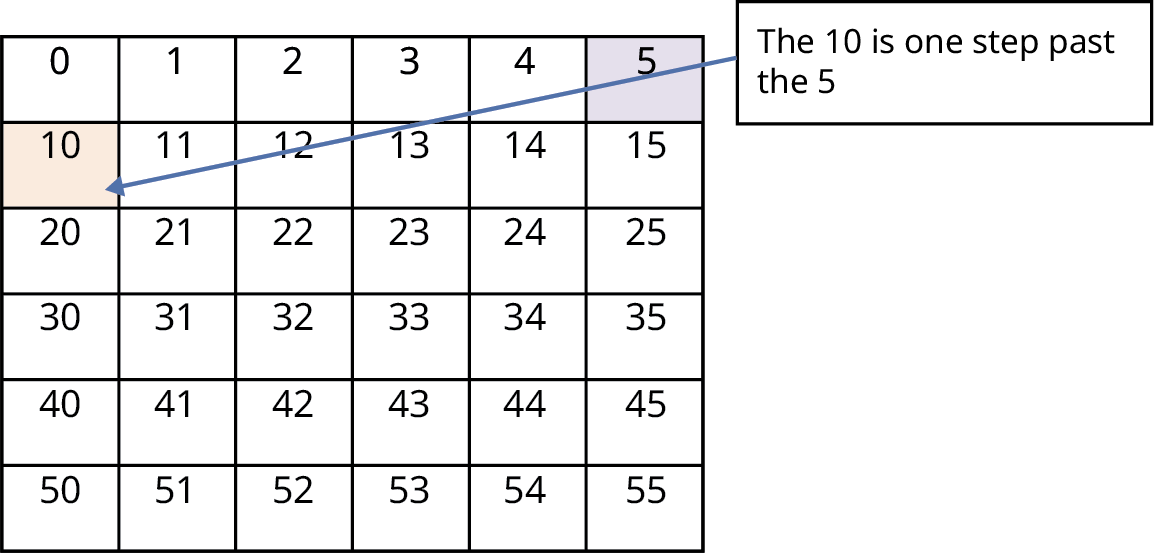
This means that, in base 6, 5 + 1 = 10.
So, what is 5 + 2 in base 6? Well, 5 + 2 = 5 + 1 + 1, so 10 + 1…jump one more space and you land on 11. So, 5 + 2 = 11 in base 6.
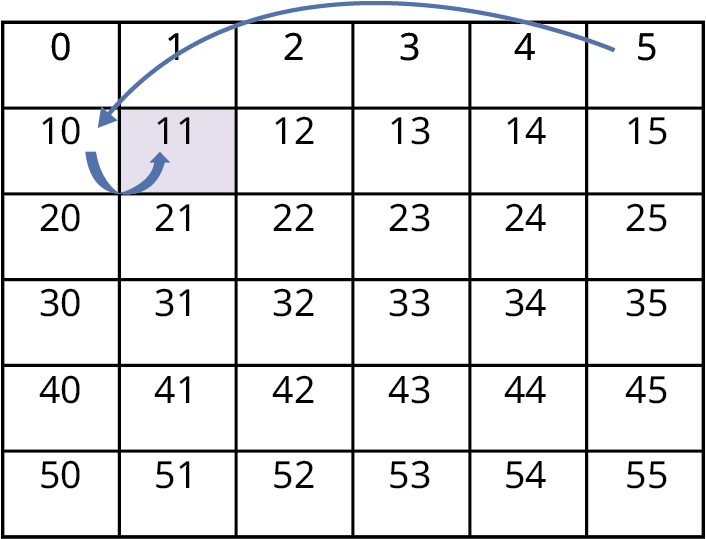
And so it goes. Using that process, stepping one more along the list, we can fill in the remainder of the base 6 addition table (Table 4.4).
| + | 0 | 1 | 2 | 3 | 4 | 5 |
|---|---|---|---|---|---|---|
| 0 | 0 | 1 | 2 | 3 | 4 | 5 |
| 1 | 1 | 2 | 3 | 4 | 5 | 10 |
| 2 | 2 | 3 | 4 | 5 | 10 | 11 |
| 3 | 3 | 4 | 5 | 10 | 11 | 12 |
| 4 | 4 | 5 | 10 | 11 | 12 | 13 |
| 5 | 5 | 10 | 11 | 12 | 13 | 14 |
With this table, and with our understanding of “carrying the one,” we can then use the addition table to do addition in base 6 for numbers with two or more digits, using the same processes you learned for addition when you did it by hand.
To summarize the creation of the addition tables for a given base, do the following.
Step 1: Set up the table.
Step 2: Fill in all the additions that use the “legal” symbols for the base. The diagonal that goes from upper left to lower right that is immediately next to the filled boxes all get the value 10, regardless of base.
Step 3: Enter the values that are in the “teens.” This can all be done on one table without creating multiple copies of previously done work.
As seen previously, when performing addition in another base, set up the problem exactly as you would for addition in base 10. At each step, check the addition table for the base. As in base 10 addition, move right to left, adding down the columns using the rules in the addition table. When necessary and just as in base 10, be sure to carry the 1.
Subtraction in Bases Other Than Base 10
Subtraction in bases other than base 10 follow the same processes as base 10 subtraction, but, as with addition, using the addition table for the base.
Errors When Adding and Subtracting in Bases Other Than Base 10
Errors when computing in bases other than 10 often involve applying base 10 rules or symbols to an arithmetic problem in a base other than base 10. The first type of error is using a symbol that is not in the symbol set for the base. For instance, if a 9 shows up when working in base 7, you know an error has happened because 9 is not a legal symbol in base 7.
The second type of error is using a base 10 rule when the numbers are not in base 10. For instance, if you are working in base 13, then 913 + 913 is not 1813, even though 18 is the correct answer in base 10.
Key Concepts
- Addition tables for bases other than 10 can be built using the same processes that are used in base 10, including using a number line.
- Addition in bases other than base 10 use the same processes as addition in base 10, but use the addition table for that base.
- Subtraction in bases other than base 10 use the same processes as subtraction in base 10, but use the addition table for that base.
Adapted from Contemporary Mathematics by OpenStax (openstax.org), licensed under CC BY-NC-SA 4.0. Changes were made. License: CC-BY-NC-SA-4.0.