
1.5 Set Operations with Three Sets

Learning Objectives
After completing this section, you should be able to:
- Interpret Venn diagrams with three sets.
- Create Venn diagrams with three sets.
- Apply set operations to three sets.
- Prove equality of sets using Venn diagrams.
Have you ever searched for something on the Internet and then soon after started seeing multiple advertisements for that item while browsing other web pages? Large corporations have built their business on data collection and analysis. As we start working with larger data sets, the analysis becomes more complex. In this section, we will extend our knowledge of set relationships by including a third set.
A Venn diagram with two intersecting sets breaks up the universal set into four regions; simply adding one additional set will increase the number of regions to eight, doubling the complexity of the problem.
Venn Diagrams with Three Sets
Below is a Venn diagram with two intersecting sets, which breaks the universal set up into four distinct regions.
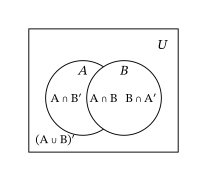
Next, we see a Venn diagram with three intersecting sets, which breaks up the universal set into eight distinct regions.
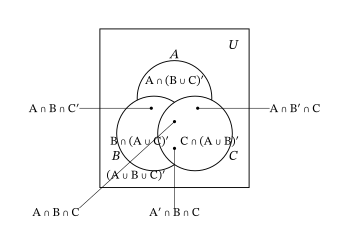
In the next example, we will explore the three main blood factors, A, B and Rh. The following background information about blood types will help explain the relationships between the sets of blood factors. If an individual has blood factor A or B, those will be included in their blood type. The Rh factor is indicated with a or a . For example, if a person has all three blood factors, then their blood type would be . In the Venn diagram, they would be in the intersection of all three sets, If a person did not have any of these three blood factors, then their blood type would be and they would be in the set which is the region outside all three circles.
Creating Venn Diagrams with Three Sets
In general, when creating Venn diagrams from data involving three subsets of a universal set, the strategy is to work from the inside out. Start with the intersection of the three sets, then address the regions that involve the intersection of two sets. Next, complete the regions that involve a single set, and finally address the region in the universal set that does not intersect with any of the three sets. This method can be extended to any number of sets. The key is to start with the region involving the most overlap, working your way from the center out.
Applying Set Operations to Three Sets
Set operations are applied between two sets at a time. Parentheses indicate which operation should be performed first. As with numbers, the inner most parentheses are applied first. Next, find the complement of any sets, then perform any union or intersections that remain.
Notice that rewriting these set operations in equivalent forms produces the same answers. This is not a coincidence. The following equivalences hold true for sets:
- and These are the associative property for set intersection and set union.
- and These are the commutative property for set intersection and set union.
- and These are the distributive property for sets over union and intersection, respectively.
Proving Equality of Sets Using Venn Diagrams
To prove set equality using Venn diagrams, the strategy is to draw a Venn diagram to represent each side of the equality, then look at the resulting diagrams to see if the regions under consideration are identical.
Augustus De Morgan was an English mathematician known for his contributions to set theory and logic. De Morgan’s law for set complement over union states that . In the next example, we will use Venn diagrams to prove De Morgan’s law for set complement over union is true. But before we begin, let us confirm De Morgan’s law works for a specific example. While showing something is true for one specific example is not a proof, it will provide us with some reason to believe that it may be true for all cases.
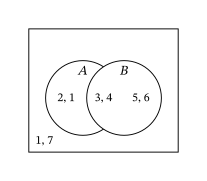
Let and We will use these sets in the equation To begin, find the value of the set defined by each side of the equation.
Step 1: is the collection of all unique elements in set or set or both. The complement of A union B, , is the set of all elements in the universal set that are not in . So, the left side the equation is equal to the set
Step 2: The right side of the equation is is the set of all members of the universal set that are not in set . Similarly,
Step 3: Finally, is the set of all elements that are in both and The numbers 1 and 7 are common to both sets, therefore, Because, we have demonstrated that De Morgan’s law for set complement over union works for this particular example. The Venn diagram below depicts this relationship.
Key Concepts
- A Venn diagram with two overlapping sets breaks the universal set up into four distinct regions. When a third overlapping set is added the Venn diagram is broken up into eight distinct regions.
- Analyze, interpret, and create Venn diagrams involving three overlapping sets.
- Including the blood factors: A, B and Rh
- To find unions and intersections.
- To find cardinality of both unions and intersections.
- When performing set operations with three or more sets, the order of operations is inner most parentheses first, then fine the complement of any sets, then perform any union or intersection operations that remain.
- To prove set equality using Venn diagrams the strategy is to draw a Venn diagram to represent each side of the equality or equation, then look at the resulting diagrams to see if the regions under consideration are identical. If they regions are identical the equation represents a true statement, otherwise it is not true.
Projects
Cardinality of Infinite Sets
In set theory, it has been shown that the set of irrational numbers has a cardinality greater than the set of natural numbers. That is, the set of irrational numbers is so large that it is uncountably infinite.
- Perform a search with the phrase, “Who first proved that the real numbers are uncountable?”
- Who first proved that the real numbers are uncountable?
- What was the significance of this proof to the development of set theory and by extension other fields of mathematics?
- Recent discoveries in the field of set theory include the solution to a 70-year-old problem previously thought to be unprovable. To learn more read this article:
- What does it mean for two infinite sets to have the same size?
- The real numbers are sometimes referred to as what?
- Summarize your understanding of the problem known as the “Continuum Hypothesis.”
- Malliaris and Shelah’s proof of this 70-year-old problem is opening up investigation in what two fields of mathematics?
- Summarize your understanding of infinity.
- Define what it means to be infinite.
- Explain the difference between countable and uncountable sets.
- Research the difference between a discrete set and a continuous set, then summarize your findings.
Set Notation
In arithmetic, the operation of addition is represented by the plus sign, +, but multiplication is represented in multiple ways, including and parentheses, such as 5(3). Several set operations also are written in different forms based on the preferences of the mathematician and often their publisher.
- Search for “Set Complement” on the internet and list at least three ways to represent the complement of a set.
- Both the Set Challenge and Venn Diagram smartphone apps highlighted in the Tech Check sections have an operation for set difference. List at least two ways to represent set difference and provide a verbal description of how to calculate the difference between two sets and .
- When researching possible Venn diagram applications, the Greek letter delta, appeared as a symbol for a set operator. List at least one other symbol used for this same operation.
- Search for “List of possible set operations and their symbols.” Find and select two symbols that were not presented in this chapter.
The Real Number System
The set of real numbers and their properties are studied in elementary school today, but how did the number system evolve? The idea of natural numbers or counting numbers surfaced prior to written words, as evidenced by tally marks in cave writing. Create a timeline for significant contributions to the real number system.
- Use the following phrase to search online for information on the origins of the number zero: “History of the number zero.” Then, record significant dates for the invention and common use of the number zero on your timeline.
- Find out who is credited for discovering that the is irrational and add this information to your timeline. Hint: Search for, “Who was the first to discover irrational numbers?”
- Research Georg Cantor’s contribution to the representation of real numbers as a continuum and add this to your timeline.
- Research Ernst Zermelo’s contribution to the real number system and add this to your timeline.
Adapted from Contemporary Mathematics by OpenStax (openstax.org), licensed under CC BY-NC-SA 4.0. Changes were made. License: CC-BY-NC-SA-4.0.