Figure 1.4The players on a soccer team who are actively participating in a game are a subset of the greater set of team members.The players on a soccer team who are actively participating in a game are a subset of the greater set of team members. (Credit: “PAFC-Mezokovesd-108” by Puskás Akadémia/Flickr, Public Domain Mark 1.0)
Learning Objectives
After completing this section, you should be able to:
Represent subsets and proper subsets symbolically.
Compute the number of subsets of a set.
Apply concepts of subsets and equivalent sets to finite and infinite sets.
The rules of Major League Soccer (MLS) allow each team to have up to 30 players on their team. However, only 18 of these players can be listed on the game day roster, and of the 18 listed, 11 players must be selected to start the game. How the coaches and general managers form the team and choose the starters for each game will determine the success of the team in any given year.
The entire group of 30 players is each team’s set. The group of game day players is a subset of the team set, and the group of 11 starters is a subset of both the team set and the set of players on the game day roster.
Set is a subset of set if every member of set is also a member of set . Symbolically, this relationship is written as .
Sets can be related to each other in several different ways: they may not share any members in common, they may share some members in common, or they may share all members in common. In this section, we will explore the way we can select a group of members from the whole set.
Recall the set of flatware in our kitchen drawer from Section 1.1, . Suppose you are preparing to eat dinner, so you pull a fork and a knife from the drawer to set the table. The set is a subset of set , because every member or element of set is also a member of set . More specifically, set is a proper subset of set , because there are other members of set not in set . This is written as . The only subset of a set that is not a proper subset of the set would be the set itself.
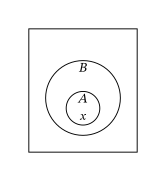
Graphically, sets are often represented as circles. In the following graphic, set is represented as a circle completely enclosed inside the circle representing set , showing that set is a proper subset of set . The element represents an element that is in both set and set .
Figure 1.5
Exponential Notation
So far, we have figured out how many subsets exist in a finite set by listing them. Recall that in Example 1, when we listed all the subsets of the three-element set we saw that there are eight subsets. In Your Turn 1.11, we discovered that there are four subsets of the two-element subset, . A one-element set has two subsets, the empty set and itself. The only subset of the empty set is the empty set itself. But how can we easily figure out the number of subsets in a very large finite set? It turns out that the number of subsets can be found by raising 2 to the number of elements in the set, using exponential notation to represent repeated multiplication. For example, the number of subsets of the set is equal to . Exponential notation is used to represent repeated multiplication, , where appears as a factor times.
Equivalent Subsets
In the early 17th century, the famous astronomer Galileo Galilei found that the set of natural numbers and the subset of the natural numbers consisting of the set of square numbers, , are equivalent. Upon making this discovery, he conjectured that the concepts of less than, greater than, and equal to did not apply to infinite sets.
Sequences and series are defined as infinite subsets of the set of natural numbers by forming a relationship between the sequence or series in terms of a natural number, . For example, the set of even numbers can be defined using set builder notation as . The formula in this case replaces every natural number with two times the number, resulting in the set of even numbers, . The set of even numbers is also equivalent to the set of natural numbers.
Key Terms
subset
proper subset
equivalent subsets
exponential notation
Every member of a subset of a set is also a member of the set containing it.
A proper subset of a set does not contain all the members of the set containing it. There is a least one member of set that is not a member of set .
The number subsets of a finite set with members is equal to 2 raised to the power.
The empty set is a subset of every set and must be included when listing all the subsets of a set.
Understand how to create and distinguish between equivalent subsets of finite and infinite sets that are not equal to the original set.
Formulas
The number of subsets of a finite set is equal to 2 raised to the power of , where is the number of elements in set : Number of Subsets of Set .
Adapted from Contemporary Mathematics by OpenStax (openstax.org), licensed under CC BY-NC-SA 4.0. Changes were made. License: CC-BY-NC-SA-4.0.
These eBooks are a prerelease and are not yet certified conformant with WCAG 2.1 AA or ADA Title II. Every page is built against an automated accessibility gate, and the published editions will meet ADA Title II requirements when they release in late September 2026. If something is unusable, please tell us.