
1.4 Set Operations with Two Sets

Learning Objectives
After completing this section, you should be able to:
- Determine the intersection of two sets.
- Determine the union of two sets.
- Determine the cardinality of the union of two sets.
- Apply the concepts of AND and OR to set operations.
- Draw conclusions from Venn diagrams with two sets.
The movie Yours, Mine, and Ours was originally released in 1968 and starred Lucille Ball and Henry Fonda. This movie, which is loosely based on a true story, is about the marriage of Helen, a widow with eight children, and Frank, a widower with ten children, who then have an additional child together. The movie is a comedy that plays on the interpersonal and organizational struggles of feeding, bathing, and clothing twenty people in one household.
If we consider the set of Helen's children and the set of Frank's children, then the child they had together is the intersection of these two sets, and the collection of all their children combined is the union of these two sets. In this section, we will explore the operations of union and intersection as it relates to two sets.
The Intersection of Two Sets
The members that the two sets share in common are included in the intersection of two sets. To be in the intersection of two sets, an element must be in both the first set and the second set. In this way, the intersection of two sets is a logical AND statement. Symbolically, intersection is written as: . intersection is written in set builder notation as: .
Let us look at Helen's and Frank's children from the movie Yours, Mine, and Ours. Helen's children consist of the set and Frank's children are included in the set . intersection is the set of children they had together. , because Joseph is in both set and set .
Notice that if sets and are disjoint sets, then they do not share any elements in common, and intersection is the empty set, as shown in the Venn diagram below.
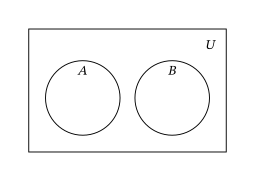
Notice that if set is a subset of set , then intersection is equal to set , as shown in the Venn diagram below.
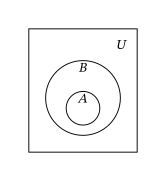
The Union of Two Sets
Like the union of two families in marriage, the union of two sets includes all the members of the first set and all the members of the second set. To be in the union of two sets, an element must be in the first set, the second set, or both. In this way, the union of two sets is a logical inclusive OR statement. Symbolically, union is written as: union is written in set builder notation as:
Let us consider the sets of Helen's and Frank's children from the movie Yours, Mine, and Ours again. Helen's children is set and Frank's children is set . The union of these two sets is the collection of all nineteen of their children,
Notice, Joseph is in both set and set , but he is only one child, so, he is only listed once in the union.
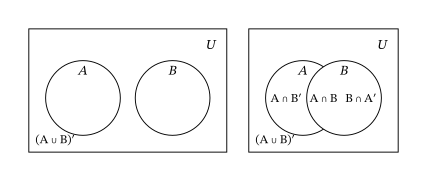
When observing the union of sets and , notice that both set and set are subsets of union . Graphically, union can be represented in several different ways depending on the members that they have in common. If and are disjoint sets, then union would be represented with two disjoint circles within the universal set, as shown in the Venn diagram below.
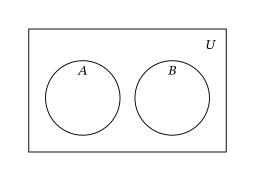
If sets and share some, but not all, members in common, then the Venn diagram is drawn as two separate circles that overlap.
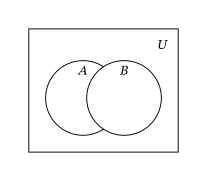
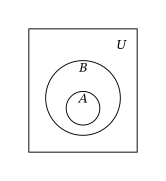
If every member of set is also a member of set , then is a subset of set , and union would be equal to set . To draw the Venn diagram, the circle representing set should be completely enclosed in the circle containing set .
Determining the Cardinality of Two Sets
The cardinality of the union of two sets is the total number of elements in the set. Symbolically the cardinality of union is written, . If two sets and are disjoint, the cardinality of union is the sum of the cardinality of set and the cardinality of set . If the two sets intersect, then intersection is a subset of both set and set . This means that if we add the cardinality of set and set , we will have added the number of elements in intersection twice, so we must then subtract it once as shown in the formula that follows.
Applying Concepts of “AND” and “OR” to Set Operations
To become a licensed driver, you must pass some form of written test and a road test, along with several other requirements depending on your age. To keep this example simple, let us focus on the road test and the written test. If you pass the written test but fail the road test, you will not receive your license. If you fail the written test, you will not be allowed to take the road test and you will not receive a license to drive. To receive a driver's license, you must pass the written test AND the road test. For an “AND” statement to be true, both conditions that make up the statement must be true. Similarly, the intersection of two sets and is the set of elements that are in both set and set . To be a member of intersection , an element must be in set and also must be in set . The intersection of two sets corresponds to a logical "AND" statement.
The union of two sets is a logical inclusive "OR" statement. Say you are at a birthday party and the host offers Leah, Lenny, Maya, and you some cake or ice cream for dessert. Leah asks for cake, Lenny accepts both cake and ice cream, Maya turns down both, and you choose only ice cream. Leah, Lenny, and you are all having dessert. The “OR” statement is true if at least one of the components is true. Maya is the only one who did not have cake or ice cream; therefore, she did not have dessert and the “OR” statement is false. To be in the union of two sets and , an element must be in set or set or both set and set .
Drawing Conclusions from a Venn Diagram with Two Sets
All Venn diagrams will display the relationships between the sets, such as subset, intersecting, and/or disjoint. In addition to displaying the relationship between the two sets, there are two main additional details that Venn diagrams can include: the individual members of the sets or the cardinality of each disjoint subset of the universal set.
A Venn diagram with two subsets will partition the universal set into 3 or 4 sections depending on whether they are disjoint or intersecting sets. Recall that the complement of set , written is the set of all elements in the universal set that are not in set
Key Terms
- intersection of two sets
- union of two sets
Key Concepts
- The intersection of two sets, is the set of all elements that they have in common. Any member of intersection must be is both set and set .
- The union of two sets, , is the collection of all members that are in either in set , set or both sets and combined.
- Two sets that share at least one element in common, so that they are not disjoint are represented in a Venn Diagram using two circles that overlap.
- The region of the overlap is the set intersection ,
- The regions that include everything in the circle representing set or the circle representing set or their overlap is the set union ,
- Apply knowledge of set union and intersection to determine cardinality and membership using Venn Diagrams, the roster method and set builder notation.
Formulas
The cardinality of union
Video
Adapted from Contemporary Mathematics by OpenStax (openstax.org), licensed under CC BY-NC-SA 4.0. Changes were made. License: CC-BY-NC-SA-4.0.