
3.10 Arithmetic Sequences
Learning Objectives
After completing this section, you should be able to:
- Identify arithmetic sequences.
- Find a given term in an arithmetic sequence.
- Find the th term of an arithmetic sequence.
- Find the sum of a finite arithmetic sequence.
- Use arithmetic sequences to solve real- world applications
As we saw in the previous section, we are adding about 2.5 quintillion bytes of data per day to the Internet. If there are 550 quintillion bytes of data today, then there will be 552.5 quintillion bytes tomorrow, and 555 quintillion bytes in 2 days. This is an example of an arithmetic sequence. There are many situations where this concept of fixed increases comes into play, such as raises or table arrangements.
Identifying Arithmetic Sequences
A sequence of numbers is just that, a list of numbers in order. It can be a short list, such as the number of points earned on each assignment in a class, such as {10, 10, 8, 9, 10, 6, 10}. Or it can be a longer list, even infinitely long, such as the list of prime numbers. For example, here’s a sequence of numbers, specifically, the squares of the first 12 natural numbers.
{1, 4, 9, 16, 25, 36, 49, 64, 81, 100, 121, 144}
Each value in the sequence is called a term. Terms in the list are often referred to by their location in the sequence, as in the th term. For the sequence {1, 4, 9, 16, 25, 36, 49, 64, 81, 100, 121, 144}, the first term of the sequence is 1, the fourth term is 16, and so on. In the sequence of assignment scores {10, 10, 8, 9, 10, 6, 10}, the first term is 10 and the third term is 8 (Figure 3.47).
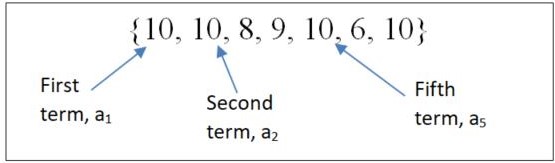
The notation we use with sequences is a letter, which represents a term in the sequence, and a subscript, which indicates what place the term is in the sequence. For the sequence {1, 4, 9, 16, 25, 36, 49, 64, 81, 100, 121, 144}, we will use the letter as a value in the sequence, and so would be the term in the sequence at the fifth position. That number is 25, so we can write .
In this section, we focus on a special kind of sequence, one referred to as an arithmetic sequence. Arithmetic sequences have terms that increase by a fixed number or decrease by a fixed number, called the constant difference (denoted by ), provided that value is not 0. This means the next term is always the previous term plus or minus a specified, constant value. Another way to say this is that the difference between any consecutive terms of the sequence is always the same value.
To see a constant difference, look at the following sequence: {7, 15, 23, 31, 39, 47, 55, 63, 71, 79, 87}. Figure 3.48 illustrates that each term of the sequence is the previous term plus 8. Eight is the constant difference here.

Arithmetic sequences can be expressed with a formula. When we know the first term of an arithmetic sequence, which we label , and we know the constant difference, which is denoted , we can find any other term of the arithmetic sequence. The formula for the term of an arithmetic sequence is .
Let’s examine the formula with this arithmetic sequence: . In this sequence and . The table below shows the values calculated.
| , Place in Sequence | , Term | Value of Term | Term Written as |
|---|---|---|---|
| 1 | 4 | ||
| 2 | 7 | ||
| 3 | 10 | ||
| 4 | 13 | ||
| 5 | 16 | ||
We can see how the term can be directly calculated. In this sequence, the formula is where the first term, , is 4 and the constant difference is 3. We can then determine the term of this sequence: .
If we know two terms of the sequence, it is possible to determine the general form of an arithmetic sequence, .
Finding the Sum of a Finite Arithmetic Sequence
Sometimes we want to determine the sum of the numbers of a finite arithmetic sequence. The formula for this is fairly straightforward.
Using Arithmetic Sequences to Solve Real-World Applications
Applications of arithmetic sequences occur any time some quantity increases by a fixed amount at each step. For instance, suppose someone practices chess each week and increases the amount of time they study each week. The first week the person practices for 3 hours, and vows to practice 30 more minutes each week. Since the amount of time practicing increases by a fixed number each week, this would qualify as an arithmetic sequence.
Key Terms
- sequence
- term of a sequence
- arithmetic sequence
- first term
- constant difference
Key Concepts
- A sequence is a list of numbers. Any individual number in that list, or sequence, is a term of the sequence. A specific term of a sequence is denoted by the sequence symbol with a subscript indicating where the term in the sequence is.
- A special form of a sequence is an arithmetic sequence. Each arithmetic sequence is determined by its first term and its constant difference. Any term in an arithmetic sequence is determined by adding the constant difference to the preceding term.
- If the first term and the constant difference of an arithmetic sequence are known, then any term of the sequence can be found directly.
- Because arithmetic sequences follow such a strict pattern, the sum of the first terms of an arithmetic sequence can be determined with the formula .
Formulas
Videos
Adapted from Contemporary Mathematics by OpenStax (openstax.org), licensed under CC BY-NC-SA 4.0. Changes were made. License: CC-BY-NC-SA-4.0.