Figure 3.28The Pythagoreans were a philosophical sect of ancient Greece, often associated with mathematics.The Pythagoreans were a philosophical sect of ancient Greece, often associated with mathematics. (credit: Fedor Andreevich Bronnikov (1827-1902) “Hymn of the Pythagoreans to the Rising Sun,” 1877, oil on canvas/Wikimedia, public domain)
Learning Objectives
After completing this section, you should be able to:
Define and identify numbers that are irrational.
Simplify irrational numbers and express in lowest terms.
Add and subtract irrational numbers.
Multiply and divide irrational numbers.
Rationalize fractions with irrational denominators.
The Pythagoreans were a philosophical sect in ancient Greece. Their philosophy included reincarnation and purifying the mind through the study and contemplation of mathematics and science. One of their principles was the cosmos is ruled by order, specifically mathematics and music. They even held mystic beliefs about specific numbers and figures. For example, the number 1 was associated with the mind and essence. Four represented justice, as it is the first product of two even numbers. Most famously, though, is the association with the Pythagorean Theorem, which states that in a right triangle, the sum of the squares of the shorter sides of the triangle (the legs) equals the square of the longer side (the hypotenuse). Even the ancient Egyptians used this relationship, as triangles with side measures 3, 4, and 5 were often used in surveying following the flooding of the Nile.
There is a story of a Pythagorean, Hippasus, discovering that not all numbers could be expressed as fractions. In other words, not all numbers were rational numbers. The story ends with Hippasus, who shared this, or in some versions discovered it, put to death by drowning for sharing this fact, that not all quantities could be expressed as the ratio of two natural numbers.
As colorful as that story may be, it is most likely false, as there are no contemporary sources to corroborate it. But it does seem to mark the discovery that not all quantities or measures were fractions of numbers. And so, irrational numbers were discovered.
Defining and Identifying Numbers That Are Irrational
We defined rational numbers in the last section as numbers that could be expressed as a fraction of two integers. Irrational numbers are numbers that cannot be expressed as a fraction of two integers. Recall that rational numbers could be identified as those whose decimal representations either terminated (ended) or had a repeating pattern at some point. So irrational numbers must be those whose decimal representations do not terminate or become a repeating pattern.
One collection of irrational numbers is square roots of numbers that aren’t perfect squares. is the square root of the number , denoted , if . The number is the perfect square of the integer if . The rational number is a perfect square if both and are perfect squares.
One method of determining if an integer is a perfect square is to examine its prime factorization. If, in that factorization, all the prime factors are raised to even powers, the integer is a perfect square. Another method is to attempt to factor the integer into an integer squared. It is possible that you recognize the number as a perfect square (such as 4 or 9). Or, if you have a calculator at hand, use the calculator to determine if the square root of the integer is an integer.
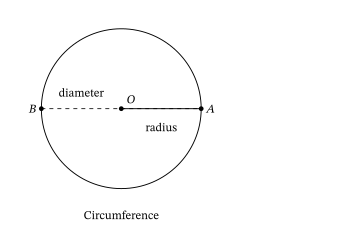
Another collection of irrational numbers is based on the special number, pi, denoted by the Greek letter , which is the ratio of the circumference of the diameter of the circle (Figure 3.30).
Figure 3.30Circle with radius, diameter, and circumference labeled
Any multiple or power of is an irrational number.
Any number expressed as a rational number times an irrational number is an irrational number also. When an irrational number takes that form, we call the rational number the rational part, and the irrational number the irrational part. It should be noted that a rational number plus, minus, multiplied by, or divided by any irrational number is an irrational number.
Simplifying Square Roots and Expressing Them in Lowest Terms
To simplify a square root means that we rewrite the square root as a rational number times the square root of a number that has no perfect square factors. The act of changing a square root into such a form is simplifying the square root.
The number inside the square root symbol is referred to as the radicand. So in the expression the number is referred to as the radicand.
Before discussing how to simplify a square root, we need to introduce a rule about square roots. The square root of a product of numbers equals the product of the square roots of those number. Written symbolically, .
Using this formula, we can factor an integer inside a square root into a perfect square times another integer. Then the square root can be applied to the perfect square, leaving an integer times the square root of another integer. If the number remaining under the square root has no perfect square factors, then we’ve simplified the irrational number into lowest terms. To simplify the irrational number into lowest terms when is an integer:
Step 1: Determine the largest perfect square factor of , which we denote .
Step 2: Factor into .
Step 3: Apply .
Step 4: Write in its simplified form, .
When a square root has been simplified in this manner, is referred to as the rational part of the number, and is referred to as the irrational part.
Adding and Subtracting Irrational Numbers
Just like any other number we’ve worked with, irrational numbers can be added or subtracted. When working with a calculator, enter the operation and a decimal representation will be given. However, there are times when two irrational numbers may be added or subtracted without the calculator. This can happen only when the irrational parts of the irrational numbers are the same.
To add or subtract two irrational numbers that have the same irrational part, add or subtract the rational parts of the numbers, and then multiply that by the common irrational part.
Multiplying and Dividing Irrational Numbers
Just like any other number that we’ve worked with, irrational numbers can be multiplied or divided. When working with a calculator, enter the operation and a decimal representation will be given. Sometimes, though, you may want to retain the form of the irrational number as a rational part times an irrational part. The process is similar to adding and subtracting irrational numbers when they are in this form. We do not need the irrational parts to match. Even though they need not match, they do need to be similar, such as both irrational parts are square roots, or both irrational parts are multiples of pi. Also, if the irrational parts are square roots, we may need to reduce the resulting square root to lowest terms.
When multiplying two square roots, use the following formula. It is the same formula presented during the discussion of simplifying square roots.
When dividing two square roots, use the following formula.
To multiply or divide irrational numbers with similar irrational parts, do the following:
Step 1: Multiply or divide the rational parts.
Step 2: If necessary, reduce the result of Step 1 to lowest terms. This becomes the rational part of the answer.
Step 3: Multiply or divide the irrational parts.
Step 4: If necessary, reduce the result from Step 3 to lowest terms. This becomes the irrational part of the answer.
Step 5: The result is the product of the rational and irrational parts.
Rationalizing Fractions with Irrational Denominators
Fractions often represent that some amount is being equally divided into some number of parts. But to conceptualize a fraction in that manner, the denominator needs to be an integer. An irrational number in the denominator interferes with that interpretation of a fraction. Fractions that have denominators that are just the square root of an integer can be altered into fractions with integer denominators using a process called rationalizing the denominator. The process relies on the following property of square roots: and the following property of fractions: for any non-zero number .
Using these two properties, when a fraction has a square root in the denominator, we can eliminate that square root. Multiply the numerator and denominator by that square root from the denominator, . Then apply to the denominator, yielding . Notice that there is no longer a square root in the denominator, which allows for interpreting the fraction as dividing a whole into equal parts.
There are occasions when the denominator is irrational but is the sum of two numbers where one or both involve square roots. For instance, . The process used earlier required that the denominator was the square root of a number and would not work here. However, this type of denominator can be rationalized. In order to rationalize such a denominator, we will multiply the numerator and denominator of the fraction by the conjugate of the denominator. The conjugate of is . We say that and are conjugate numbers.
So, the conjugate of is just . But why is this of interest? The reason is because it leads to the difference of squares formula, which is used to factor the difference of two squares. Or, for our purposes, in reverse it allows us to eliminate a square root.
Looking at that formula, you should see that the two factors on the right-hand side of the equals sign are conjugates of one another. So, for our purposes, we’re interested in . This tells us that when we multiply by its conjugate, we get squared minus squared, or . But how is this useful? Let’s return to the fraction above, . The denominator is . Its conjugate is . According to the formula, and letting and , we see that . But is just 3. That means the product is or 13. This no longer has a square root. We use this to rationalize the denominator.
We will also need the distributive property of numbers.
Key Terms
conjugate numbers
difference of squares
irrational numbers
lowest terms
rationalize the denominator
Key Concepts
Irrational numbers are numbers that cannot be written as an integer divided by another integer. One example is pi, denoted . Another collection of irrational numbers are natural numbers that are not perfect squares.
Some irrational numbers can be written as a rational part multiplied by an irrational part. If two irrational numbers have the same irrational parts, they can be added or subtracted.
When irrational numbers are similar, on can multiply and divide the numbers without a calculator.
Since , and , products and quotients of square roots can be determined.
Because and , it is possible to simplify square root expressions so the radicand contains no perfect square factors.
When a fraction has an irrational number as its denominator, it is possible to convert the denominator into a rational number using its conjugate. Doing so involves multiplying the numerator and denominator by the conjugate of the denominator, and then applying the difference of squares formula.
Adapted from Contemporary Mathematics by OpenStax (openstax.org), licensed under CC BY-NC-SA 4.0. Changes were made. License: CC-BY-NC-SA-4.0.
These eBooks are a prerelease and are not yet certified conformant with WCAG 2.1 AA or ADA Title II. Every page is built against an automated accessibility gate, and the published editions will meet ADA Title II requirements when they release in late September 2026. If something is unusable, please tell us.