
3.4 Rational Numbers
Learning Objectives
After completing this section, you should be able to:
- Define and identify numbers that are rational.
- Simplify rational numbers and express in lowest terms.
- Add and subtract rational numbers.
- Convert between improper fractions and mixed numbers.
- Convert rational numbers between decimal and fraction form.
- Multiply and divide rational numbers.
- Apply the order of operations to rational numbers to simplify expressions.
- Apply density property of rational numbers.
- Solve problems involving rational numbers.
- Use fractions to convert between units.
- Define and apply percent.
- Solve problems using percent.
We are often presented with percentages or fractions to explain how much of a population has a certain feature. For example, the 6-year graduation rate of college students at public institutions is 57.6%, or 72/125. That fraction may be unsettling. But without the context, the percentage is hard to judge. So how does that compare to private institutions? There, the 6-year graduation rate is 65.4%, or 327/500. Comparing the percentages is straightforward, but the fractions are harder to interpret due to different denominators. For more context, historical data could be found. One study reported that the 6-year graduation rate in 1995 was 56.4%. Comparing that historical number to the recent 6-year graduation rate at public institutions of 57.6% shows that there hasn't been much change in that rate.
Defining and Identifying Numbers That Are Rational
A rational number (called rational since it is a ratio) is just a fraction where the numerator is an integer and the denominator is a non-zero integer. As simple as that is, they can be represented in many ways. It should be noted here that any integer is a rational number. An integer, , written as a fraction of two integers is .
In its most basic representation, a rational number is an integer divided by a non-zero integer, such as . Fractions may be used to represent parts of a whole. The denominator is the total number of parts to the object, and the numerator is how many of those parts are being used or selected. So, if a pizza is cut into 8 equal pieces, each piece is of the pizza. If you take three slices, you have of the pizza (Figure 3.21). Similarly, if in a group of 20 people, 5 are wearing hats, then of the people are wearing hats (Figure 3.22).


Another representation of rational numbers is as a mixed number, such as (Figure 3.23). This represents a whole number (2 in this case), plus a fraction (the ).

Rational numbers may also be expressed in decimal form; for instance, as 1.34. When 1.34 is written, the decimal part, 0.34, represents the fraction , and the number 1.34 is equal to . However, not all decimal representations are rational numbers.
A number written in decimal form where there is a last decimal digit (after a given decimal digit, all following decimal digits are 0) is a terminating decimal, as in 1.34 above. Alternately, any decimal numeral that, after a finite number of decimal digits, has digits equal to 0 for all digits following the last non-zero digit.
All numbers that can be expressed as a terminating decimal are rational. This comes from what the decimal represents. The decimal part is the fraction of the decimal part divided by the appropriate power of 10. That power of 10 is the number of decimal digits present, as for 0.34, with two decimal digits, being equal to .
Another form that is a rational number is a decimal that repeats a pattern, such as 67.1313… When a rational number is expressed in decimal form and the decimal is a repeated pattern, we use special notation to designate the part that repeats. For example, if we have the repeating decimal 4.3636…, we write this as . The bar over the 36 indicates that the 36 repeats forever.
If the decimal representation of a number does not terminate or form a repeating decimal, that number is not a rational number.
One class of numbers that is not rational is the square roots of integers or rational numbers that are not perfect squares, such as and . More generally, the number is the square root of the number if . The notation for this is , where the symbol is the square root sign. An integer perfect square is any integer that can be written as the square of another integer. A rational perfect square is any rational number that can be written as a fraction of two integers that are perfect squares.
Sometimes you may be able to identify a perfect square from memory. Another process that may be used is to factor the number into the product of an integer with itself. Or a calculator (such as Desmos) may be used to find the square root of the number. If the calculator yields an integer, the original number was a perfect square.
Simplifying Rational Numbers and Expressing in Lowest Terms
A rational number is one way to express the division of two integers. As such, there may be multiple ways to express the same value with different rational numbers. For instance, and are the same value. If we enter them into a calculator, they both equal 0.8. Another way to understand this is to consider what it looks like in a figure when two fractions are equal.
In Figure 3.25, we see that of the rectangle and of the rectangle are equal areas.
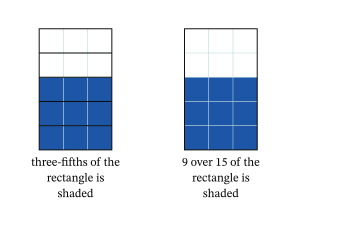
They are the same proportion of the area of the rectangle. The left rectangle has 5 pieces, three of which are shaded. The right rectangle has 15 pieces, 9 of which are shaded. Each of the pieces of the left rectangle was divided equally into three pieces. This was a multiplication. The numerator describing the left rectangle was 3 but it becomes , or 9, as each piece was divided into three. Similarly, the denominator describing the left rectangle was 5, but became , or 15, as each piece was divided into 3. The fractions and are equivalent because they represent the same portion (often loosely referred to as equal).
This understanding of equivalent fractions is very useful for conceptualization, but it isn’t practical, in general, for determining when two fractions are equivalent. Generally, to determine if the two fractions and are equivalent, we check to see that . If those two products are equal, then the fractions are equal also.
That indicates the fractions and are equivalent is due to some algebra. One property of natural numbers, integers, and rational numbers (also irrational numbers) is that for any three numbers and with , if , then . In other words, when two numbers are equal, then dividing both numbers by the same non-zero number, the two newly obtained numbers are also equal. We can apply that to and , to show that and are equivalent if .
If , and , we can divide both sides by and obtain the following: . We can divide out the on the right-hand side of the equation, resulting in . Similarly, we can divide both sides of the equation by and obtain the following: . We can divide out the on the left-hand side of the equation, resulting in . So, the rational numbers and are equivalent when .
Recall that a common divisor or common factor of a set of integers is one that divides all the numbers of the set of numbers being considered. In a fraction, when the numerator and denominator have a common divisor, that common divisor can be divided out. This is often called canceling the common factors or, more colloquially, as canceling.
To show this, consider the fraction . The numerator and denominator have the common factor 3. We can rewrite the fraction as . The common divisor 3 is then divided out, or canceled, and we can write the fraction as . The 3s have been crossed out to indicate they have been divided out. The process of dividing out two factors is also referred to as reducing the fraction.
If the numerator and denominator have no common positive divisors other than 1, then the rational number is in lowest terms.
The process of dividing out common divisors of the numerator and denominator of a fraction is called reducing the fraction.
One way to reduce a fraction to lowest terms is to determine the GCD of the numerator and denominator and divide out the GCD. Another way is to divide out common divisors until the numerator and denominator have no more common factors.
Adding and Subtracting Rational Numbers
Adding or subtracting rational numbers can be done with a calculator, which often returns a decimal representation, or by finding a common denominator for the rational numbers being added or subtracted.
Performing addition and subtraction without a calculator may be more involved. When the two rational numbers have a common denominator, then adding or subtracting the two numbers is straightforward. Add or subtract the numerators, and then place that value in the numerator and the common denominator in the denominator. Symbolically, we write this as . This can be seen in the Figure 3.27, which shows .
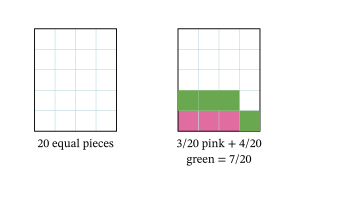
It is customary to then write the result in lowest terms.
When the rational numbers do not have common denominators, then we have to transform the rational numbers so that they do have common denominators. The common denominator that reduces work later in the problem is the LCM of the numerator and denominator. When adding or subtracting the rational numbers and , we perform the following steps.
Step 1: Find .
Step 2: Calculate and .
Step 3: Multiply the numerator and denominator of by , yielding .
Step 4: Multiply the numerator and denominator of by , yielding .
Step 5: Add or subtract the rational numbers from Steps 3 and 4, since they now have the common denominators.
You should be aware that the common denominator is . For the first denominator, we have , since we multiply and divide by the same number. For the same reason, .
Converting Between Improper Fractions and Mixed Numbers
One way to visualize a fraction is as parts of a whole, as in of a pizza. But when the numerator is larger than the denominator, as in , then the idea of parts of a whole seems not to make sense. Such a fraction is an improper fraction. That kind of fraction could be written as an integer plus a fraction, which is a mixed number. The fraction rewritten as a mixed number would be . Arithmetically, is equivalent to , which is read as “one and 11 twelfths.”
Improper fractions can be rewritten as mixed numbers using division and remainders. To find the mixed number representation of an improper fraction, divide the numerator by the denominator. The quotient is the integer part, and the remainder becomes the numerator of the remaining fraction.
Similarly, we can convert a mixed number into an improper fraction. To do so, first convert the whole number part to a fraction by writing the whole number as itself divided by 1, and then add the two fractions.
Alternately, we can multiply the whole number part and the denominator of the fractional part. Next, add that product to the numerator. Finally, express the number as that product divided by the denominator.
Converting Rational Numbers Between Decimal and Fraction Forms
Understanding what decimals represent is needed before addressing conversions between the fractional form of a number and its decimal form, or writing a number in decimal notation. The decimal number 4.557 is equal to . The decimal portion, .557, is 557 divided by 1,000. To write any decimal portion of a number expressed as a terminating decimal, divide the decimal number by 10 raised to the power equal to the number of decimal digits. Since there were three decimal digits in 4.557, we divided 557 by .
Decimal representations may be very long. It is convenient to round off the decimal form of the number to a certain number of decimal digits. To round off the decimal form of a number to (decimal) digits, examine the ()st decimal digit. If that digit is 0, 1, 2, 3, or 4, the number is rounded off by writing the number to the th decimal digit and no further. If the ()st decimal digit is 5, 6, 7, 8, or 9, the number is rounded off by writing the number to the th digit, then replacing the th digit by one more than the th digit.
To convert a rational number in fraction form to decimal form, use your calculator to perform the division.
Converting a terminating decimal to the fractional form may be done in the following way:
Step 1: Count the number of digits in the decimal part of the number, labeled .
Step 2: Raise 10 to the th power.
Step 3: Rewrite the number without the decimal.
Step 4: The fractional form is the number from Step 3 divided by the result from Step 2.
This process works due to what decimals represent and how we work with mixed numbers. For example, we could convert the number 7.4536 to fractional from. The decimal part of the number, the .4536 part of 7.4536, has four digits. By the definition of decimal notation, the decimal portion represents . The decimal number 7.4536 is equal to the improper fraction . Adding those to fractions yields .
The process is different when converting from the decimal form of a rational number into fraction form when the decimal form is a repeating decimal. This process is not covered in this text.
Multiplying and Dividing Rational Numbers
Multiplying rational numbers is less complicated than adding or subtracting rational numbers, as there is no need to find common denominators. To multiply rational numbers, multiply the numerators, then multiply the denominators, and write the numerator product divided by the denominator product. Symbolically, . As always, rational numbers should be reduced to lowest terms.
As with multiplication, division of rational numbers can be done using a calculator.
Before discussing division of fractions without a calculator, we should look at the reciprocal of a number. The reciprocal of a number is 1 divided by the number. For a fraction, the reciprocal is the fraction formed by switching the numerator and denominator. For the fraction , the reciprocal is . An important feature for a number and its reciprocal is that their product is 1.
When dividing two fractions by hand, find the reciprocal of the divisor (the number that is being divided into the other number). Next, replace the divisor by its reciprocal and change the division into multiplication. Then, perform the multiplication. Symbolically,. As before, reduce to lowest terms.
Applying the Order of Operations to Simplify Expressions
The order of operations for rational numbers is the same as for integers, as discussed in Order of Operations. The order of operations makes it easier for anyone to correctly calculate and represent. The order follows the well-known acronym PEMDAS:
| P | Parentheses |
|---|---|
| E | Exponents |
| M/D | Multiplication and division |
| A/S | Addition and subtraction |
The first step in calculating using the order of operations is to perform operations inside the parentheses. Moving down the list, next perform all exponent operations moving from left to right. Next (left to right once more), perform all multiplications and divisions. Finally, perform the additions and subtractions.
Applying the Density Property of Rational Numbers
Between any two rational numbers, there is another rational number. This is called the density property of the rational numbers.
Finding a rational number between any two rational numbers is very straightforward.
Step 1: Add the two rational numbers.
Step 2: Divide that result by 2.
The result is always a rational number. This follows what we know about rational numbers. If two fractions are added, then the result is a fraction. Also, when a fraction is divided by a fraction (and 2 is a fraction), then we get another fraction. This two-step process will give a rational number, provided the first two numbers were rational.
Solving Problems Involving Rational Numbers
Rational numbers are used in many situations, sometimes to express a portion of a whole, other times as an expression of a ratio between two quantities. For the sciences, converting between units is done using rational numbers, as when converting between gallons and cubic inches. In chemistry, mixing a solution with a given concentration of a chemical per unit volume can be solved with rational numbers. In demographics, rational numbers are used to describe the distribution of the population. In dietetics, rational numbers are used to express the appropriate amount of a given ingredient to include in a recipe. As discussed, the application of rational numbers crosses many disciplines.
Using Fractions to Convert Between Units
A common application of fractions is called unit conversion, or converting units, which is the process of changing from the units used in making a measurement to different units of measurement.
For instance, 1 inch is (approximately) equal to 2.54 cm. To convert between units, the two equivalent values are made into a fraction. To convert from the first type of unit to the second type, the fraction has the second unit as the numerator, and the first unit as the denominator.
From the inches and centimeters example, to change from inches to centimeters, we use the fraction . If, on the other hand, we wanted to convert from centimeters to inches, we’d use the fraction . This fraction is multiplied by the number of units of the type you are converting from, which means the units of the denominator are the same as the units being multiplied.
Defining and Applying Percent
A percent is a specific rational number and is literally per 100. percent, denoted %, is the fraction .
You should notice that you can simply move the decimal two places to the left without using the fractional definition of percent.
Percent is used to indicate a fraction of a total. If we want to find 30% of 90, we would perform a multiplication, with 30% written in either decimal form or fractional form. The 90 is the total, 30 is the percentage, and 27 (which is ) is the percentage of the total.
In the previous situation, we knew the total and we found the percentage of the total. It may be that we know the percentage of the total, and we know the percent, but we don't know the total. To find the total if we know the percentage of the total, use the following formula.
The percentage can be found if the total and the percentage of the total is known. If you know the total, and the percentage of the total, first divide the part by the total. Move the decimal two places to the right and append the symbol %. The percentage may be found using the following formula.
Solve Problems Using Percent
In the media, in research, and in casual conversation percentages are used frequently to express proportions. Understanding how to use percent is vital to consuming media and understanding numbers. Solving problems using percentages comes down to identifying which of the three components of a percentage you are given, the total, the percentage, or the percentage of the total. If you have two of those components, you can find the third using the methods outlined previously.
Key Terms
- density property of rational numbers
- improper fraction
- lowest terms
- mixed number
- rational number
- repeating decimal
- terminating decimal
Key Concepts
- Rational numbers are fractions of integers, and can always be written as an integer divided by an integer.
- The numerator and denominator of a fraction may have common factors. In such cases, the fraction can be reduced by canceling common factors. When the numerator and denominator of a fraction have no common factors, the fraction is said to be reduced.
- An improper fraction is one with a numerator larger than the denominator. Such a fraction can be rewritten as an integer plus a proper fraction. This is called a mixed number.
- Using division and remainder, an improper fraction may be written as a mixed number.
- A mixed number can be converted to an improper fraction by reversing the process for changing an improper fraction to a mixed number.
- The arithmetic operations or addition, subtraction, multiplication and division can all be performed on rational numbers.
- Addition and subtraction of rational numbers can be performed after a common denominator has been identified, and the fractions have been converted to forms having the common denominator.
- Multiplication and division of rational numbers can be performed without regard to common denominators.
- Between any two rational numbers, there is always another rational number. This is the density property of the rational numbers.
Formulas
Videos
- Introduction to Fractions
- Equivalent Fractions
- Reducing Fractions to Lowest Terms
- Using Desmos to Reduce a Fraction
- Adding and Subtracting Fractions with Different Denominators
- Converting an Improper Fraction to a Mixed Number Using Desmos
- Multiplying Fractions
- Dividing Fractions
- Order of Operations Using Fractions
- Finding a Fraction of a Total
- Converting Units
Adapted from Contemporary Mathematics by OpenStax (openstax.org), licensed under CC BY-NC-SA 4.0. Changes were made. License: CC-BY-NC-SA-4.0.