
3.6 Real Numbers
Learning Objectives
After completing this section, you should be able to:
- Define and identify numbers that are real numbers.
- Identify subsets of the real numbers.
- Recognize properties of real numbers.
Have you ever been impressed by the speed at which someone can do math in their head? Most of us at one time or another have witnessed a person speed through mental math, an impressive feat that often bests calculators. One such person is Neelkantha Bhanu Prakash. As of September 20, 2020, he is considered the world’s fastest human calculator. He currently holds four world records. How does someone do that, though? Have they memorized lots of arithmetic facts? Are they simply brilliant?
The answer isn't simple so much as it is about knowledge. Real numbers behave in some very regular ways, following rules that can be learned. In this section, those rules are explored.
Watch the video of Arthur Benjamin’s TED Talk to learn about another mathematician with remarkable mental abilities.
Defining and Identifying Real Numbers
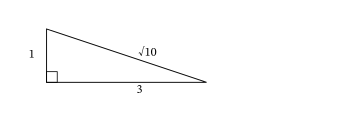
Real numbers are the rational and irrational numbers combined. The real numbers represent the collection of all physical distances that exist, along with 0 and the negatives of those physical distances. For example, if you take a measure of three units, and divide that distance into eight (8) equal lengths, the distance you have formed is units. Also, if you draw a right triangle (a triangle with one angle equal to 90 degrees) with one side length of 1, and the other side length of 3, the long side of the triangle will have length units, as shown in Figure 3.32.
Of course, if we name something the real numbers, there must be numbers that aren't real. Otherwise, they’d just be called the numbers. One such not real number, one that cannot be a length, is . It is part of a collection of numbers called the complex numbers, it is denoted with the letter . As an extension, the square root of any negative number is not a real number, but instead a complex number.
To determine if a number is real, check to see if there are any negatives under a square root or any . If there are any present, the number is not real.
Identifying Subsets of Real Numbers
The real numbers were built out of pieces, including integers, rational numbers, and irrational numbers. As such, the real numbers have named subsets, as shown in the table below.
| Set Name | Set Symbol | Set Description |
|---|---|---|
| Natural Numbers | The counting numbers | |
| Whole Numbers | The counting numbers and 0 | |
| Integers | The natural numbers, their negatives, and 0 | |
| Rational Numbers | Fractions of integers | |
| Irrational Numbers | Numbers that cannot be written as a fraction of integers | |
| Real Numbers | The union of the rational and irrational numbers, all possible physical lengths, and their negatives |
When we categorize numbers using these sets, we use the smallest set that they belong to. For instance, −7 is an integer, and a rational number, and a real number. The smallest set to which −7 belongs is integer, so we’d say it belongs to the integers.
We can also represent the relationships between the different sets of real numbers using set notation. All natural numbers are integers, but there are integers that are not natural numbers, so . Similarly, every integer is a rational number, but there are rational numbers that are not integers, so . The same is true of the rational numbers and the real numbers, so .
There is no agreed-upon symbol for the irrational numbers. If we represent the irrationals as the set , we should note that the following are true: and . Recall that this means the irrationals are the complement of the rational numbers in the universal set of real numbers.
Recognizing Properties of Real Numbers
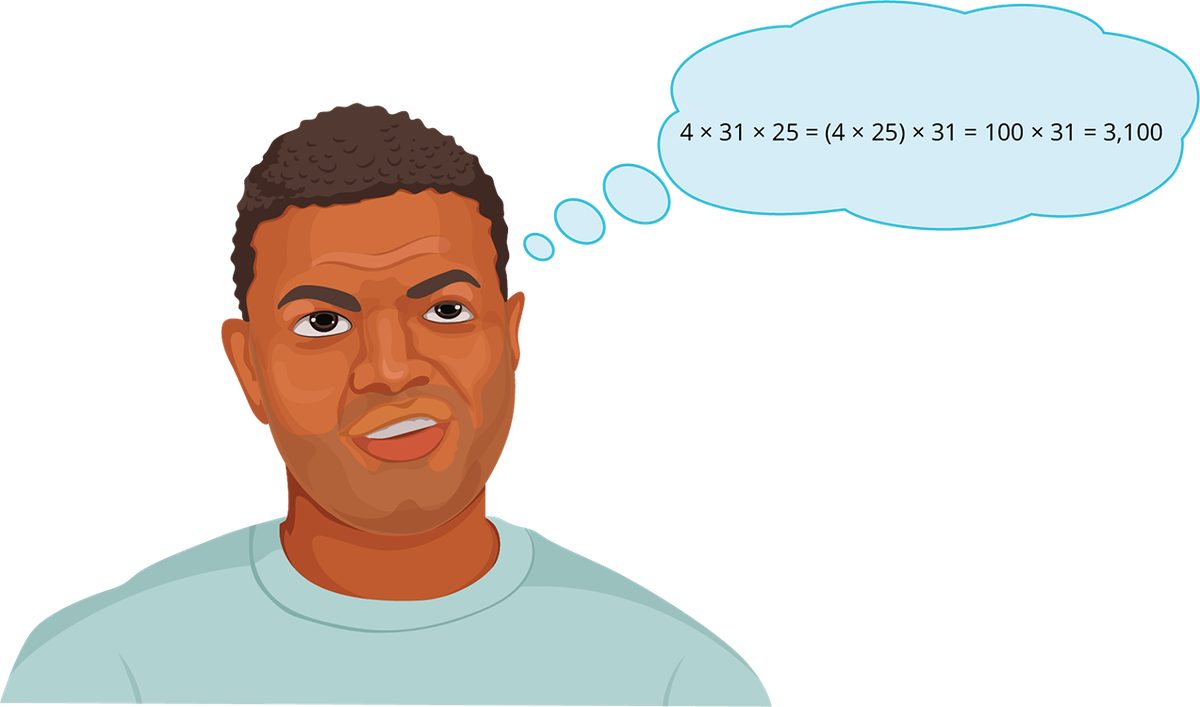
The real numbers behave in very regular ways. These behaviors are called the properties of the real numbers. Knowing these properties helps when evaluating formulas, working with equations, or performing algebra. Being familiar with these properties is helpful in all settings where numbers are used and manipulated. For example, when multiplying , you could multiply the 4 and 25 first. If you know that product is 100, it makes the multiplication easier.
The table below is a partial list of properties of real numbers.
| Property | Example | In Words |
|---|---|---|
| Distributive property | Multiplication distributes across addition | |
| Commutative property of addition | Numbers can be added in any order | |
| Commutative property of multiplication | Numbers can be multiplied in any order | |
| Associative property of addition | Doesn't matter which pair of numbers is added first | |
| Associative property of multiplication | Doesn't matter which pair of numbers is multiplied first | |
| Additive identity property | Any number plus 0 is the number | |
| Multiplicative identity property | Any number times one is the number | |
| Additive inverse property | Every number plus its negative is 0 | |
| Multiplicative inverse property , provided | Every non-zero number times its reciprocal is 1 |
The names of the properties are suggestive. The commutative properties, for example, suggest commuting, or moving. Associative properties suggest which items are associated with others, or if order matters in the computation. The distributive property addresses how a number is distributed across parentheses.
Using these properties to perform arithmetic quickly relies on spotting easy numbers to work with. Look for numbers that add to a multiple of 10, or multiply to a multiple of 10 or 100.
Videos
Key Terms
- complex number
- imaginary number
- real number
Key Concepts
- Real numbers is the collection of all rational and irrational numbers. Conceptually, it is the collection of all values that can be represented on a number line, or, as a length along with sign.
- The subsets of the real numbers include the natural numbers, integers, rational numbers and irrational numbers. The natural numbers are a subset of the integers, which is a subset of the rational numbers. The rational and irrational numbers are disjoint sets.
- The real numbers, due to order of operation rules and that performing arithmetic operations on real number always results in a real number, have arithmetic properties that apply in all cases. There include the distributive property, the commutative property, and the associative property. Also, every real number has an additive inverse and, except for zero (0), have a multiplicative inverse.
Formulas
Videos
Adapted from Contemporary Mathematics by OpenStax (openstax.org), licensed under CC BY-NC-SA 4.0. Changes were made. License: CC-BY-NC-SA-4.0.