Figure 6.17Loans are contracts that allow people to buy now but require them to pay more.Loans are contracts that allow people to buy now but require them to pay more. (credit: "Closing" by Tim Pierce/Flickr, CC BY 2.0)
Learning Objectives
After completing this section, you should be able to:
Describe various reasons for loans.
Describe the terminology associated with loans.
Understand how credit scoring works.
Calculate the payment necessary to pay off a loan.
Read an amortization table.
Determine the cost to finance for a loan.
New car envy is real. Some people look at a new car and feel that they too should have a new car. The search begins. They find the model they want, in the color they want, with the features they want, and then they look at the price. That’s often the point where the new car fever breaks and the reality of borrowing money to purchase the car enters the picture. This borrowing takes the form of a loan.
In this section, we look at the basics of loans, including terminology, credit scores, payments, and the cost of borrowing money.
Reasons for Loans
Even if you want a new car because you need one, or if you need a new computer since your current one no longer runs as fast or smoothly as you would like, or you need a new chimney because the one on your house is crumbling, it’s likely you do not have that cost in cash. Those are very large purchases. How do you buy that if you don ’t have the cash?
You borrow the money.
And for helping you with your purchase, the company or bank charges you interest.
Loans are taken out to pay for goods or services when a person does not have the cash to pay for the goods or services. We are most familiar with loans for the big purchases in our lives, such as cars, homes, and a college education. Loans are also taken out to pay for repairs, smaller purchases, and home goods like furniture and computers.
Loans can come from a bank, or from the company selling the goods or providing the service. The borrower agrees to pay back more than the amount borrowed. So there is a cost to borrowing that should be considered when deciding on a purchase bought with credit or a borrowed money.
Even using a credit card is a form of a loan.
Essentially, a loan can be obtained for just about any purchase, large or small, that has a cost beyond a person’s cash on hand.
The Terminology of Loans
There are many words and acronyms that get used in relation to loans. A few are below.
APR is the annual percentage rate. It is the annual interest paid on the money that was borrowed. The principal is the total amount of the loan, or that has been financed. A fixed interest rate loan has an interest rate that does not change during the life of the loan. A variable interest rate loan has an interest rate that may change during the life of the loan. The term of the loan is how long the borrower has to pay the loan back. An installment loan is a loan with a fixed period, and the borrower pays a fixed amount per period until the loan is paid off. The periods are almost uniformly monthly. Loan amortization is the process used to calculate how much of each payment will be applied to principal and how much is applied to interest. Revolving credit, also known as open-end credit, is how most credit cards work but is also a kind of loan account. (We will learn about credit cards in Credit Cards) You can use up to some specified value, called the limit, any way you want, and as long as you pay the issuer of the credit according to their terms, you can keep borrowing from this account.
These and other terminologies can be researched further at Forbes.
Calculating Loan Payments
Loan payments are made up of two components. One component is the interest that accrued during the payment period. The other component is part of the principal. This should remind you of partial payments from Simple Interest.
Over the course of the loan, the amount of principal remaining to be paid decreases. The interest you pay in a month is based on the remaining principal, just as in the partial payments of Simple Interest.
The payment of the loan has to be such that the principal of the loan is paid off with the last payment. In any period, the amount of interest is defined by the formula above, but changes from period to period since the principal is decreasing with each payment. The trick is knowing how much principal should be paid each payment so that the loan is paid off at the stated time. Fortunately, that is found using the following formula.
Reading Amortization Tables
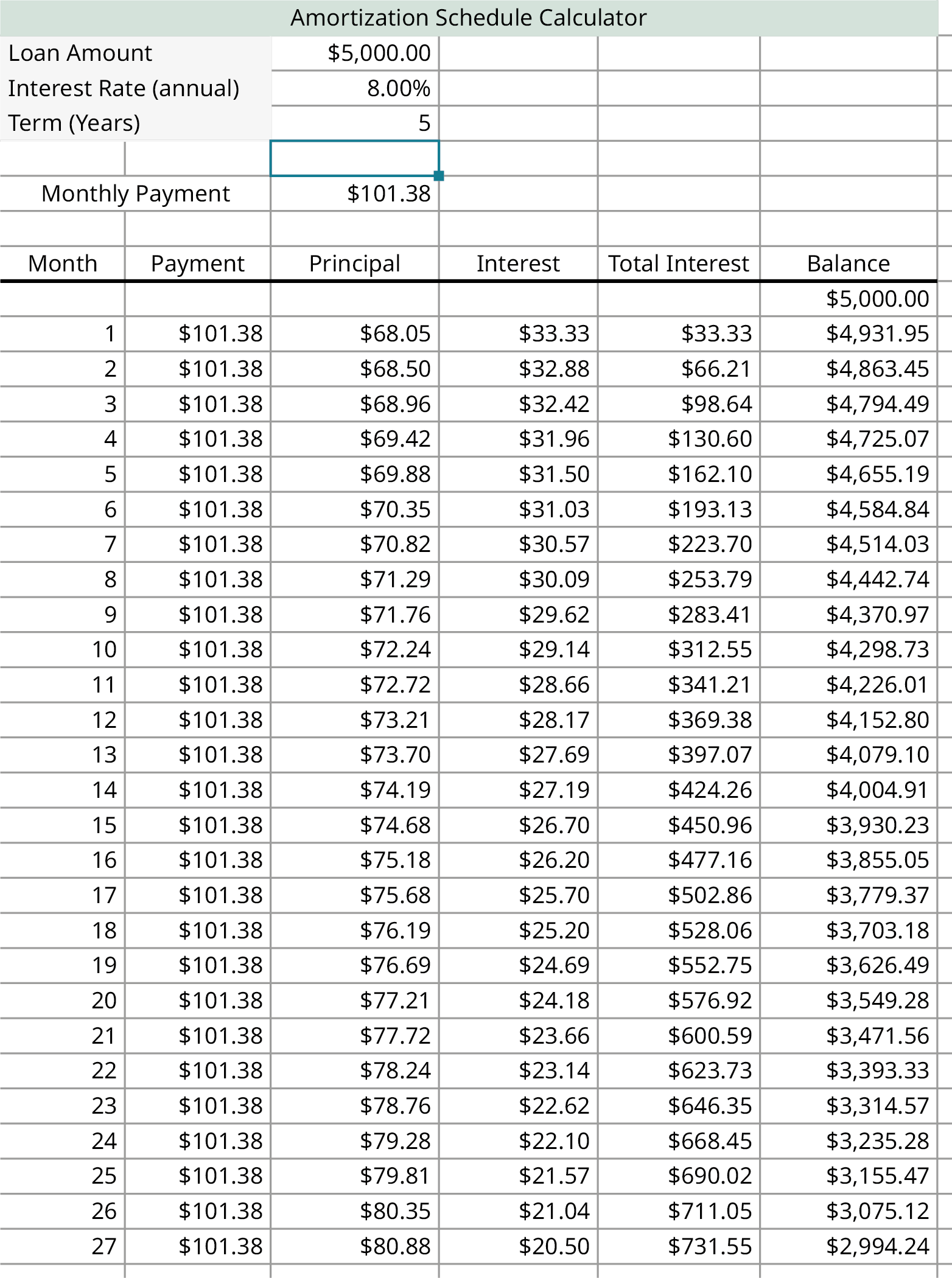
An amortization table or amortization schedule is a table that provides the details of the periodic payments for a loan where the payments are applied to both the principal and the interest. The principal of the loan is paid down over the life of the loan. Typically, the payments each period are equal. Importantly, one of the columns will show how much of each payment is used for interest, another column shows how much is applied to the outstanding principal, and another column shows the remaining principal or balance Figure 6.19.
Figure 6.19Amortization table
Cost of Finance
There are often costs associated with a loan beyond the interest being paid. The cost of finance of a loan is the sum of all costs, fees, interest, and other charges paid over the life of the loan.
Key Terms
Fixed interest rate
Variable interest rate
Installment loan
Loan amortization
Revolving credit
Amortization table
Cost of finance
Key Concepts
There are many reasons for a loan, but primarily it is taken out for a large expense when cash is not available.
Each payment for an installment loan consists of an interest portion and a principal portion.
There is a formula to calculate the payment necessary to pay off a loan in installments.
Amortization schedules, or tables, show how each payment is applied to principal and interest. It also includes other details such as remaining balance and total interest paid.
Loans often have other fees associated with them such as origination fees or application fees. The total of the interest paid and the fees is the cost of finance.
Adapted from Contemporary Mathematics by OpenStax (openstax.org), licensed under CC BY-NC-SA 4.0. Changes were made. License: CC-BY-NC-SA-4.0.
These eBooks are a prerelease and are not yet certified conformant with WCAG 2.1 AA or ADA Title II. Every page is built against an automated accessibility gate, and the published editions will meet ADA Title II requirements when they release in late September 2026. If something is unusable, please tell us.