
6.1 Understanding Percent
Learning Objectives
After completing this section, you should be able to:
- Define and calculate percent.
- Convert between percent, decimal, and fractional values.
- Calculate the total, percent, or part.
- Solve application problems involving percents.
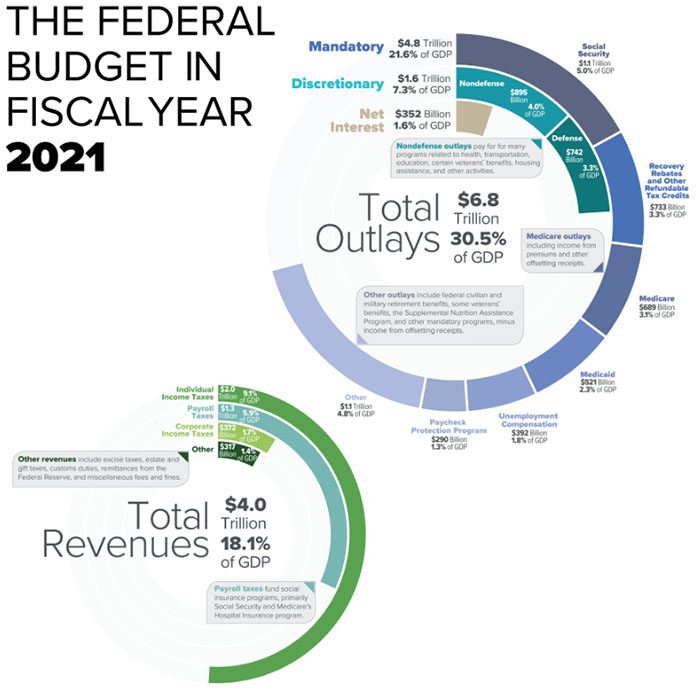
In 2020, the U.S. federal government budgeted $3.5 billion for the National Park Service, which appears to be a very large number (and is!) and a large portion of the total federal budget. However, the total outlays from the U.S. federal government in 2020 was $6.6 trillion. So, the amount budgeted for the National Park Service was less than one-tenth of 1 percent, or 1/10%, of the total outlays. This percent describes a specific number. Understanding that ratio puts the $3.5 billion budgeted to the National Park Service in perspective.
This chapter focuses on percent as a primary tool for understanding money management. The interest paid on debt, the interest earned through investments, and even taxes are entirely determined using percent. This section introduces the basics of working with this invaluable tool.
Define and Calculate Percent
The word percent comes from the Latin phrase per centum, which means “by the hundred.” So any percent is a number divided by 100. Changing a percent to a fraction is to write the percent in its fractional form. To write % in its fractional form is to write the percent as the fraction .
Convert Between Percent, Decimal, and Fractional Values
When any calculation with a percent is to be performed, the form of the percent must be changed, either to its fractional form or its decimal form. We can change a percent into decimal form by dividing the percent by 100 and representing the result as a decimal.
You should notice that, to convert from percent to decimal form, you can simply move the decimal two places to the left without performing the division.
You should notice that, to convert from decimal form to percent form, you can simply move the decimal two places to the right without performing the multiplication.
Calculate the Total, Percent, or Part
The word “of” is used to indicate multiplication using fractions, as in “one-fourth of 56.” To find “one-fourth of 56” we would multiply 56 by one-fourth. We can think of percents as fractions with a specific denominator—100. So, to calculate “25% of 52,” we multiply 52 by 25%. But, first we need to convert the percent to either fractional form (25/100) or decimal form. Using the decimal form of 25% we have 0.25 × 52, which equals 13.
In this problem, 52 is the total or base, 25 is the percentage, and 13 is the percentage of 52, or the part of 52. This is sometimes referred to as the amount.
Knowing any two of the values in our formula allows us to calculate the third value. In the following example, we know the total and the percent, and are asked to find the percentage of the total.
In the previous example, we knew the total and the percent and found the part using our formula. We may instead know the percent and the part, but not the total. We can use our formula again to solve for the total.
Similarly, the percent can be found if the total and the percent of the total (the part) are known. This will result in the decimal form of the percent, so it must be converted to percent form.
Solve Application Problems Involving Percents
Percents are frequently used in finance, research, science experiments, and even casual conversation. Understanding these types of values helps when consuming media or discussing finances, for instance. Effectively working with and interpreting numbers and percents will help you become an informed consumer of this information.
In most cases, working through what is presented requires you to identify that you are indeed working with a question of percents, which two of the three values that are related through percents are known, and which of the three values you need to find.
For any answer, round to two decimal places, if necessary.
Key Terms
- Percent
- Fractional form
- Decimal form
- Total
- Base
- Percent of the total
- Part
- Amount
Key Concepts
- Know what a percent is as a fraction, a decimal, and as a part of the whole.
- Use the percent equation to find any of the three values that are related by the equation.
- Apply the percent equation in applications.
Video
Formulas
part = percent x total
Adapted from Contemporary Mathematics by OpenStax (openstax.org), licensed under CC BY-NC-SA 4.0. Changes were made. License: CC-BY-NC-SA-4.0.