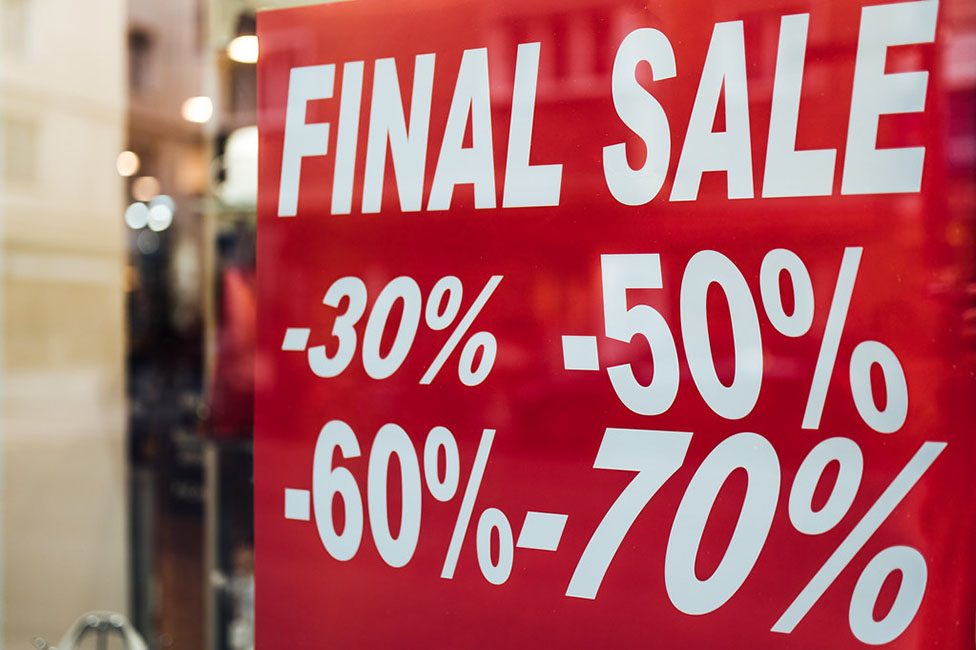
Figure 6.3Sale prices are often described as percent discounts.Sale prices are often described as percent discounts. (credit: "Close-up of a discount sign" by Ivan Radic/Flickr, CC BY 2.0)
Learning Objectives
After completing this section, you should be able to:
Calculate discounts.
Solve application problems involving discounts.
Calculate markups.
Solve application problems involving markups.
Compute sales tax.
Solve application problems involving sales tax.
Many people first encounter percentages during a retail transaction such as a percent discount (SALE! 25% off!!), or through sales tax ("Wait, I thought this was $1.99?"), a report that something has increased by some percentage of the previous value (NOW! 20% more!!). These are examples of percent decreases and percent increases. In this section, we discuss decrease, increase, and then the case of sales tax.
Calculating Discounts
Retailers frequently hold sales to help move merchandise. The sale price is almost always expressed as some amount off the original price. These are discounts, a reduction in the price of something. The price after the discount is sometimes referred to as the reduced price or the sale price.
When a reduction is a percent discount, it is an application of percent, which was introduced in Understanding Percent. The formula used was . In a discount application, the discount plays the role of the part, the percent discount is the percentage, and the original price plays the role of the total.
When the original price and the percent discount are known, the discount and the sale price can be directly computed.
Sometimes the original price and the sale price of an item is known. From this, the percent discount can be computed using the formula , by solving for the percent discount.
Sometimes the sale price and the percent discount of an item are known. From this, the original price can be found. To avoid multiple steps, though, the formula that we will use is . The original price can be found by solving this equation for the original price.
Solve Application Problems Involving Discounts
In application problems, identify what is given and what is to be found, using the terms that have been learned, such as discount, original price, percent discount, and sale price. Once you have identified those, use the appropriate formula (or formulas) to find the solution(s).
Calculate Markups
When retailers purchase goods to sell, they pay a certain price, called the cost. The retailer then charges more than that amount for the goods. This increase is called the markup. This selling price, or retail price, is what the retailer charges the consumer in order to pay their own costs and make a profit. Markup, then is very similar to discount, except we add the markup, while we subtract the discount.
It should be noted that the formulas used for a markup are very similar to those for a discount, with addition replacing the subtraction.
Sometimes the cost and the retail price of an item are known. From this, the percent markup can be computed using the formula , by solving for the percent markup.
Sometimes the retail price and the percent markup of an item are known. From this, the cost can be found. To avoid multiple steps, though, the formula that we will use is . The cost can be found by solving this equation for the cost.
Solve Application Problems Involving Markups
As before when working with application problems, be sure to look for what is given and identify what you are to find. Once you have evaluated the problem, use the appropriate formula to find the solution(s). These application problems address markups.
Compute Sales Tax
Sales tax is applied to the sale or lease of some goods and services in the United States but is not determined by the federal government. It is most often set, collected, and spent by individual states, counties, parishes, and municipalities. None of these sales tax revenues go to the federal government.
For example, North Carolina has a state sales tax of 4.75% while New Mexico has a state sales tax of 5%. Additionally, many counties in North Carolina charge an additional 2% sales tax, bringing the total sales tax for most (72 of the 100) counties in North Carolinians to 6.75%. However, in Durham, the county sales tax is 2.25% plus an additional 0.5% tax used to fund public transportation, bringing Durham County’s sales tax to 7%. To find the sales tax in a particular place, then, add other locality sales taxes to the base state sales tax rate.
How much we pay in sales tax depends on where we are, and what we are buying.
To determine the amount of sales tax on taxable purchase, we need to find the product of the purchase price, or marked price, and the sales tax rate for that locality.
You should notice that this the same as markup, except using a different term. Sales tax plays the role of markup, the purchase price plays the role of cost, and the tax rate plays the role of percent markup. This means all the strategies developed for markups apply to this situation, with the changes indicated.
As before, the information available might be different than only the purchase price and the sales tax rate. In these cases, use either or and solve for the indicated tax, price, or rate. These problems mirror those for percent markup.
Be aware, almost all sales tax rates are structured as full percentages, or half percent, or one-quarter percent, or three-quarter percent. This means the decimal value of the sales tax rate, written as a percent, will be either 0, as in 5.0%, 5 as in 7.5%, 25 as in 3.25%, or 75 as in 4.75%. When rounding for the sales tax percentage, be sure to use this guideline.
Solve Application Problems Involving Sales Tax
Solving problems involving sales tax follows the same ideas and steps as solving problems for markups. But here we will use the following formula:
We can also use the formula:
This can be seen in the following examples.
Key Terms
Discount
Cost
Markup
Retail price
Key Concepts
Discounts are markdowns from an original price.
Mark-ups are increases to the price paid by a retailer to cover their costs.
be able to calculate the markup based on a percentage of the cost
Sales taxes vary from state to state and often county to county.
Retail prices, sales prices and percent discounts can be calculated if the other two values are known.
Original costs, retail prices, and percent markup can be calculated if the other two values are known.
Adapted from Contemporary Mathematics by OpenStax (openstax.org), licensed under CC BY-NC-SA 4.0. Changes were made. License: CC-BY-NC-SA-4.0.
These eBooks are a prerelease and are not yet certified conformant with WCAG 2.1 AA or ADA Title II. Every page is built against an automated accessibility gate, and the published editions will meet ADA Title II requirements when they release in late September 2026. If something is unusable, please tell us.