
6.7 Investments

Learning Objectives
After completing this section, you should be able to:
- Distinguish between basic forms of investments including stocks, bonds, and mutual funds.
- Understand what bonds are and how bond investments work.
- Understand how stocks are purchased and gain or lose value.
- Read and derive information from a stock table.
- Define a mutual fund and how to invest.
- Compute return on investment for basic forms of investments.
- Compute future value of investments.
- Compute payment to reach a financial goal.
- Identify and distinguish between retirement savings accounts.
You can save your money in a safe or a vault (or worse, under the mattress!), but that money does not grow. It would be hard to save enough for retirement that way. What can be done to increase the value of the money you already have?
The answer is to invest it. Use the money that you have to earn more money back. For instance, as we saw in Methods of Savings, you can save it in a bank. Or, to reach loftier goals, invest in something more likely to grow, such as stocks.
A great example of this is Apple stock. Anyone who bought stock in Apple Inc. (formerly Apple Computer, Inc.) in 1997 and held onto the shares earned a lot of money. To be more specific, $100 worth of Apple shares bought in 1980, when it was first sold to the public, was valued at $67,564 in 2019, or 676 times more! Perhaps you have heard a story like that, of an investment opportunity taken that paid off, or the story of an investment opportunity missed. But such stories are the exceptions.
In this section, we’ll investigate bonds, stocks, and mutual funds and their comparative strengths and weaknesses. We close the section with a discussion of retirement savings accounts.
Distinguish Between Basic Forms of Investments
Bonds, stocks, and mutual funds tend to offer higher returns, but to varying degrees, come with higher risks. Stocks and mutual funds also vary in how much they earn. Their predicted rates of return on investment are not guaranteed, but educated guesses based on market trends and historical performance.
We will use the methods and formulas we learned earlier to evaluate these forms of investment.
Bonds
Bonds are issued from big companies and from governments. Selling bonds is an alternative to an institution taking a loan from a bank. The funds from the selling of bonds are often used for large projects, like funding the building of a new highway or hospital.
Bonds are considered a conservative investment. They are bought for what is known as the issue price. The interest is fixed (does not change) at the time of purchase and is based on the issue price of the bond. The interest rate is often referred to as the coupon rate; the interest paid is often called the coupon yield. The interest paid is often higher than savings accounts and the risk is exceptionally low. The bond is for a fixed length of time. The end of this time is the maturity date of the bond.
There are several types of bonds:
- Treasury bonds are issued by the federal government.
- Municipal bonds are issued by state and local governments.
- Corporate bonds are issued by major corporations.
There are other types of bonds available, but they are beyond the scope of this section.
Stocks
Stocks are part ownership in a company. They come in units called shares. The performance and earnings of stocks is not guaranteed, which makes them riskier than any other investment discussed earlier. However, they can offer higher return on investment than the other investments. Their value grows in two ways. They offer dividends, which is a portion of the profit made by the company. And the price per share can increase based on how others see that value of the company changing. If the value of the company drops, or the company folds, the money invested in the stock also drops.
Most stock transactions are executed through a broker. Brokers’ commissions can be a percentage of value of the trades made or a flat fee. There are full-service brokers who charge higher commission rates, but they also offer financial advice and perform the research that you may not have the time or the expertise to do on your own. A discount broker only executes the stock transactions, buying or selling, so they charge lower rates than full-service brokers. There are also brokers that offer commission-free trading.
An important thing to remember is that stocks might provide a very large return on investment, but the trade-off is the risk associated with owning stocks.
Reading Stock Tables
Information about particular stocks is contained in stock tables. This information includes how much the stock is selling for, and its high and low values form the past year (52 weeks). In a newspaper, the stock table may look like this:
| 52-Week High Low | Stock | SYM | Div | Yld % | P/E | Vol 100s | High | Low | Close | Net Chg | |
|---|---|---|---|---|---|---|---|---|---|---|---|
| 41.66 | 18.90 | McDonald’s | MCD | .72 | 2.9 | 12 | 7588 | 25.73 | 23.87 | 25.42 | +0.31 |
| 22.60 | 13.20 | Monsanto | MON | .52 | 2.4 | 55 | 15474 | 21.86 | 21.48 | 21.64 | -0.29 |
| 17.05 | 8.30 | Motorola | MOT | .16 | 1.7 | dd | 16149 | 10.57 | 8.88 | 10.43 | +0.14 |
| 31.75 | 22.99 | Mueller | MLI | - | - | 16 | 1564 | 29.32 | 27.03 | 27.11 | -0.02 |
The symbols and abbreviations are defined here:
| 52-week High | 52-week Low | The highest and lowest price of the stock over the past 52 weeks |
|---|---|---|
| Stock | SYM | The name of the company and the symbol used for trading |
| Annual DIV | The current annual dividend per share | |
| Yld % | Percent yield is | |
| P/E | Price to earnings ratio, share price divided by earnings per share over past year (dd indicates loss) | |
| Vol 100s | The number of shares traded yesterday in 100s | |
| High | Low | The highest and lowest prices at which stocks traded yesterday |
| Close | The price at which the stock traded at the close of the market yesterday | |
| Net Chg | Net change; change in price from market close 2 days ago to yesterday’s close |
The formulas for yield and price to earnings is a good way to measure how much the stock returns per share. Their values are calculated in the stock table, but deserve attention here.
It should be noted that the price of a stock increases and decreases every moment, and so these value change as the share price changes.
The stock table information is now, and has been, available online, from websites such as cnn.com/markets, markets.businessinsider.com/stocks, and marketwatch.com. The same information is available from these sites as from the newspaper listings, but are often accessed one stock at a time. Figure 6.14 shows the stock table for Lowe’s on September 7, 2022.
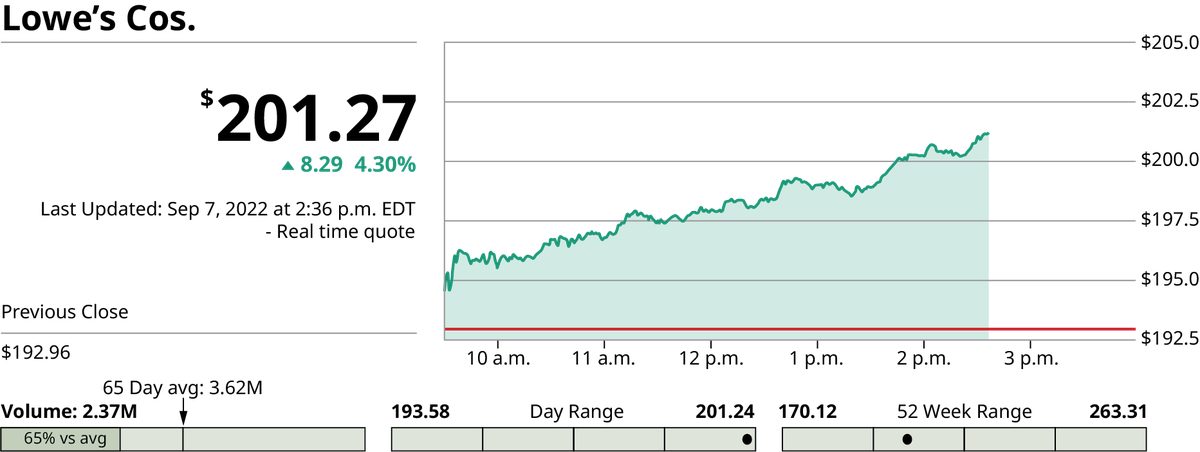
Other key data is further down on the website, and is shown in Figure 6.15, below.
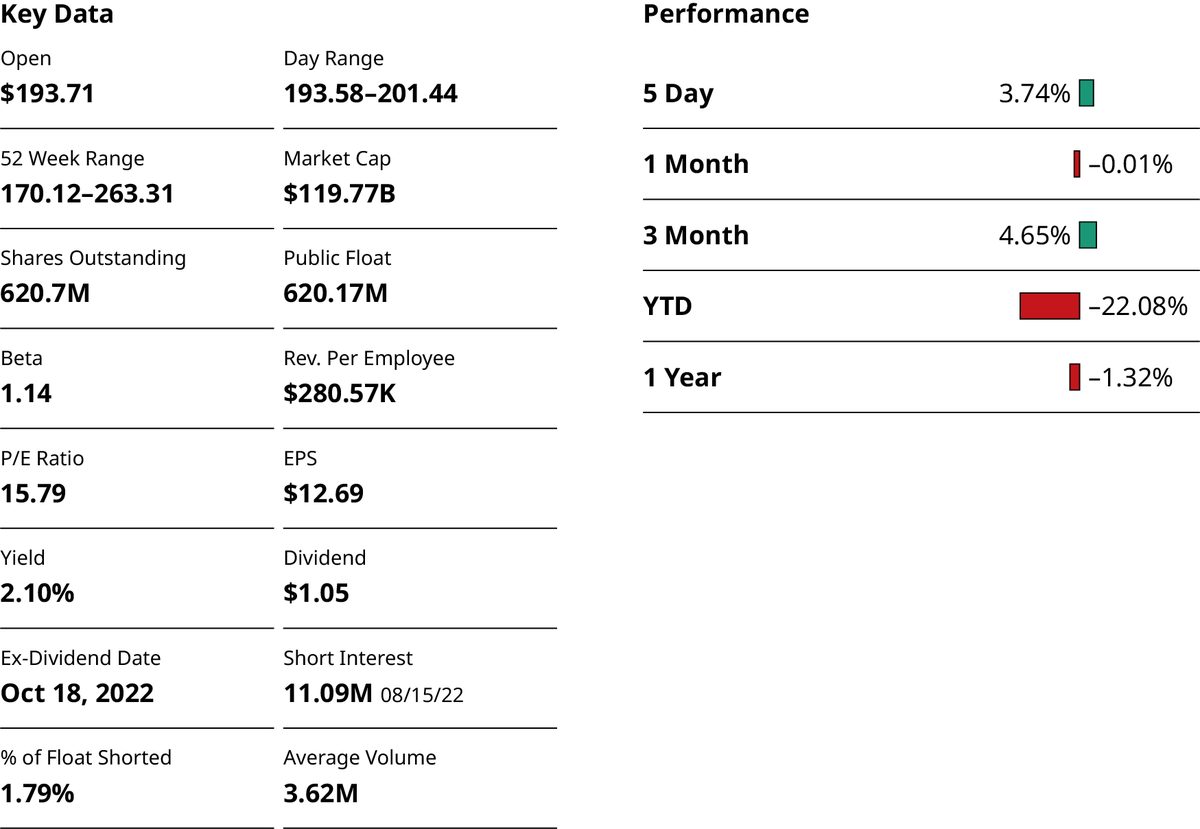
Notice that the 52-week high and low are now shown as the 52-week range. However, you get additional information, including the stock performance over the past 5 days, past month, past 3 months, the year to date (YTD), and over the past year. You can also read the number of shares outstanding, the expected date for the dividend (EX-DIVIDEND DATE), and importantly for the P/E ratio, the earning per share (EPS).
As mentioned, stocks earn money in two ways, through dividends and increase in share price.
Mutual Funds
A mutual fund is a collection of investments that are all bundled together. When you buy shares of a mutual fund, your money is pooled with the assets of other investors. This pooled money is invested in stocks, bonds, money market instruments, and other assets. Mutual funds are typically operated by professional money managers who allocate the fund's assets and attempt to produce capital gains or income for the fund's investors.
A key benefit of mutual funds is that they allow small or individual investors to invest in professionally managed portfolios of equities, bonds, and other securities. This means each shareholder participates proportionally in the gains or losses of the fund. The performance of a mutual fund is usually stated as how much the mutual fund’s total value has increased or decreased. Since there are many different investments inside the mutual fund, the risk is reduced significantly, compared to direct ownership of stocks. Even so, mutual funds historically perform well and can earn more than 10% annually.
The investments that make up a mutual fund are structured and maintained to match stated investment objectives, which are specified in its prospectus. A prospectus is a pamphlet or brochure that provides information about the mutual fund. Before buying shares of a mutual fund, consult its prospectus, consider its goals and strategies to see if they match your goals and values and also research any associated fees.
Return on Investment
As in Methods of Savings, the formula for return on investment is . As indicated before, this formula does not take into account how long the investment took to reach its current value. It depends only on the initial value, , and the value at the end of the investment, .
As mentioned, the ROI does not address the length of time of the investment. A good way to do that is to equate the ROI to an account bearing interest that is compounded annually.
The annual return is the average annual rate, or the annual percentage yield (APY) that would result in the same amount were the interest paid once a year.
We apply this to the previous example.
In Example 10 and Your Turn, the annual return was lower than the interest rate of the investment. This is because the interest from a bond is simple interest, but annual yield equates to compounded annually.
You should see that the annual return is equal to the annual compounded interest that was assumed for the stocks.
Compute Payment to Reach a Financial Goal
As in Methods of Savings, determining the payment necessary to reach a financial goal uses the payment formula for an ordinary annuity, . If dealing with mutual funds or stocks, an assumed annual interest rate, compounded, will be used. This value is often determined through research and informed speculation.
Retirement Savings Plans
We close this section by investigating the three main forms of retirement savings accounts: traditional individual retirement accounts (IRAs), Roth IRAs, and 401(k) accounts. Each has distinct characteristics that are suited to different investors’ needs.
Individual Retirement Accounts
A traditional IRA lets you contribute up to an amount set by the government, which may change from year to year. For example, the maximum contribution for 2022 is $6,000; $7,000 over age 50. Anyone is eligible to contribute to a traditional IRA, regardless of your income level. Your money grows tax-deferred, but withdrawals after age 59½ are taxed at current rates. Traditional IRAs also allow you to use the contribution itself as a deduction on a current year tax return.
Roth IRAs allow contributions at the same levels as traditional IRAs, with a maximum $6,000 for 2022; $7,000 over age 50. However, to be eligible to make contributions, your earned income must be below a certain level. A Roth IRA allows after-tax contributions. In other words, the contribution itself is not tax-deductible, as it is with the traditional IRA. However, your money grows tax-free. If you make no withdrawals until you are age 59½, there are no penalties. IRAs pay a modest interest rate.
In either case, IRA deposits have to be from earned income, which in effect means if your earned income is over $6,000 ($7,000) then you can deposit the maximum.
401(k) Accounts
Your employer may offer a retirement account to you. These are often in the form of a 401(k) account. There are traditional and Roth 401(k) accounts, which differ in how they are taxed, much as with other IRAs. In the traditional 401(k) plans, the money is deposited before tax is assessed, which means you do not pay taxes on this money. However, that means when money is withdrawn, it is taxed. These accounts are similar to mutual funds, in that the money is invested in a wide range of assets, spreading the risk.
One of the perks some employers offer is to match some amount of your contributions to the 401(k) plan. For instance, they may match your deposits up to 5% of your income. This is an instant 100% return on the money that was matched.
401(k) plans with matching funds provide great value, as their rates of return are high compared to savings accounts, and are less risky that stocks since such funds invest across many investment vehicles. The next example demonstrates the power of constant deposits into a 401(k) plan that has some employer match.
Key Terms
- Bonds
- Maturity date
- Stocks
- Dividend
- Mutual fund
- Prospectus
- Issue price
- Shares
- Stock table
- Individual retirement account
- Roth IRA
- 401(k)
Key Concepts
- There are many different investments with different returns and risks.
- Bonds are loans form the purchaser to the entity selling the bond.
- Bonds have some tax benefits, low to no risk, and a low return.
- Stocks represent part ownership in a company. As such, stock holders share in the profits, and losses, of the company.
- Information, including price, P/E, yearly highs and lows, and dividend amount can be found in online stock tables available on many websites.
- Mutual funds represent collections of professionally administered investment vehicles. Have shares in a mutual fund has lower risk than ownership of stocks.
- Retirement accounts employ some of the same strategies as mutual funds, in that they spread the risk and are professionally managed.
- IRAs and Roth IRAs differ on when taxes are paid on the money, and who can use them. Roth IRAs have income limits while traditional IRAs do not.
Videos
Formulas
Adapted from Contemporary Mathematics by OpenStax (openstax.org), licensed under CC BY-NC-SA 4.0. Changes were made. License: CC-BY-NC-SA-4.0.