
6.10 Credit Cards
Learning Objectives
After completing this section, you should be able to:
- Apply for a credit card armed with basic knowledge.
- Distinguish between three basic types of credit cards.
- Compare and contrast the benefits and drawbacks of credit cards.
- Read and understand the basic parts of a credit card statement.
- Compute interest, balance due, and minimum payment due for a credit card.
It can be difficult to get along these days without at least one credit card. Most hotels and rental car agencies require that a credit card is used. There are even a number of retailers and restaurants that no longer accept cash. They make online purchasing easier. And nothing contributes more to a good credit rating than a solid history of making credit card payments on time.
Being granted a credits card is a privilege. Used unwisely that privilege can become a curse and the privilege may be withdrawn. In this section, we will talk about the different types of credit cards and their advantages and disadvantages. The more knowledge a cardholder has about the credit card industry, the better able credit accounts can be managed, and that knowledge may cause major adjustments to a cardholder’s lifestyle.
All credit cards are not equal, but they all represent consumers borrowing money, usually from a bank, to pay for needs and “wants.” As such, they are a type of loan, and your repayment may include interest. (You might want to review Section 6.8, which discusses loans and repayment plans.)
There are many institutions and credit cards to choose from. Use caution as you shop around for a credit card that suits you. Your top concern is likely the interest rates on purchases and cash advances. But be careful to also read the small print regarding charges for late payments, and other fees such as an annual fee, where the credit card charges you (the cardholder) a fee each year for the privilege of using the cards. Many cards charge no such fee, but there are many that charge modest to heavy fees. Make sure to understand rules for reward programs, where the credit card issuer grants benefits based on one’s spending. Finally, once one applies for and is granted a credit card, pay attention to the credit limit the bank offers. Once a company is owed that much money, use of the card for purchases should be curtailed until some of the debt is paid off.
Types of Credit Cards
There are basically three types of credit cards: bank-issued credit cards, store-issued credit cards, and travel/entertainment credit cards. We will look at all three and explain the good and the bad qualities of each.
Bank-Issued Credit Cards
Perhaps the most widely used credit card type is the bank-issued credit card, like Visa or MasterCard (and even American Express and Discover cards). These types of cards are an example of revolving credit, meaning that additional credit is extended before the previous balance is paid—but only up to the assigned credit limit. Bank-issued cards are considered the most convenient, as they can be used to purchase anything, including apparel, furniture, groceries, fuel for automobiles, meals, hotel bills, and so on, just as if paying with cash. The interest rates on bank-issued credit cards are usually lower than those for other credit cards we’ll discuss, and the credit limits are generally higher. Currently, bank-issued cards have an average 20.09% APR.
Store-Issued Credit Cards
Store-issued credit cards are issued by retailers. One can hardly walk into a store these days without being offered a discount on purchases if one applies for the store credit card. These cards can only be used in that store or family of stores that issues the card. However, if a store credit card is associated with Visa, MasterCard, or American Express, then the card might be used the same way that the bank-issued cards are used. This is called cobranding. The logo of the bank-issued card will be present on the store card. Many stores offer both types. Like other credit cards, they may come with an annual fee.
Store credit cards usually charge higher interest rates than bank-issued cards. Currently, store credit cards have an APR (annual percentage rate) of 24.15%. Any rewards offered by store credit cards are usually limited to purchases made in their own store, and it typically takes longer to accumulate enough rewards or points to redeem them, whereas cobranded credit cards offer opportunities to earn rewards on all purchases, regardless of whether purchases are made in the issuing store or not.
Store credit cards usually offer lower credit limits, at least in the beginning. After being proved to be a responsible credit card owner, credit limits can be raised. Nevertheless, store credit cards are a good choice for those new to the credit card industry. If on-time payments are consistently made, it is an excellent way to get started building a credit history.
Travel/Entertainment Cards, or Charge Cards
This is the third type of credit card. The travel and entertainment cards, also known as charge cards, first and foremost offer very high limits or unlimited credit, but they must be paid in full every month. They generally charge high annual fees and impose expensive penalties should a payment be late. On the other hand, they typically have longer grace periods and offer many and various kinds of rewards.
Check out this nerdwallet article about the differences between a charge card and a credit card.
Credit Card Statements
Cardholders usually receive monthly statements and have 21 days to pay the minimum amount due. The statements itemize and summarize activity on the credit card for that statement’s billing period. The billing period for a credit card is generally a month long, but typically does not start and end on the first and last days of the month. The statement will include the current balance, interest rate, the minimum payment due, and the due date. Be aware, different companies produce statements that are laid out differently. The information will be clearly labeled though.
The due date is a top concern. Missing a due date is one of the worst things a cardholder can do financially, and this is by far the biggest downfall of owning a credit card. Not only is the cardholder subject to late fees, but when a payment is late more than once there is a high probability that the cardholder will be negatively reported to the credit bureaus, which can quickly erode a credit score. Figure 6.23 shows an excerpt from an actual statement from a Chase Bank Visa card, based on the current $668.25 balance.
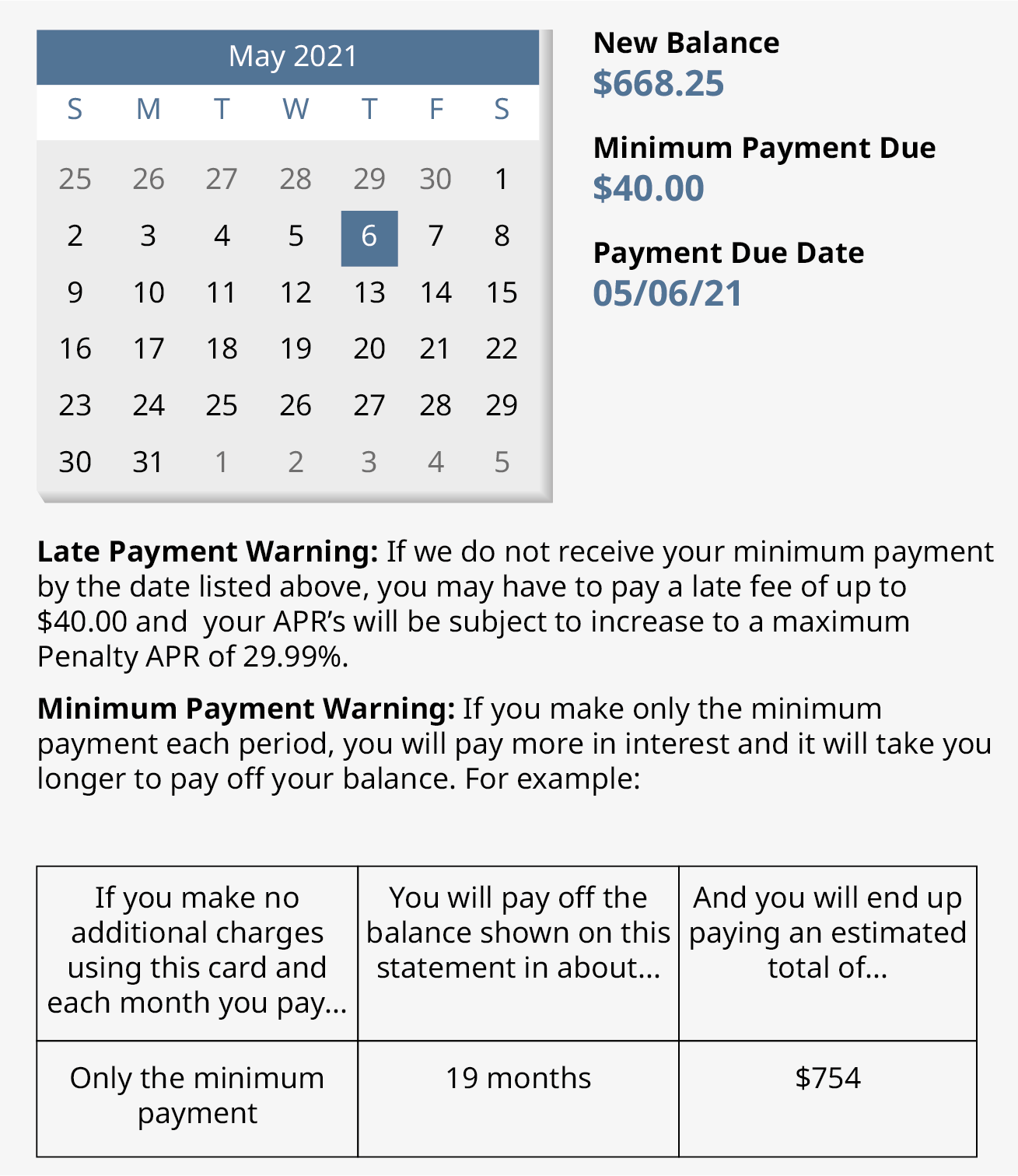
Specifically pay attention to the late payment penalty and minimum payment warning statements. stating that if no other purchases are made and you continue making only the minimum payment, it will take 19 months to pay off the balance and you will pay $754.00. You can’t say you were not warned.
It is critical that you examine your statement every month because it is always a possibility that your account may have been compromised. If you should notice fraudulent charges on your statement, notifying the credit card company is often enough to have those charges researched by the company and removed. The card with the fraudulent charges will be canceled and a new card with a new account number will be sent to you.
Compute Interest, Balance Due, and Minimum Payment Due for a Credit Card
Computing all of these values depends on understanding and computing the average daily balance on a credit card. Once that is known, the interest, balance due, and minimum payment can be found.
Above all else, if you pay off the entire balance each month, interest is not charged.
Average Daily Balance
Most credit card companies compute interest using the average daily balance method.
To find the average daily balance on your credit card, determine the balance on the card each day of the billing period (often that month), and take the average. One process to find that average daily balance follows these steps:
- Start with a list of transactions with their dates and amounts.
- For each day that had transactions, find the total of the transactions for the day. Expenditures are treated as positive values, payments are treated as negative values.
- Create a table containing each day with a different balance. The balance is the previous balance plus the day’s total transactions.
- Add a column for the number of days those balances until the balance changed.
- Add a column that contains the balances multiplied by the number of days until the balance changed.
- Find the sum of that last column.
- Divide the sum by the number of days in the billing period (often the number of days in the month). This is the average daily balance.
Calculating the Interest for a Credit Card
The interest charged for a credit card is based on the daily interest rate of the card, the number of days in the billing cycle, and the average daily balance on the card.
Calculating the Balance of a Credit Card
The balance, or sometimes balance due, on a credit card is the previous balance, plus all expenses, minus all payments and credits, plus the interest on the card. As stated before, if the card was paid off, there is no interest to be paid.
The next example puts all those steps together.
Minimum Payment Due
The minimum payment due is the smallest required amount to be paid on a credit card to avoid late fees and penalties, such as an increased interest rate. The calculations for this may differ from card to card. They also depend in the balance of the credit card. General guidelines for minimum payment due are:
- For larger balances (usually over $1,000), the minimum payment will be some percentage of the balance due.
- For moderate balances (between $25 and $1,000), the minimum would be a specified dollar amount. $25 seems to be a common value.
- If the balance is small (under $25 for instance), then the minimum payment is the balance.
Those are just guidelines. Individual cards may vary in these values.
Minimum payments should only be paid if money is short in a given month. The length of time to pay off a credit card using minimum payments is quite long, and results in paying a lot of interest. It is strongly discouraged.
Check out this nerdwallet article about minimum payments for more!
Key Terms
- Reward program
- Annual fee
- Credit limit
- Bank-issued credit card
- Store-issued credit card
- Travel and entertainment cards
- Charge cards
- Billing period
- Balance
- Minimum payment
- Average daily balance
Key Concepts
- Credit cards can be a flexible way to pay for almost anything, but can become a financial hazard if used unwisely.
- When deciding which credit card to apply for, evaluate the interest rate, fees (annual and late), reward programs and credit limit. Be sure they meet your criteria.
- Paying off the balance of your credit card every month will control your spending and will never result in paying interest.
- Credit card statements hold all important information about your credit card, including payment, balances, charges and billing cycle dates.
- Although the minimum payment is attractive precisely because it is so small, paying only the minimum results is a long payoff term and higher interest costs.
Video
Formula
Adapted from Contemporary Mathematics by OpenStax (openstax.org), licensed under CC BY-NC-SA 4.0. Changes were made. License: CC-BY-NC-SA-4.0.