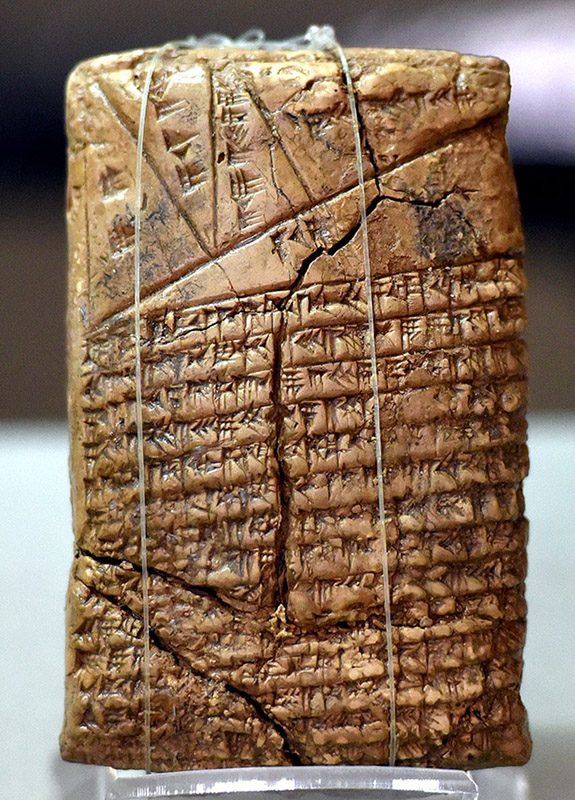
Figure 4.3Babylonians used clay tablets for writing and record keeping.Babylonians used clay tablets for writing and record keeping. (credit: modification of work by Osama Shukir Muhammed Amin FRCP(Glasg), CC BY 4.0 International)
Learning Objectives
After completing this section, you should be able to:
Understand and convert Babylonian numerals to Hindu-Arabic numerals.
Understand and convert Mayan numerals to Hindu-Arabic numerals.
Understand and convert between Roman numerals and Hindu-Arabic numerals.
Each culture throughout history had to develop its own method of counting and recording quantity. The system used in Australia would necessarily differ from the system developed in Babylon that would, in turn, differ from the system developed in sub-Saharan Africa. These differences arose due to cultural differences. In nearly all societies, knowing the difference between one and two would be useful. But it might not be useful to know the difference between 145 and 167, as those quantities never had a practical use. For example, a shepherd likely didn't manage more than 100 sheep, so quantities larger than 100 might never have been encountered. This can even be seen in our use of the term few, which is an inexact quantity that most would agree means more than two. However, as societies became more complex, as commerce arose, as military bodies developed, so did the need for a system to handle large numbers. No matter the system, the issues of representing multiple values and how many symbols to use had to be addressed. In this section, we explore how the Babylonians, Mayans, and Romans addressed these issues.
Understand and Convert Babylonian Numerals to Hindu-Arabic Numerals
The Babylonians used a mix of an additive system of numbers and a positional system of numbers. An additive system is a number system where the value of repeated instances of a symbol is added the number of times the symbol appears. A positional system is a system of numbers that multiplies a “digit” by a number raised to a power, based on the position of the “digit.”
The Babylonian place values didn’t use powers of 10, but instead powers of 60. They didn’t use 60 different symbols though. For the value 1, they used the following symbol:
For values up to 9, that symbol would be repeated, so three would be written as
To represent the quantity 10, they used
For 20, 30, 40, and 50, they repeated the symbol for 10 however many times it was needed, so 40 would be written
When they reached 60, they moved to the next place value. The complete list of the Babylonian numerals up to 59 is in Table 4.1.
Table 4.1
You can see how Babylonians repeated the symbols to indicate multiples of a value. The number 6 is 6 of the symbol for 1 grouped together. The symbol for 30 is three of the symbols for 10 grouped together. However, their system doesn’t go past 59. To go past 59, they used place values. As opposed to the Hindu-Arabic system, which was based on powers of 10, the Babylonian positional system was based on powers of 60. You should also notice there is no symbol for 0, which has some impact on the number system. Since the Babylonian number system lacked a 0, they didn’t have a placeholder when a power of 60 was absent. Without a 0, 101, 110, and 11 all look the same. However, there is some evidence that the Babylonians left a small space between "digits" where we would use a 0, allowing them to represent the absence of that place value. To summarize, the Babylonian system of numbers used repeating a symbol to indicate more than one, used place values, and lacked a 0.
So how do we convert from Babylonian numbers to Hindu-Arabic numbers? To do so, we need to use the symbols from Table 4.1, and then place values based on powers of 60. If you have digits in the Babylonian number, you multiply the first “digit” by 60 raised to one less than the number of “digits.” You then continue through the “digits,” multiplying each by 60 raised to a power that is one smaller. However, be careful of spaces, since they represent a zero in that place.
Understand and Convert Mayan Numerals to Hindu-Arabic Numerals
The Mayans employed a positional system just as we do and the Babylonians did, but they based their position values on powers of 20 and they had a dedicated symbol for zero. Similar to the Babylonians, the Mayans would repeat symbols to indicate certain values. A single dot was a 1, two dots were a 2, up to four dots. Then a five was a horizontal bar. The horizontal bars could be used three times, since the fourth horizontal bar would make a 20, which was a new position in the number. The 0 was a special picture, which appears like a turtle lying on its back. The shell would then be "empty," so maybe that’s why the symbol was 0. The complete list is provided in Table 4.2. Another feature of Mayan numbers was that they were written vertically. The powers of 20 increased from bottom to top.
Table 4.2
To summarize, the Mayan system of numbers used repeating symbol to indicate more than one, used place values, and employed a 0. So how do we convert from Mayan numbers to Hindu-Arabic numbers? To do so, we need to use the symbols from Table 4.2 and then place values based on powers of 20. If you have digits in the Mayan number, you multiply the first “digit” by 20 raised to one less than the number of “digits.” You then continue through the “digits,” multiplying each by 20 raised to a power that is one smaller than the previous power. Fortunately, there is an explicit 0, so there is no ambiguity about numbers like 110, 101, and 11.
Understand and Convert Between Roman Numerals and Hindu-Arabic Numerals
The Mayan and Babylonian systems shared two features, one of which we are familiar with (place value) and one that we don’t use (repeated symbols). The Roman system of numbers used repeated symbols, but does not employ a place value. It also lacks a 0. The Roman system is built on the following symbols in Table 4.3.
Table 4.3
Roman Numeral
Hindu-Arabic Value
I
1
V
5
X
10
L
50
C
100
D
500
M
1,000
As in the Mayan and Babylonian systems, a symbol may be repeated to indicate a larger value. However, at 4, they did not use IIII. They instead used IV. Since the I came before the V, the number stands for “one before five.” A similar process was used for 9, which was written IX, or “one before ten.” The value 40 was written XL, or “ten before fifty,” while 49 was written XLIX, or “forty plus nine.”
The following are the rules for writing and reading Roman numerals.
The representations for bigger values precede those for smaller values.
Up to three symbols may be grouped together; for example, III for 3, or XXX for 30, or CC for 200.
A larger value followed by a smaller value indicated addition; for example, VII for 7, XIII for 13, LV for 55, and MCC for 1200.
I can be placed before V to indicate 4, or before X, to indicate 9. These are the only ways I is used as a subtraction.
X can be placed before L to indicate 40, and before C to indicate 90. These are the only ways X is used as a subtraction.
C can be placed before D to indicate 400, and before M to indicate 900. These are the only ways C is used as a subtraction.
If multiple symbols are used, and a subtraction involving that symbol, the subtraction part comes after the multiple symbols. For example, XXIX for 29 and CCXC for 290.
Of course, we can convert from Hindu-Arabic numerals, to Roman numerals, too.
Key Terms
additive system of numbers
positional system of numbers
Babylonian system of numbers
Mayan system of numbers
Roman system of numbers
Key Concepts
Historically, there have been many systems for numbering. One system is an additive system, in which symbols are repeated to express larger numbers. Another system is a positional system, in which the digits and their positions determine the quantity being represented.
The Babylonian system was a combination of a positional and additive system. It used 60 as its base. Using that in the positional system makes it possible to convert between Babylonian and Hindu-Arabic numbers.
The Mayan system was a combination of a positional and additive system. It used 20 as its base. Using that in the positional system makes it possible to convert between Mayan and Hindu-Arabic numbers.
The Roman system was an additive system. Knowing what each symbol represents makes it possible to convert between Roman and Hindu-Arabic numbers.
Adapted from Contemporary Mathematics by OpenStax (openstax.org), licensed under CC BY-NC-SA 4.0. Changes were made. License: CC-BY-NC-SA-4.0.
These eBooks are a prerelease and are not yet certified conformant with WCAG 2.1 AA or ADA Title II. Every page is built against an automated accessibility gate, and the published editions will meet ADA Title II requirements when they release in late September 2026. If something is unusable, please tell us.