
4.3 Converting with Base Systems
Learning Objectives
After completing this section, you should be able to:
- Convert another base to base 10.
- Write numbers in different base systems.
- Convert base 10 to other bases.
- Determine errors in converting between bases.
In our system of numbers, we use base 10, but using base 10 was not a given within other systems. There were other systems that used bases other than 10, as we saw with the Mayans and the Babylonians. The base 10 system comes down to grouping objects in sets of 10, but grouping in sets of 10 only happens if the culture values grouping by that many. We feel 10 is natural because we have 10 fingers. There are other systems using other grouping values, such as 4 or 20.
One good reason for examining other bases is to remind ourselves how we had to learn arithmetic when we were young, memorizing rules for our base 10 system. We had to learn why those arithmetic rules made sense, such as why and . Another good reason for learning other base systems is due to computers; their circuitry instead uses base 2.
In this section, we explore other base systems and how to convert between them.
Conversion of Another Base into Base 10 and Other Bases
We saw in Hindu-Arabic Positional System that our Hindu-Arabic system uses base 10, which is a system using place values of digits that depend on powers of 10 (or, are based on powers of 10). We’ve already worked with bases other than base 10: The Babylonian system was base 60, while the Mayan system was base 20.
To explore how our base 10 system is used, answer the following question: What’s the following quantity: 4,572? You probably said four thousand five hundred seventy-two (no, there is no “and” between hundred and seventy). But why do you think that 4 means four thousand? A very young person when learning their numbers might say that’s a four five seven and two. But you added the context of thousands to the four. Why?
Place value, that’s why. You learned early on that where the numeral was gave it different meanings. Ten thousands, thousands, hundreds, tens, and ones. So, you translate that symbol string (4,572) into “four thousand five hundred seventy-two.” As we saw in Hindu-Arabic Positional System, expanding a Hindu-Arabic number involved writing the number using each digit times its appropriate power of 10. So, we could write 4,572 as .
One possible reason we use base 10 is that we have 10 fingers, and in the cultures where the Hindu-Arabic system developed, that became the standard. Other cultures may have used other ways of organizing numbers, perhaps using 20 by including toes, or using 60 because 60 has many divisors. Mathematically though, base 10 is an awkward base to work in since 10 has limited divisors. But we think it is easy and simple because that’s what we’ve been taught to use.
Using a base 10 system means we need 10 symbols to make our numbering system work: 0, 1, 2, 3, 4, 5, 6, 7, 8, 9.
Now imagine that we all only had 6 fingers instead of 10 and our counting system was based on those 6 fingers. We would be counting in groups of 6, not groups of 10. How would this change how we work with quantity?
First, we’d need only six symbols. Let’s use 0, 1, 2, 3, 4, 5. Second, our place values would be based on powers of 6, not powers of 10. For instance, the number 3,024 in base 6 would be . That is how you can translate a base 6 number into a base 10 number. When we calculate that expression we get .
This means the base 6 number 3,024 is equal to the base 10 number 664.
From now on, if we are using a base 6 number, we will follow it with the subscript 6, like the following: 3,0246 means the number is in base 6.
A base 10 number gets no subscript (it’s the standard). So, 3,024 is a base 10 number. A base 13 number would be 4,67213.
So, a base 6 system uses only the symbols 0, 1, 2, 3, 4, and 5. Also, the place values use powers of 6. However, we still don’t know how to count in base 6. In order to do so, we’d have to know how to represent the quantities larger than five in base 6. Let’s review how our base 10 system works by counting from 0 to 100, which shows how larger values are represented.
In writing the base 10 numbers, you start with these first 10 values:
| 0 | 1 | 2 | 3 | 4 | 5 | 6 | 7 | 8 | 9 |
But you’ve run out of symbols. So, we use two digits:
| 10 | 11 | 12 | 13 | 14 | 15 | 16 | 17 | 18 | 19 |
The 1 out front means you’ve run out of digits one time.
But now you’ve run out twice. Continuing with those numbers gives:
| 20 | 21 | 22 | 23 | 24 | 25 | 26 | 27 | 28 | 29 |
And so on,
| 30 | 31 | 32 | 33 | 34 | etc.… |
Eventually, you hit the 90s,
| 90 | 91 | 92 | 93 | 94 | 95 | 96 | 97 | 98 | 99 |
And you’ve run out of the digits again! So, we say we’ve run out of digits in the tens place one time, hence:
| 100 | 101 | 102 | 103 | 104 | 105 | 106 | 107 | 108 | 109 |
That’s the pattern we use in base 10. We write out the symbols until we’ve used all the symbols, then add a digit in front that counts how many times we’ve used the digits. Knowing the numbers, or being able to count higher and higher, is necessary to understand how all the arithmetic works, as it all goes back to counting.
The counting pattern is the same for any other base, including base 6. So, let’s start:
| 0 | 1 | 2 | 3 | 4 | 5 |
But we’ve run out of symbols! Just like in base 10, we use a second digit, where the first digit will tell us we’ve run out of symbols one time.
| 10 | 11 | 12 | 13 | 14 | 15 |
And we use the same pattern:
| 20 | 21 | 22 | 23 | 24 | 25 |
|---|---|---|---|---|---|
| 30 | 31 | 32 | 33 | 34 | 35 |
| 40 | 41 | 42 | 43 | 44 | 45 |
| 50 | 51 | 52 | 53 | 54 | 55 |
But we’ve run out of symbols for that front digit. So, we indicate it the same way as in base 10…by adding a third digit in front, indicating we’ve run out of symbols once in the second place:
| 100 | 101 | 102 | 103 | 104 | 105 |
|---|---|---|---|---|---|
| 110 | 111 | etc. |
The symbol pattern is the same, but truncated. We only use the six symbols. So that is how we represent base 6. Being able to write out these numbers is important when working with addition in the base.
When using a base larger than 10, though, we need more symbols. Instead of creating new symbols, we use capital letters, with A representing the digit for "10," B representing the digit for "11," and so on.
Base 2 is important in the digital age, as it is the system used by computers. It is the simplest base to work with, but has the drawback that the numbers in base 2 may use many, many digits. In Addition and Subtraction in Base Systems and Multiplication and Division in Base Systems, we will look at base 2 in each situation.
Conversion of Base 10 into Another Base
Converting from base 10 into another base uses repeated division, recording the remainder at each step. Then, the number in the new base is the remainder starting from the last remainder found. To be accurate in what we’re saying, we need to remind ourselves of some terminology associated with division. When integers are divided, the one being divided is the dividend, and the one that is dividing the dividend is the divisor. The quotient is the largest natural number that can be multiplied by the divisor where the product is less than the dividend.
When the integer is divided by the integer , is called the dividend and is the divisor.
To convert a base 10 number into base , we divide by , recording the remainder. Then we divide the quotient from that step by the base , and record the remainder again. We continue this process until the quotient is 0. Then, the base number has digits that start with the last remainder and use each remainder in reverse order.
Converting from Hindu-Arabic Numbers to Mayan Numbers
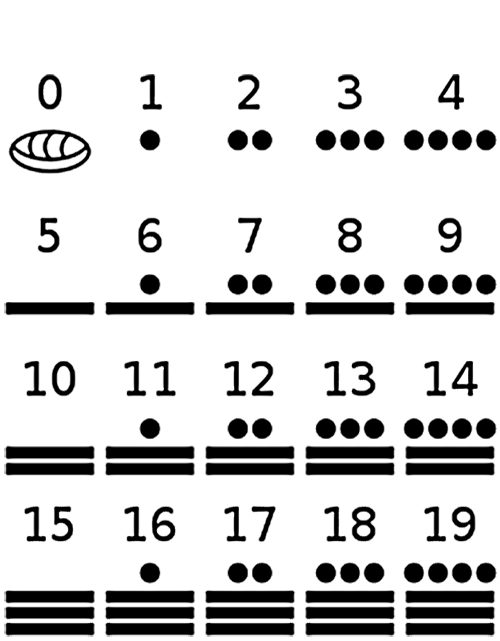
To convert from a Hindu-Arabic number to a Mayan number involves two distinct processes. First, the number must be converted to base 20, using the process described and demonstrated previously. Next, that base 20 number has to be written using Mayan numerals. For reference, the Mayan numerals and their values are below.
Errors in Converting Between Bases
There are some common errors that are made when converting between bases. Often, it comes down to using an “illegal” symbol in the new base.
When converting from base 10 to another base, an illegal symbol will be used if a mistake was made in the division process used to find the number in the new base. Since the digits are based on the remainders, any remainder that is an illegal symbol would indicate an error.
Another possible way to detect an error in converting between bases is to count the number of digits. When converting from a higher base to a lower base, the number of digits cannot get smaller. Similarly, when converting from a lower base to a higher base, the number of digits cannot get bigger. So, if a base 10 number is converted to a base 3 number, the number of digits in the new base 3 numbers cannot be less than the number of digits in the base 10 number. Similarly, if a base 7 number is converted to base 10, the number of digits in the base 10 number cannot be more than the number of digits in the original base 7 number.
The Babylonian system used base 60. To convert from Hindu Arabic numbers into Babylonian numbers, the process for converting from base 10 to a different base would be done first. Then, the results found in the conversion process would be changed to Babylonian numerals. This process is similar to the one for Mayan numbers.
Key Terms
- base 10
- remainder
- dividend
- divisor
- quotient
Key Concepts
- The system we use is the base 10 system. Base 10 is not the only base that can be used. To use another base, one could start with a list of numbers in that base.
- To indicate that a number is written in a base other than 10, a subscript is appended to the end of the number. That subscript indicates the base for the number.
- Numbers written in a base smaller than 10 use the same symbols as base 10. However, when using bases larger than 10, the symbols A, B, C, … are used to represent digits larger than 9.
- To convert from a number written in a base other than 10 into a base 10 number, the number is written in expanded form and then that expression is computed.
- To convert a number from base 10 into another base, the base 10 number is repeatedly divided by the new base. The remainders when performing these divisions become the digits for the number in the new base.
- Common errors can be detected when performing base conversions.
Videos
Adapted from Contemporary Mathematics by OpenStax (openstax.org), licensed under CC BY-NC-SA 4.0. Changes were made. License: CC-BY-NC-SA-4.0.