
2.7 Logical Arguments
Learning Objectives
After completing this section, you should be able to:
- Apply the law of detachment to determine the conclusion of a pair of statements.
- Apply the law of denying the consequent to determine the conclusion for pairs of statements.
- Apply the chain rule to determine valid conclusions for pairs of true statements.
The previous sections of this chapter provide the foundational skills for constructing and analyzing logical arguments. All logical arguments include a set of premises that support a claim or conclusion; but not all logical arguments are valid and sound. A logical argument is valid if its conclusion follows from the premises, and it is sound if it is valid and all of its premises are true. A false or deceptive argument is called a fallacy. Many types of fallacies are so common that they have been named.
This section focuses on the two main forms that logical arguments can take. While inductive arguments attempt to draw a more general conclusion from a pattern of specific premises, deductive arguments attempt to draw specific conclusions from at least one or more general premises. Deductive arguments can be proven to be valid using Venn diagrams or truth tables.
Inductive arguments generally cannot be proven to be true. They are judged as being strong or weak, but, like any opinion, whether you believe an argument is strong or weak often depends on your knowledge of the topic being discussed along with the evidence being provided in the premises. Hasty generalization is the name given to any fallacy that presents a weak inductive argument.
Law of Detachment
The law of detachment is a valid form of a conditional argument that asserts that if both the conditional, , and the hypothesis, , are true, then the conclusion must also be true. The law of detachment is also called affirming the hypothesis (or antecedent) and modus ponens. Symbolically, it has the form .
| Law of Detachment | |
|---|---|
| Premise: | |
| Premise: | |
| Conclusion: | |
Looking at the truth table for the conditional statement, the only time the conditional is true is when the hypothesis is also true. The only place this happens is in the first row, where is also true, confirming that the law of detachment is a valid argument.
| T | T | T |
| T | F | F |
| F | T | T |
| F | F | T |
Another way to verify that the law of detachment is a valid argument is to construct a truth table for the argument and verify that it is a tautology.
| T | T | T | T | T |
| T | F | F | F | T |
| F | T | T | F | T |
| F | F | T | F | T |
Venn diagrams may also be used to verify deductive arguments, which include conditional premises. Consider the statement “If you play guitar, then you are a musician.” The set of guitarists is a subset of the set of musicians, To verify that an argument is valid using a Venn diagram, draw the Venn diagram representing all the premises in the argument only, as shown in Figure 2.16. Then verify if the conclusion is also represented by the Venn diagram of the premises. If it is, the argument is valid. If it is not, the argument is not valid. The set of guitarists is drawn as a subset of the set of musicians to represent the premise, The represents the premise: is true. This completes the drawing of the premises.
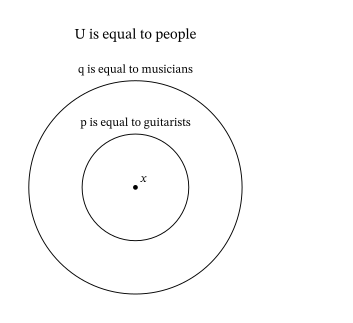
Now, examine the Venn diagram to verify if the conclusion is included in the picture. The conclusion is . Because the is in the set , and is a subset of , is also in ; therefore, the law of detachment is a valid argument.
Law of Denying the Consequent
Another form of a valid conditional argument is called the law of denying the consequent, or modus tollens. Recall, that the conditional statement, , is logically equivalent to the contrapositive, So, if the conditional statement is true, then the contrapositive statement is also true. By the law of detachment, if is also true, then it follows that must also be true. Symbolically, it has the form .
| Law of Denying the Consequent | |
|---|---|
| Premise: | |
| Premise: | |
| Conclusion: | |
To verify if the law of denying the consequent is a valid argument, construct a truth table for the argument, , and verify that it is a tautology.
| T | T | F | F | T | F | T |
| T | F | F | T | F | F | T |
| F | T | T | F | T | F | T |
| F | F | T | T | T | T | T |
To verify an argument of this form using a Venn diagram, again consider the premise: “If you play guitar, then you are a musician.” We will change the second premise to In this case, the represents the premise, So, it will be placed inside the universal set of all people, but outside the set of musicians, as depicted in the Venn diagram in Figure 2.17.
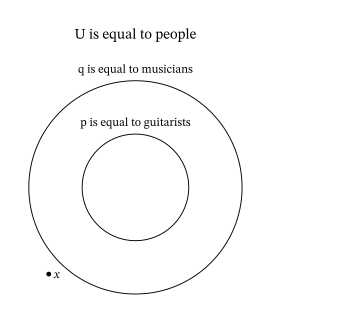
Because the is also outside the set of guitarists, the statement follows from the premises and the argument is valid.
Chain Rule for Conditional Arguments
The chain rule for conditional arguments is another form of a valid conditional argument. It is also called hypothetical syllogism or the transitivity of implication. Recall that the conditional statement can also be read as implies . This is where the name transitivity of implication comes from. The transitive property for numbers states that, if and then it follows that The chain rule extends this property to conditional statements. If the premises of the argument consist of two conditional statements, with the form “” and “” then it follows that Symbolically, it has the form .
| Chain Rule for Conditional Arguments | |
|---|---|
| Premise: | |
| Premise: | |
| Conclusion: | |
To verify the chain rule for conditional arguments, construct a truth table for the argument, , and verify that it is a tautology.
| T | T | T | T | T | T | T | T |
| T | T | F | T | F | F | F | T |
| T | F | T | F | T | F | T | T |
| T | F | F | F | T | F | F | T |
| F | T | T | T | T | T | T | T |
| F | T | F | T | F | F | T | T |
| F | F | T | T | T | T | T | T |
| F | F | F | T | T | T | T | T |
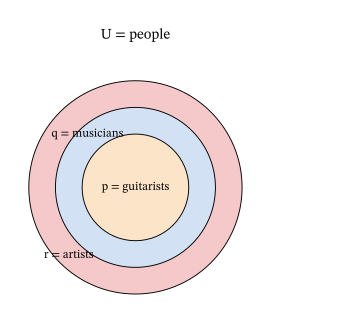
To verify an argument of this form using a Venn diagram, again consider the premise “If you play guitar, then you are a musician,” but change the second premise to “If you are a musician, then you are an artist.” In this case, the set of guitarists is a subset of the set of artists, and it follows that if you are a guitarist, then you are an artist. Therefore, the conclusion follows from the premises and the chain rule for logical arguments is valid. See Figure 2.18.
Projects
Logic Gates
Logic gates are the basis for all digital circuits.
- Research and document the following terms: logic gate, OR gate, AND gate, and NOT gate.
- Construct a diagram of a NAND gate, NOR gate, and a XOR gate by using at least two of the following gates: AND, OR, and NOT.
- Digital electronics use a 1 for true or on, and a 0 for false or off. Create a truth table documenting all possible cases using 0s and 1s for the NAND gate, NOR gate and XOR gate.
- Use a truth table to explain how XOR is related to the biconditional statement.
Logical Fallacies
Fallacies are false or deceptive logical arguments.
- Research and document the structure of five of the following named fallacies: hasty generalization, limited choice, false cause, appeal to popularity, appeal to emotion, appeal to authority, personal attack, gamblers' ruin, slippery slope, and circular reasoning.
- Create a presentation highlighting one of the five fallacies researched in the previous question. The presentation must include an introductory slide with the title of the fallacy and the form or structure of the argument. The second slide must include an example of this fallacy as used in a commercial, a political cartoon or a current event or new article. The third slide must include an explanation of why the example on slide to is a representative example of the fallacy. The last slide must include citations for any materials used. No textbooks should be used as reference.
Careers in Logic
Lawyers, mathematicians, and computer programmers are a few of the careers that require knowledge of logic.
- What career are you interested in? Research how knowledge of logic applies to your chosen field of study. Then, write a cover letter for a position in your field you'd like to apply to. In the cover letter, include how your knowledge of logic qualifies you for the position you are applying for. If you do not think logic is important for your given career choice, find a position where logic is an essential element of the position and complete the project by pretending you are writing a cover letter for that job.
Key Terms
- sound
- fallacy
- deductive arguments
- law of detachment
- law of denying the consequent
- chain rule for conditional arguments
Key Concepts
- A logical argument uses a series of facts or premises to justify a conclusion or claim. It is valid if its conclusion follows from the premises, and it is sound if it is valid, and all of its premises are true.
- The law of detachment is a valid form of a conditional argument that asserts that if both the conditional, is true and the hypothesis, is true, then the conclusion must also be true.
Law of Detachment Premise: Premise: Conclusion: - Know how to apply the law of detachment to determine the conclusion of a pair of statements.
- The law of denying the consequent is a valid form of a conditional argument that asserts that if both the conditional, is true and the negation of the conclusion, is true, then the negation of the hypothesis must also be true.
Law of Denying the Consequent Premise: Premise: Conclusion: - Know how to apply the law of denying the consequent to determine the conclusion for pairs of statements.
- The chain rule for conditional arguments is a valid form of a conditional argument that asserts that if the premises of the argument have the form, and , then it follows that
Chain Rule for Conditional Arguments Premise: Premise: Conclusion: - Know how to apply the chain rule to determine valid conclusions for pairs of true statements.
Video
Adapted from Contemporary Mathematics by OpenStax (openstax.org), licensed under CC BY-NC-SA 4.0. Changes were made. License: CC-BY-NC-SA-4.0.