
2.2 Compound Statements

Learning Objectives
After completing this section, you should be able to:
- Translate compound statements into symbolic form.
- Translate compound statements in symbolic form with parentheses into words.
- Apply the dominance of connectives.
Suppose your friend is trying to get a license to drive. In most places, they will need to pass some form of written test proving their knowledge of the laws and rules for driving safely. After passing the written test, your friend must also pass a road test to demonstrate that they can perform the physical task of driving safely within the rules of the law.
Consider the statement: "My friend passed the written test, but they did not pass the road test." This is an example of a compound statement, a statement formed by using a connective to join two independent clauses or logical statements. The statement, “My friend passed the written test,” is an independent clause because it is a complete thought or idea that can stand on its own. The second independent clause in this compound statement is, “My friend did not pass the road test.” The word "but" is the connective used to join these two statements together, forming a compound statement. So, did your friend acquire their driving license?.
This section introduces common logical connectives and their symbols, and allows you to practice translating compound statements between words and symbols. It also explores the order of operations, or dominance of connectives, when a single compound statement uses multiple connectives.
Common Logical Connectives
Understanding the following logical connectives, along with their properties, symbols, and names, will be key to applying the topics presented in this chapter. The chapter will discuss each connective introduced here in more detail.
The joining of two logical statements with the word "and" or "but" forms a compound statement called a conjunction. In logic, for a conjunction to be true, all the independent logical statements that make it up must be true. The symbol for a conjunction is . Consider the compound statement, “Derek Jeter played professional baseball for the New York Yankees, and he was a shortstop.” If represents the statement, “Derrick Jeter played professional baseball for the New York Yankees,” and if represents the statement, “Derrick Jeter was a short stop,” then the conjunction will be written symbolically as
The joining of two logical statements with the word “or” forms a compound statement called a disjunction. Unless otherwise specified, a disjunction is an inclusive or statement, which means the compound statement formed by joining two independent clauses with the word or will be true if a least one of the clauses is true. Consider the compound statement, "The office manager ordered cake for for an employee’s birthday or they ordered ice cream.” This is a disjunction because it combines the independent clause, “The office manager ordered cake for an employee’s birthday,” with the independent clause, “The office manager ordered ice cream,” using the connective, or. This disjunction is true if the office manager ordered only cake, only ice cream, or they ordered both cake and ice cream. Inclusive or means you can have one, or the other, or both!
Joining two logical statements with the word implies, or using the phrase “if first statement, then second statement,” is called a conditional or implication. The clause associated with the "if" statement is also called the hypothesis or antecedent, while the clause following the "then" statement or the word implies is called the conclusion or consequent. The conditional statement is like a one-way contract or promise. The only time the conditional statement is false, is if the hypothesis is true and the conclusion is false. Consider the following conditional statement, “If Pedro does his homework, then he can play video games.” The hypothesis/antecedent is the statement following the word if, which is “Pedro does/did his homework.” The conclusion/consequent is the statement following the word then, which is “Pedro can play his video games.”
Joining two logical statements with the connective phrase “if and only if” is called a biconditional. The connective phrase "if and only if" is represented by the symbol, In the biconditional statement, is called the hypothesis or antecedent and is called the conclusion or consequent. For a biconditional statement to be true, the truth values of and must match. They must both be true, or both be false.
The table below lists the most common connectives used in logic, along with their symbolic forms, and the common names used to describe each connective.
| Connective | Symbol | Name |
|---|---|---|
| and but | conjunction | |
| or | disjunction, inclusive or | |
| not | ~ | negation |
| if , then implies | conditional, implication | |
| if and only if | biconditional |
Translating Compound Statements to Symbolic Form
To translate a compound statement into symbolic form, we take the following steps.
- Identify and label all independent affirmative logical statements with a lower case letter, such as , , or .
- Identify and label any negative logical statements with a lowercase letter preceded by the negation symbol, such as , , or .
- Replace the connective words with the symbols that represent them, such as
Consider the previous example of your friend trying to get their driver’s license. Your friend passed the written test, but they did not pass the road test. Let represent the statement, “My friend passed the written test.” And, let represent the statement, “My friend did not pass the road test.” Because the connective but is logically equivalent to the word and, the symbol for but is the same as the symbol for and; replace but with the symbol The compound statement is symbolically written as: . My friend passed the written test, but they did not pass the road test.
Translating Compound Statements in Symbolic Form with Parentheses into Words
When parentheses are written in a logical argument, they group a compound statement together just like when calculating numerical or algebraic expressions. Any statement in parentheses should be treated as a single component of the expression. If multiple parentheses are present, work with the inner most parentheses first.
Consider your friend’s struggles to get their license to drive. Let represent the statement, “My friend passed the written test,” let represent the statement, “My friend passed the road test,” and let represent the statement, “My friend received a driver’s license.” The statement can be translated into words as follows: the statement is grouped together to form the hypothesis of the conditional statement and is the conclusion. The conditional statement has the form “if then ” Therefore, the written form of this statement is: “If my friend passed the written test and they passed the road test, then my friend received a driver’s license.”
Sometimes a compound statement within parentheses may need to be negated as a group. To accomplish this, add the phrase, “it is not the case that” before the translation of the phrase in parentheses. For example, using , , and of your friend obtaining a license, let’s translate the statement into words.
In this case, the hypothesis of the conditional statement is and the conclusion is To negate the hypothesis, add the phrase “it is not the case” before translating what is in parentheses. The translation of the hypothesis is the sentence, “It is not the case that my friend passed the written test and they passed the road test,” and the translation of the conclusion is, “My friend did not receive a driver’s license.” So, a translation of the complete conditional statement, is: “If it is not the case that my friend passed the written test and the road test, then my friend did not receive a driver’s license.”
The Dominance of Connectives
The order of operations for working with algebraic and arithmetic expressions provides a set of rules that allow consistent results. For example, if you were presented with the problem , and you were not familiar with the order of operation, you might assume that you calculate the problem from left to right. If you did so, you would add 1 and 3 to get 4, and then multiply this answer by 2 to get 8, resulting in an incorrect answer. Try inputting this expression into a scientific calculator. If you do, the calculator should return a value of 7, not 8.
The order of operations for algebraic and arithmetic operations states that all multiplication must be applied prior to any addition. Parentheses are used to indicate which operation—addition or multiplication—should be done first. Adding parentheses can change and/or clarify the order. The parentheses in the expression indicate that 3 should be multiplied by 2 to get 6, and then 1 should be added to 6 to get 7:
As with algebraic expressions, there is a set of rules that must be applied to compound logical statements in order to evaluate them with consistent results. This set of rules is called the dominance of connectives. When evaluating compound logical statements, connectives are evaluated from least dominant to most dominant as follows:
- Parentheses are the least dominant connective. So, any expression inside parentheses must be evaluated first. Add as many parentheses as needed to any statement to specify the order to evaluate each connective.
- Next, we evaluate negations.
- Then, we evaluate conjunctions and disjunctions from left to right, because they have equal dominance.
- After evaluating all conjunctions and disjunctions, we evaluate conditionals.
- Lastly, we evaluate the most dominant connective, the biconditional. If a statement includes multiple connectives of equal dominance, then we will evaluate them from left to right.
See Figure 2.7 for a visual breakdown of the dominance of connectives.
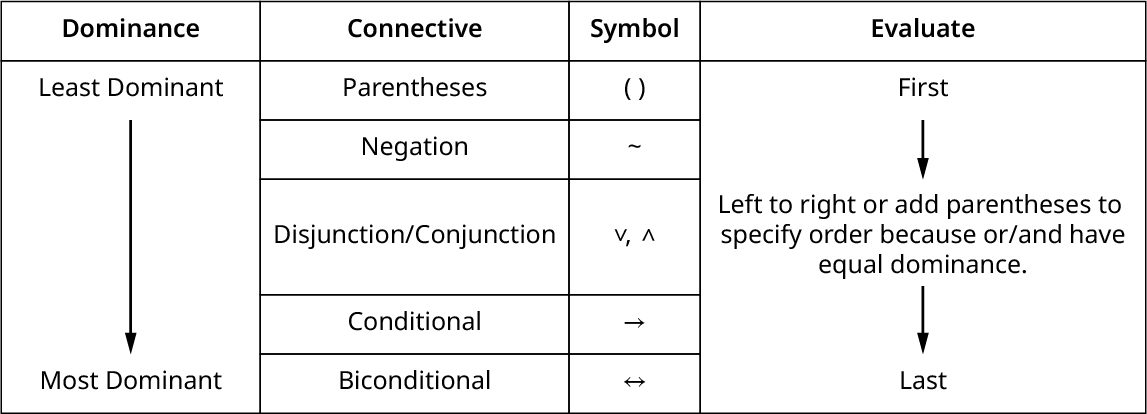
Let’s revisit your friend’s struggles to get their driver’s license. Let represent the statement, “My friend passed the written test,” let represent the statement, “My friend passed the road test,” and let represent the statement, “My friend received a driver’s license.” Let's use the dominance of connectives to determine how the compound statement should be evaluated.
Step 1: There are no parentheses, which is least dominant of all connectives, so we can skip over that.
Step 2: Because negation is the next least dominant, we should evaluate first. We could add parentheses to the statement to make it clearer which connecting needs to be evaluated first: is equivalent to
Step 3: Next, we evaluate the conjunction, . is equivalent to
Step 4: Finally, we evaluate the conditional, as this is the most dominant connective in this compound statement.
In the first module of this chapter, we evaluated the truth value of negations. In the following modules, we will discuss how to evaluate conjunctions, disjunctions, conditionals, and biconditionals, and then evaluate compound logical statements using truth tables and our knowledge of the dominance of connectives.
Key Terms
- compound statement
- connective
- conjunction
- disjunction
- conditional
- hypothesis
- conclusion
- biconditional
- dominance of connectives
Key Concepts
- Logical connectives are used to form compound logical statements by using words such as and, or, and if …, then.
- A conjunction is a compound logical statement formed by combining two statements with the words “and” or “but.” If the two independent clauses are represented by and , respectively, then the conjunction is written symbolically as . For the conjunction to be true, both and must be true.
- A disjunction joins two logical statements with the or connective. In, logic or is inclusive. For an or statement to be true at least one statement must be true, but both may also be true.
- A conditional statement has the form if , then , where and are logical statements. The only time the conditional statement is false is when is true, and is false.
- The biconditional statement is formed using the connective for the biconditional statement to be true, the true values of and , must match. If is true then must be true, if is false, then must be false.
- Translate compound statements between words and symbolic form.
Connective Symbol Name and
butconjunction or disjunction, inclusive or not ~ negation if , then implies conditional, implication if and only if biconditional - The dominance of connectives explains the order in which compound logical statements containing multiple connectives should be interpreted.
- The dominance of connectives should be applied in the following order
- Parentheses
- Negations
- Disjunctions/Conjunctions, left to right
- Conditionals
- Biconditionals
Figure 2.8
video
Adapted from Contemporary Mathematics by OpenStax (openstax.org), licensed under CC BY-NC-SA 4.0. Changes were made. License: CC-BY-NC-SA-4.0.