5.10 Systems of Linear Inequalities in Two Variables
Figure 5.86Many college students find part-time jobs at places such as coffee shops to help pay for college.Many college students find part-time jobs at places such as coffee shops to help pay for college. (credit: modification of work “TULLY’s COFFEE” by MIKI Yoshihito/Flickr, CC BY 2.0)
Learning Objectives
After completing this section, you should be able to:
Demonstrate whether an ordered pair is a solution to a system of linear inequalities.
Solve systems of linear inequalities using graphical methods.
Graph systems of linear inequalities.
Interpret and solve applications of linear inequalities.
In this section, we will learn how to solve systems of linear inequalities in two variables. In Systems of Linear Equations in Two Variables, we learned how to solve for systems of linear equations in two variables and found a solution that would work in both equations. We can solve systems of inequalities by graphing each inequality (as discussed in Graphing Linear Equations and Inequalities) and putting these on the same coordinate system. The double-shaded part will be our solution to the system. There are many real-life examples for solving systems of linear inequalities.
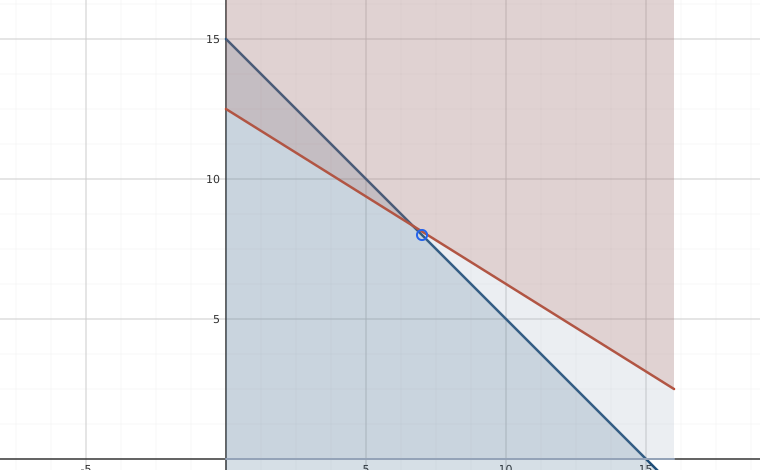
Consider Ming who has two jobs to help her pay for college. She works at a local coffee shop for $7.50 per hour and at a research lab on campus for $12 per hour. Due to her busy class schedule, she cannot work more than 15 hours per week. If she needs to make at least $150 per week, can she work seven hours at the coffee shop and eight hours in the lab?
Interactive figureMing's two jobs: the feasible region of a system of inequalitiesDrag the Earnings target ($) slider from 120 to 200.
XYZ Graph · viewer build 62c52e1
The blue boundary is x + y ≤ 15 and the rust boundary is 7.5x + 12y ≥ target, at the book's default target of $150. The gray boundary is the non-negativity constraint y ≥ 0, and the shading is clipped at x = 0 so only non-negative hours count. Ming's feasible region is where all three shaded bands overlap. The marked point (7, 8) is the opener's question — at $150 it lies on the hours line but below the earnings target, so it is not feasible. Drag the weekly earnings target from 120 to 200: the rust line slides upward and the overlap shrinks toward the single point (0, 15) at $180. Past $180 the three bands no longer share any ground — each is still shaded on its own, but nothing is feasible.
Determining If an Ordered Pair Is a Solution of a System of Linear Inequalities
The definition of a system of linear inequalities is similar to the definition of a system of linear equations. A system of linear inequalities looks like a system of linear equations, but it has inequalities instead of equations. A system of two linear inequalities is shown here.
To solve a system of linear inequalities, we will find values of the variables that are solutions to both inequalities. We solve the system by using the graphs of each inequality and show the solution as a graph. We will find the region on the plane that contains all ordered pairs that make both inequalities true. The solution of a system of linear inequalities is shown as a shaded region in the -coordinate system that includes all the points whose ordered pairs make the inequalities true.
To determine if an ordered pair is a solution to a system of two inequalities, substitute the values of the variables into each inequality. If the ordered pair makes both inequalities true, it is a solution to the system.
Solving Systems of Linear Inequalities Using Graphical Methods
The solution to a single linear inequality was the region on one side of the boundary line that contains all the points that make the inequality true. The solution to a system of two linear inequalities is a region that contains the solutions to both inequalities. We will review graphs of linear inequalities and solve the linear inequality from its graph.
Graphing Systems of Linear Inequalities
We learned that the solution to a system of two linear inequalities is a region that contains the solutions to both inequalities. To find this region by graphing, we will graph each inequality separately and then locate the region where they are both true. The solution is always shown as a graph.
Step 1: Graph the first inequality.
Graph the boundary line.
Shade in the side of the boundary line where the inequality is true.
Step 2: On the same grid, graph the second inequality.
Graph the boundary line.
Shade in the side of that boundary line where the inequality is true.
Step 3: The solution is the region where the shading overlaps.
Step 4: Check by choosing a test point.
Systems of linear inequalities where the boundary lines are parallel might have no solution. We will see this in the next example.
Some systems of linear inequalities where the boundary lines are parallel will have a solution. We will see this in the next example.
Interpreting and Solving Applications of Linear Inequalities
When solving applications of systems of inequalities, first translate each condition into an inequality. Then graph the system, as we did above, to see the region that contains the solutions. Many situations will be realistic only if both variables are positive, so add inequalities to the system as additional requirements.
Key Terms
system of linear inequalities
Key Concepts
To solve a system of linear inequalities means to find the area(s) where the points in that area make all the linear inequalities true.
Systems of linear inequalities can be solved by graphing the linear equations associated with the inequalities, then 'testing' points to see whether the values of the point make the equation true or not.
Videos
Solving Systems of Linear Inequalities by Graphing↗ new tab
Adapted from Contemporary Mathematics by OpenStax (openstax.org), licensed under CC BY-NC-SA 4.0. Changes were made. License: CC-BY-NC-SA-4.0.
These eBooks are a prerelease and are not yet certified conformant with WCAG 2.1 AA or ADA Title II. Every page is built against an automated accessibility gate, and the published editions will meet ADA Title II requirements when they release in late September 2026. If something is unusable, please tell us.