Figure 5.97The aftermath of an earthquake and tsunami.The aftermath of an earthquake and tsunami. (credit: modification of work "Earthquake and Tsunami Japan" by Climate and Ecosystems Change Adaptation Research University Network/Flickr, CC BY 2.0)
Learning Objectives
After completing this section, you should be able to:
Compose an objective function to be minimized or maximized.
Compose inequalities representing a system application.
Apply linear programming to solve application problems.
Imagine you hear about some natural disaster striking a far-away country; it could be an earthquake, a fire, a tsunami, a tornado, a hurricane, or any other type of natural disaster. The survivors of this disaster need help—they especially need food, water, and medical supplies. You work for a company that has these supplies, and your company has decided to help by flying the needed supplies into the disaster area. They want to maximize the number of people they can help. However, there are practical constraints that need to be taken into consideration; the size of the airplanes, how much weight each airplane can carry, and so on. How do you solve this dilemma? This is where linear programming comes into play. Linear programming is a mathematical technique to solve problems involving finding maximums or minimums where a linear function is limited by various constraints.
As a field, linear programming began in the late 1930s and early 1940s. It was used by many countries during World War II; countries used linear programming to solve problems such as maximizing troop effectiveness, minimizing their own casualties, and maximizing the damage they could inflict upon the enemy. Later, businesses began to realize they could use the concept of linear programming to maximize output, minimize expenses, and so on. In short, linear programming is a method to solve problems that involve finding a maximum or minimum where a linear function is constrained by various factors.
Compose an Objective Function to Be Minimized or Maximized
An objective function is a linear function in two or more variables that describes the quantity that needs to be maximized or minimized.
Composing Inequalities Representing a System Application
For our two examples of profit and production, in an ideal world the profit a person makes and/or the number of products a company produces would have no restrictions. After all, who wouldn’t want to have an unrestricted profit? However in reality this is not the case; there are usually several variables that can restrict how much profit a person can make or how many products a company can produce. These restrictions are called constraints.
Many different variables can be constraints. When making or selling a product, the time available, the cost of manufacturing and the amount of raw materials are all constraints. In the opening scenario with the tsunami, the maximum weight on an airplane and the volume of cargo it can carry would be constraints. Constraints are expressed as linear inequalities; the list of constraints defined by the problem forms a system of linear inequalities that, along with the objective function, represent a system application.
Applying Linear Programming to Solve Application Problems
There are four steps that need to be completed when solving a problem using linear programming. They are as follows:
Step 1: Compose an objective function to be minimized or maximized.
Step 2: Compose inequalities representing the constraints of the system.
Step 3: Graph the system of inequalities representing the constraints.
Step 4: Find the value of the objective function at each corner point of the graphed region.
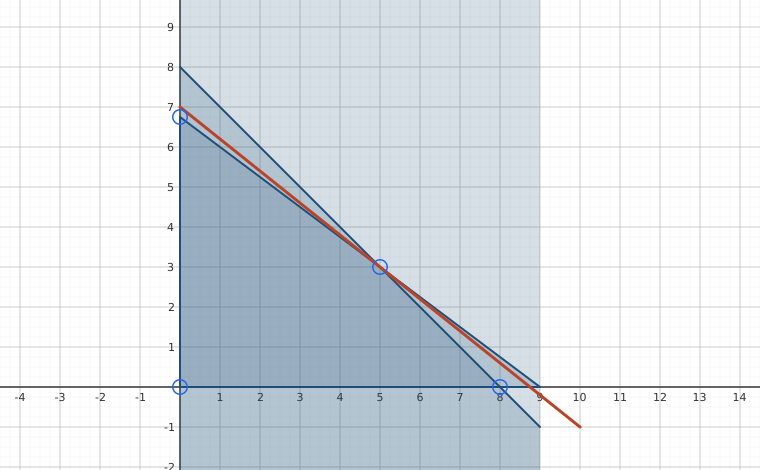
Interactive figureSliding the profit line to the optimal cornerDrag the Profit level P ($) slider from 10 to 80.
XYZ Graph · viewer build 62c52e1
The shaded region is the feasible set for the knitwear linear program: x scarves and y sweaters, with x ≥ 0, y ≥ 0, x + y ≤ 8 items per day, and 3x + 4y ≤ 27 bags of wool. The brick-red line is a profit level 8x + 10y = P; drag P from 10 to 80. Watch it sweep across the region and leave it at the corner (5, 3), the last point it touches, where P = 8(5) + 10(3) = 70, the maximum daily profit.
The first two steps you have already learned. Let’s continue to use the same examples to illustrate Steps 3 and 4.
Key Terms
linear programming
objective function
constraint
Key Concepts
Linear programming is a mathematical technique to solve problems involving finding maximums or minimums where a linear function is limited by various constraints.
An objective function is a linear function in two or more variables that describes the quantity that needs to be maximized or minimized.
In linear programming, a constraint is a restriction that affects the maximum or minimum values of an objective function.
Through the creation of objective functions and restraints, a linear system can be developed and solved through linear programming.
Projects
Ratio and Proportion—Comparing Prices, Part 1
Go to your favorite coffee shops and find out what a same sized drink costs at each. You can do something similar for pizza as well. Find the unit rate (i.e., price per ounce or price per square inch). For example, go to your favorite coffee place and find the price per units on all their large coffee drinks. Or go to your favorite pizza place and compare prices of all their extra-large pizzas (by price per square inch). Write a report on the best deals.
Ratio and Proportion—Comparing Prices, Part 2
Rather than comparing prices of different, but same sized drinks (or pizzas), compare unit prices of the same drinks but of different sizes. Find out what the best bargain is based on price per ounce, price per square inch, etc. For example, compare the prices of your favorite soft drink sold at a local store, but in various sizes (i.e., 12-ounce can, 16-ounce bottle, 20-ounce bottle, 1-liter bottle, and multipacks). Or go to a pizza place and find out what the best bargain is on their menu, based on price per square inch of pizza. Write a report on the best deals.
Systems of Linear Inequalities—Comparing Cell Phone Plans
Go to the websites of different cell phone companies and compare their plans. Write a report on “the best deals. "Best Deals” doesn’t necessarily mean “cheapest.” You will need to look at what each company provides concerning restrictions (constraints) on minutes to talk. What are the constraints on the cell phone coverage for each company? Do they cover your area of the country well? Do they cover the entire United States well, or at least areas where you will be travelling? Is this coverage 5G, or is it less? Can you add a phone easily? Can you bring your previous phone number to this plan? The possibilities of constraints affecting each plan are several. So your task is to determine which plan is best, based on not only cost but also all constraints you deem important.
Adapted from Contemporary Mathematics by OpenStax (openstax.org), licensed under CC BY-NC-SA 4.0. Changes were made. License: CC-BY-NC-SA-4.0.
These eBooks are a prerelease and are not yet certified conformant with WCAG 2.1 AA or ADA Title II. Every page is built against an automated accessibility gate, and the published editions will meet ADA Title II requirements when they release in late September 2026. If something is unusable, please tell us.