Figure 5.15This bar graph shows popular social media app usage. (Source)
Learning Objectives
After completing this section, you should be able to:
Construct ratios to express comparison of two quantities.
Use and apply proportional relationships to solve problems.
Determine and apply a constant of proportionality.
Use proportions to solve scaling problems.
Ratios and proportions are used in a wide variety of situations to make comparisons. For example, using the information from Figure 5.15, we can see that the number of Facebook users compared to the number of Twitter users is 2,006 M to 328 M. Note that the "M" stands for million, so 2,006 million is actually 2,006,000,000 and 328 million is 328,000,000. Similarly, the number of Qzone users compared to the number of Pinterest users is in a ratio of 632 million to 175 million. These types of comparisons are ratios.
Constructing Ratios to Express Comparison of Two Quantities
Note there are three different ways to write a ratio, which is a comparison of two numbers that can be written as: to OR OR the fraction . Which method you use often depends upon the situation. For the most part, we will want to write our ratios using the fraction notation. Note that, while all ratios are fractions, not all fractions are ratios. Ratios make part to part, part to whole, and whole to part comparisons. Fractions make part to whole comparisons only.
Using and Applying Proportional Relationships to Solve Problems
Using proportions to solve problems is a very useful method. It is usually used when you know three parts of the proportion, and one part is unknown. Proportions are often solved by setting up like ratios. If and are two ratios such that then the fractions are said to be proportional. Also, two fractions and are proportional if and only if .
Determining and Applying a Constant of Proportionality
In the last example, we were given that cups of flour could make 60 cookies; we then calculated that cups of flour would make 1,020 cookies, and 720 cookies could be made from 27 cups of flour. Each of those three ratios is written as a fraction below (with the fractions converted to decimals). What happens if you divide the numerator by the denominator in each?
The quotients in each are exactly the same! This number, determined from the ratio of cups of flour to cookies, is called the constant of proportionality. If the values and are related by the equality then is the constant of proportionality between and . Note since then and
One piece of information that we can derive from the constant of proportionality is a unit rate. In our example (cups of flour divided by cookies), the constant of proportionality is telling us that it takes 0.0375 cups of flour to make one cookie. What if we had performed the calculation the other way (cookies divided by cups of flour)?
In this case, the constant of proportionality is telling us that cookies can be made with one cup of flour. Notice in both cases, the "one" unit is associated with the denominator. The constant of proportionality is also useful in calculations if you only know one part of the ratio and wish to find the other.
Using Proportions to Solve Scaling Problems
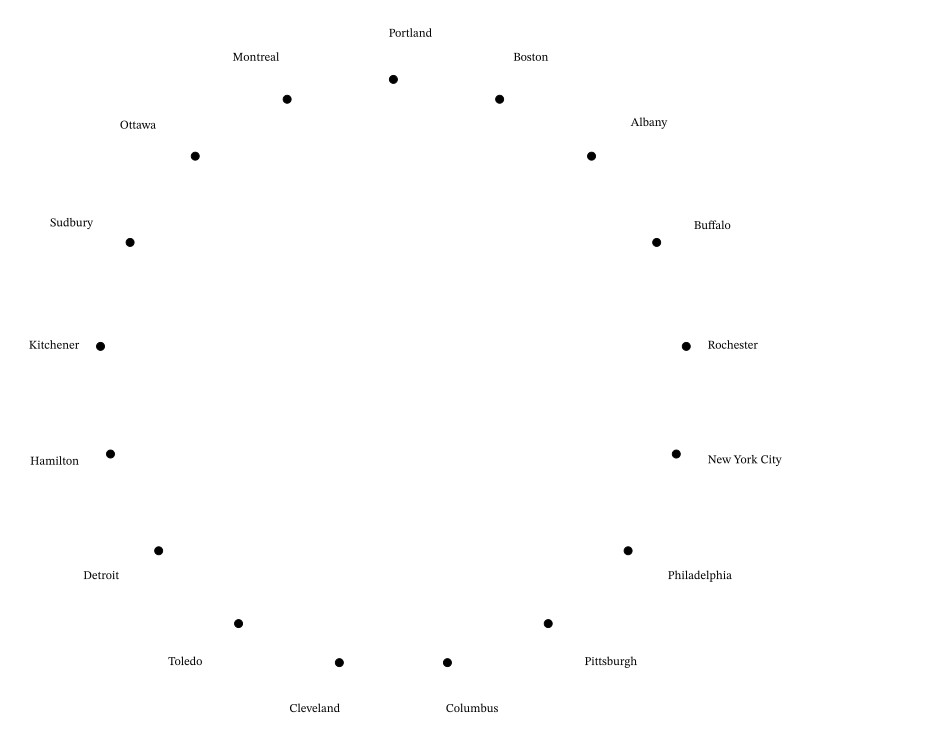
Figure 5.16A map of the northeastern United States
Ratio and proportions are used to solve problems involving scale. One common place you see a scale is on a map (as represented in Figure 5.16). In this image, 1 inch is equal to 200 miles. This is the scale. This means that 1 inch on the map corresponds to 200 miles on the surface of Earth. Another place where scales are used is with models: model cars, trucks, airplanes, trains, and so on. A common ratio given for model cars is 1:24—that means that 1 inch in length on the model car is equal to 24 inches (2 feet) on an actual automobile. Although these are two common places that scale is used, it is used in a variety of other ways as well.
Key Terms
ratio
proportion
constant of proportionality
scale
construct ratios
solve proportions
use proportions to solve scaling problems
Key Concepts
A ratio is a comparison of two numbers. The ratio of two numbers and can be written as: to OR : OR the fraction /.
All fractions are ratios, but not all ratios are fractions. Ratios make part to part, part to whole, and whole to part comparisons. Fractions make part to whole comparisons only.
When two ratios are equal, we say they are in proportion or are proportional.
Setting up proportions allows us to solve many various situations where three of the four values of the proportion are known.
Adapted from Contemporary Mathematics by OpenStax (openstax.org), licensed under CC BY-NC-SA 4.0. Changes were made. License: CC-BY-NC-SA-4.0.
These eBooks are a prerelease and are not yet certified conformant with WCAG 2.1 AA or ADA Title II. Every page is built against an automated accessibility gate, and the published editions will meet ADA Title II requirements when they release in late September 2026. If something is unusable, please tell us.