
7.1 The Multiplication Rule for Counting

Learning Objectives
After completing this section, you should be able to:
- Apply the Multiplication Rule for Counting to solve problems.
One of the first bits of mathematical knowledge children learn is how to count objects by pointing to them in turn and saying: “one, two, three, …” That’s a useful skill, but when the number of things that we need to count grows large, that method becomes onerous (or, for very large numbers, impossible for humans to accomplish in a typical human lifespan). So, mathematicians have developed short cuts to counting big numbers. These techniques fall under the mathematical discipline of combinatorics, which is devoted to counting.
Multiplication as a Combinatorial Short Cut
One of the first combinatorial short cuts to counting students learn in school has to do with areas of rectangles. If we have a set of objects to be counted that can be physically arranged into a rectangular shape, then we can use multiplication to do the counting for us. Consider this set of objects (Figure 7.3):

Certainly we can count them by pointing and running through the numbers, but it’s more efficient to group them (Figure 7.4).
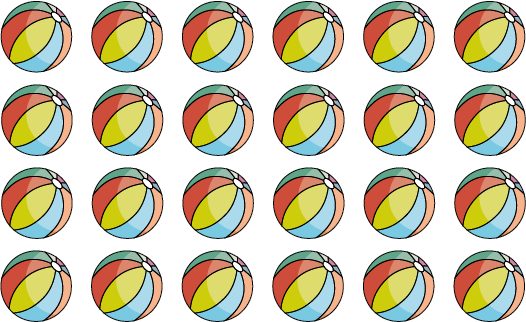
If we group the balls by 4s, we see that we have 6 groups (or, we can see this arrangement as 4 groups of 6 balls). Since multiplication is repeated addition (i.e., ), we can use this grouping to quickly see that there are 24 balls.
Let’s generalize this idea a little bit. Let’s say that we’re visiting a bakery that offers customized cupcakes. For the cake, we have three choices: vanilla, chocolate, and strawberry. Each cupcake can be topped with one of four types of frosting: vanilla, chocolate, lemon, and strawberry. How many different cupcake combinations are possible? We can think of laying out all the possibilities in a grid, with cake choices defining the rows and frosting choices defining the columns (Figure 7.5).

Since there are 3 rows (cakes) and 4 columns (frostings), we have possible combinations. This is the reasoning behind the Multiplication Rule for Counting, which is also known as the Fundamental Counting Principle. This rule says that if there are ways to accomplish one task and ways to accomplish a second task, then there are ways to accomplish both tasks. We can tack on additional tasks by multiplying the number of ways to accomplish those tasks to our previous product.
Key Terms
- combinatorics
- Multiplication Rule for Counting (Fundamental Counting Principle)
Key Concepts
- The Multiplication Rule for Counting is used to count large sets.
Adapted from Contemporary Mathematics by OpenStax (openstax.org), licensed under CC BY-NC-SA 4.0. Changes were made. License: CC-BY-NC-SA-4.0.