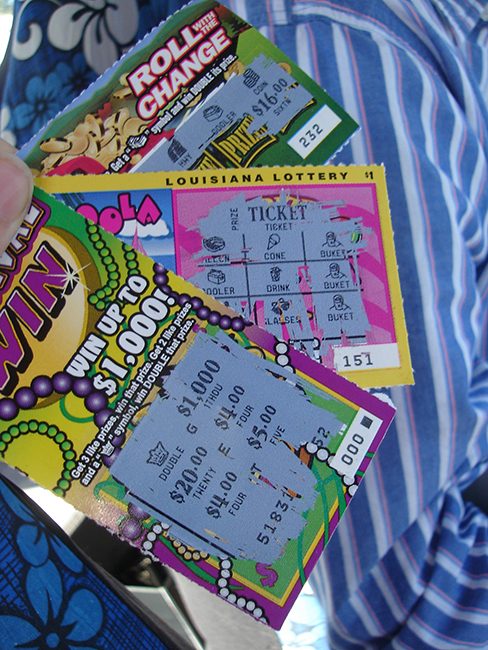
Figure 7.33Scratch-off lottery tickets, as well as many other games, represent the likelihood of winning using odds.Scratch-off lottery tickets, as well as many other games, represent the likelihood of winning using odds. (credit: “My Scratch-off Winnings” by Shoshanah/Flickr, CC BY 2.0)
Learning Objectives
After completing this section, you should be able to:
Compute odds.
Determine odds from probabilities.
Determine probabilities from odds.
A particular lottery instant-win game has 2 million tickets available. Of those, 500,000 win a prize. If there are 500,000 winners, then it follows that there are 1,500,000 losing tickets. When we evaluate the risk associated with a game like this, it can be useful to compare the number of ways to win the game to the number of ways to lose. In the case of this game, we would compare the 500,000 wins to the 1,500,000 losses. In other words, there are 3 losing tickets for every winning ticket. Comparisons of this type are the focus of this section.
Computing Odds
The ratio of the number of equally likely outcomes in an event to the number of equally likely outcomes not in the event is called the odds for (or odds in favor of) the event. The opposite ratio (the number of outcomes not in the event to the number in the event to the number in the event is called the odds against the event.
Odds as a Ratio of Probabilities
We can also think of odds as a ratio of probabilities. Consider again the instant-win game from the section opener, with 500,000 winning tickets out of 2,000,000 total tickets. If a player buys one ticket, the probability of winning is , and the probability of losing is . Notice that the ratio of the probability of winning to the probability of losing is , which matches the odds in favor of winning.
We can use these formulas to convert probabilities to odds, and vice versa.
Now, let’s convert odds to probabilities. Let’s say the odds for an event are . Then, using the formula above, we have . Converting to fractions and solving for , we get:
Let’s put this result in a formula we can use.
Key Terms
odds (for/against)
Key Concepts
Odds are computed as the ratio of the probability of an event to the probability of its compliment.
Formulas
For an event ,
If the odds in favor of are , then .
Adapted from Contemporary Mathematics by OpenStax (openstax.org), licensed under CC BY-NC-SA 4.0. Changes were made. License: CC-BY-NC-SA-4.0.
These eBooks are a prerelease and are not yet certified conformant with WCAG 2.1 AA or ADA Title II. Every page is built against an automated accessibility gate, and the published editions will meet ADA Title II requirements when they release in late September 2026. If something is unusable, please tell us.