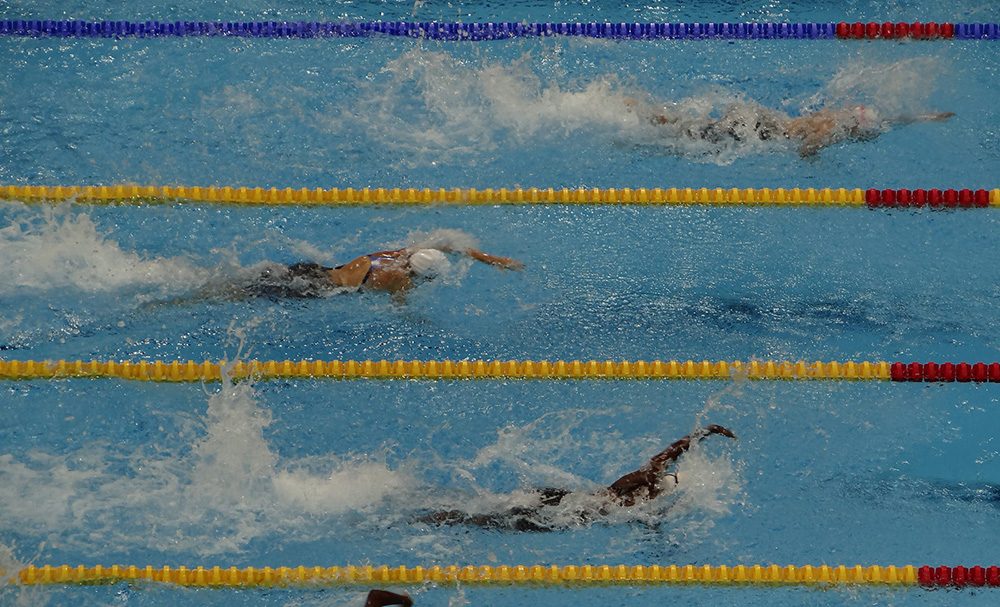
Figure 7.7We can use permutations to calculate the number of different orders of finish in an Olympic swimming heat.We can use permutations to calculate the number of different orders of finish in an Olympic swimming heat. (credit: “London 2012 Olympics Park Stratford London” by Gary Bembridge/Flickr, CC BY 2.0)
Learning Objectives
After completing this section, you should be able to:
Use the Multiplication Rule for Counting to determine the number of permutations.
Compute expressions containing factorials.
Compute permutations.
Apply permutations to solve problems.
Swimming events are some of the most popular events at the summer Olympic Games. In the finals of each event, 8 swimmers compete at the same time, making for some exciting finishes. How many different orders of finish are possible in these events? In this section, we’ll extend the Multiplication Rule for Counting to help answer questions like this one, which relate to permutations. A permutation is an ordered list of objects taken from a given population. The length of the list is given, and the list cannot contain any repeated items.
Applying the Multiplication Rule for Counting to Permutations
In the case of the swimming finals, one possible permutation of length 3 would be the list of medal winners (first, second, and third place finishers). A permutation of length 8 would be the full order of finish (first place through eighth place). Let’s use the Multiplication Rule for Counting to figure out how many of each of these permutations there are.
Factorials
The pattern we see in Example 1 occurs commonly enough that we have a name for it: factorial. For any positive whole number , we define the factorial of (denoted and read " factorial") to be the product of every whole number less than or equal to . We also define 0! to be equal to one. We will use factorials in a couple of different contexts, so let's get some practice doing computations with them.
Permutations
As we’ve seen, factorials can pop up when we’re computing permutations. In fact, there is a formula that we can use to make that connection explicit. Let’s define some notation first. If we have a collection of objects and we wish to create an ordered list of of the objects (where ), we’ll call the number of those permutations (read “the number of permutations of objects taken at a time”). We formalize the formula we'll use to compute permutations below.
If you wondered why we defined earlier, it was to make formulas like this one work; if we have objects and want to order all of them (so, we want the number of permutations of objects taken at a time), we get . Next, we’ll get some practice computing these permutations.
Key Terms
permutation
factorial
Key Concepts
Using the Multiplication Rule for Counting to enumerate permutations.
Simplifying and computing expressions involving factorials.
Using factorials to count permutations.
Formulas
Adapted from Contemporary Mathematics by OpenStax (openstax.org), licensed under CC BY-NC-SA 4.0. Changes were made. License: CC-BY-NC-SA-4.0.
These eBooks are a prerelease and are not yet certified conformant with WCAG 2.1 AA or ADA Title II. Every page is built against an automated accessibility gate, and the published editions will meet ADA Title II requirements when they release in late September 2026. If something is unusable, please tell us.