
12.6 Euler Trails
Learning Objectives
After completing this section, you should be able to:
- Describe and identify Euler trails.
- Solve applications using Euler trails theorem.
- Identify bridges in a graph.
- Apply Fleury’s algorithm.
- Evaluate Euler trails in real-world applications.
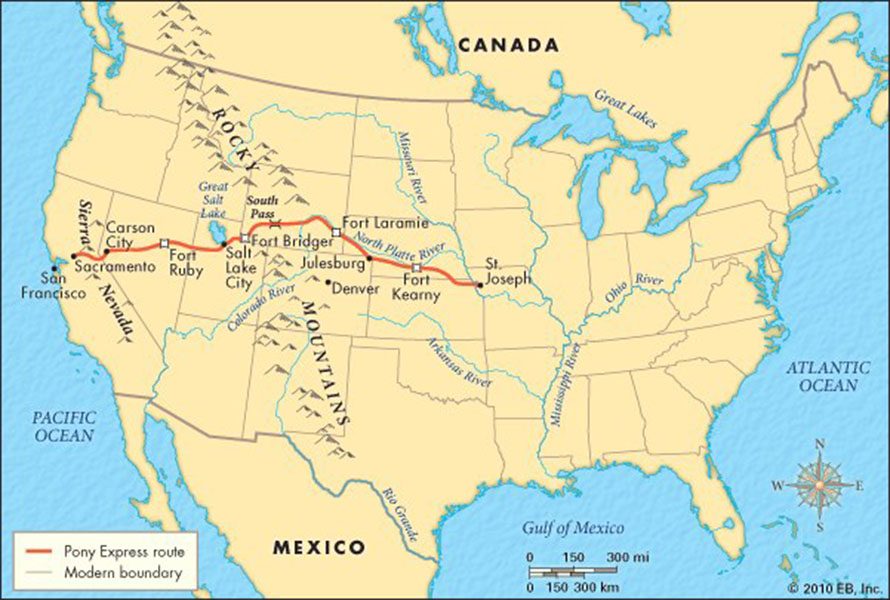
We used Euler circuits to help us solve problems in which we needed a route that started and ended at the same place. In many applications, it is not necessary for the route to end where it began. In other words, we may not be looking at circuits, but trails, like the old Pony Express trail that led from Sacramento, California in the west to St. Joseph, Missouri in the east, never backtracking.
Euler Trails
If we need a trail that visits every edge in a graph, this would be called an Euler trail. Since trails are walks that do not repeat edges, an Euler trail visits every edge exactly once.
The Five Rooms Puzzle
Just as Euler determined that only graphs with vertices of even degree have Euler circuits, he also realized that the only vertices of odd degree in a graph with an Euler trail are the starting and ending vertices. For example, in Figure 12.132, Graph H has exactly two vertices of odd degree, vertex g and vertex e. Notice the Euler trail we saw in Excercise 3 of Example 1 began at vertex g and ended at vertex e.
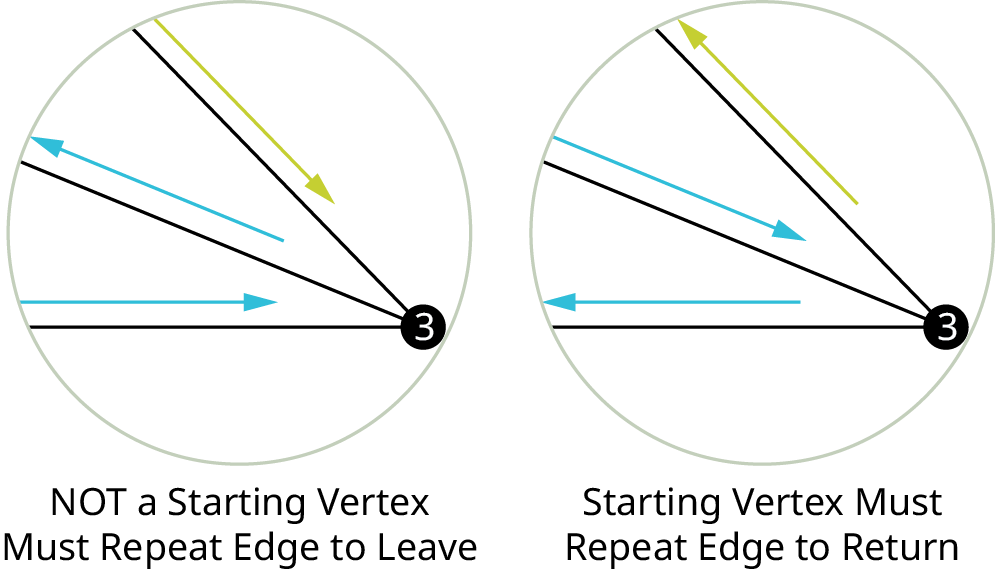
This is consistent with what we learned about vertices off odd degree when we were studying Euler circuits. We saw that a vertex of odd degree couldn't exist in an Euler circuit as depicted in Figure 12.133. If it was a starting vertex, at some point we would leave the vertex and not be able to return without repeating an edge. If it was not a starting vertex, at some point we would return and not be able to leave without repeating an edge. Since the starting and ending vertices in an Euler trail are not the same, the start is a vertex we want to leave without returning, and the end is a vertex we want to return to and never leave. Those two vertices must have odd degree, but the others cannot.
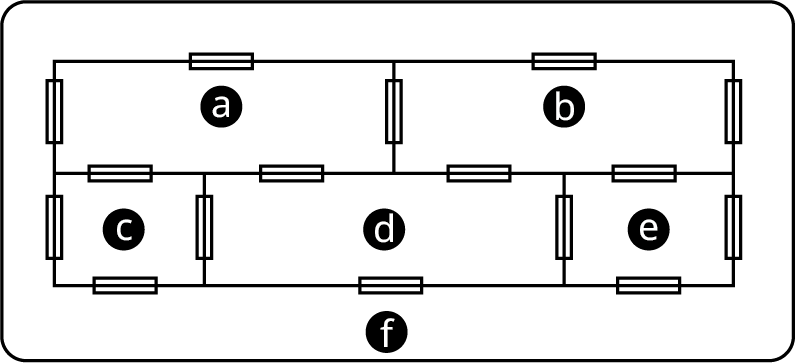
Let’s use the Euler trail theorem to solve a puzzle so you can amaze your friends! This puzzle is called the “Five Rooms Puzzle.” Suppose that you were in a house with five rooms and the exterior. There is a doorway in every shared wall between any two rooms and between any room and the exterior as shown in Figure 12.134. Could you find a route through the house that passes through each doorway exactly once?
Let’s represent the puzzle with a graph in which vertices are rooms (or the exterior) and an edge indicates a door between two rooms as shown in Figure 12.135.
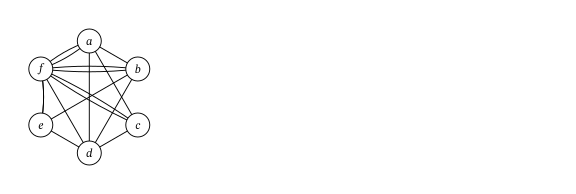
To pass through each doorway exactly once means that we cross every edge in the graph exactly once. Since we have not been asked to start and end at the same position, but to visit each edge exactly once, we are looking for an Euler trail. Let’s check the degrees of the vertices.
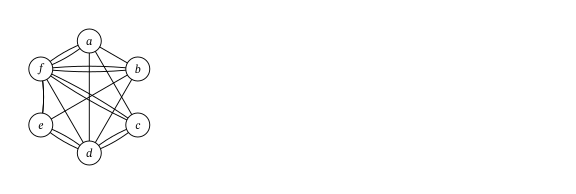
Since there are more than two vertices of odd degree as shown in Figure 12.136, the graph of the five rooms puzzle contains no Euler path. Now you can amaze and astonish your friends!
Bridges and Local Bridges
Now that we know which graphs have Euler trails, let’s work on a method to find them. The method we will use involves identifying bridges in our graphs. A bridge is an edge which, if removed, increases the number of components in a graph. Bridges are often referred to as cut-edges. In Figure 12.137, there are several examples of bridges. Notice that an edge that is not part of a cycle is always a bridge, and an edge that is part of a cycle is never a bridge.
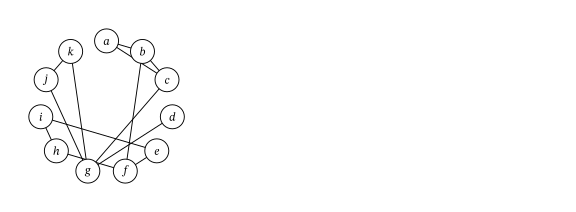
Edges bf, cg, and dg are “bridges”
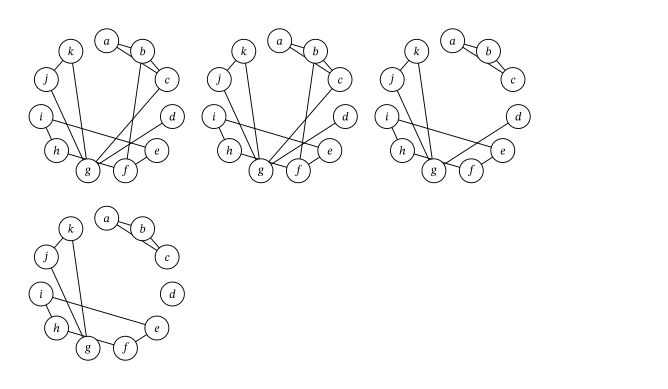
The graph in Figure 12.137 is connected, which means it has exactly one component. Each time we remove one of the bridges from the graph the number of components increases by one as shown in Figure 12.138. If we remove all three, the resulting graph in Figure 12.138 has four components.
In sociology, bridges are a key part of social network analysis. Sociologists study two kinds of bridges: local bridges and regular bridges. Regular bridges are defined the same in sociology as in graph theory, but they are unusual when studying a large social network because it is very unlikely a group of individuals in a large social network has only one link to the rest of the network. On the other hand, a local bridge occurs much more frequently. A local bridge is a friendship between two individuals who have no other friends in common. If they lose touch, there is no single individual who can pass information between them. In graph theory, a local bridge is an edge between two vertices, which, when removed, increases the length of the shortest path between its vertices to more than two edges. In Figure 12.139, a local bridge between vertices b and e has been removed. As a result, the shortest path between b and e is b → i → j → k → e, which is four edges. On the other hand, if edge ab were removed, then there are still paths between a and b that cover only two edges, like a → i → b.
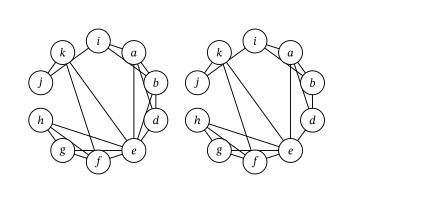
The significance of a local bridge in sociology is that it is the shortest communication route between two groups of people. If the local bridge is removed, the flow of information from one group to another becomes more difficult. Let’s say that vertex b is Brielle and vertex e is Ella. Now, Brielle is less likely to hear about things like job opportunities that Ella may know about. This is likely to impact Brielle as well as the friends of Brielle.
Finding an Euler Trail with Fleury’s Algorithm
Now that we are familiar with bridges, we can use a technique called Fleury’s algorithm, which is a series of steps, or algorithm, used to find an Euler trail in any graph that has exactly two vertices of odd degree.
Here are the steps involved in applying Fleury’s algorithm.
Step 1: Begin at either of the two vertices of odd degree.
Step 2: Remove an edge between the vertex and any adjacent vertex that is NOT a bridge, unless there is no other choice, making a note of the edge you removed. Repeat this step until all edges are removed.
Step 3: Write out the Euler trail using the sequence of vertices and edges that you found. For example, if you removed ab, bc, cd, de, and ef, in that order, then the Euler trail is a → b → c → d → e → f.
Figure 12.142 shows the steps to find an Euler trail in a graph using Fleury’s algorithm.
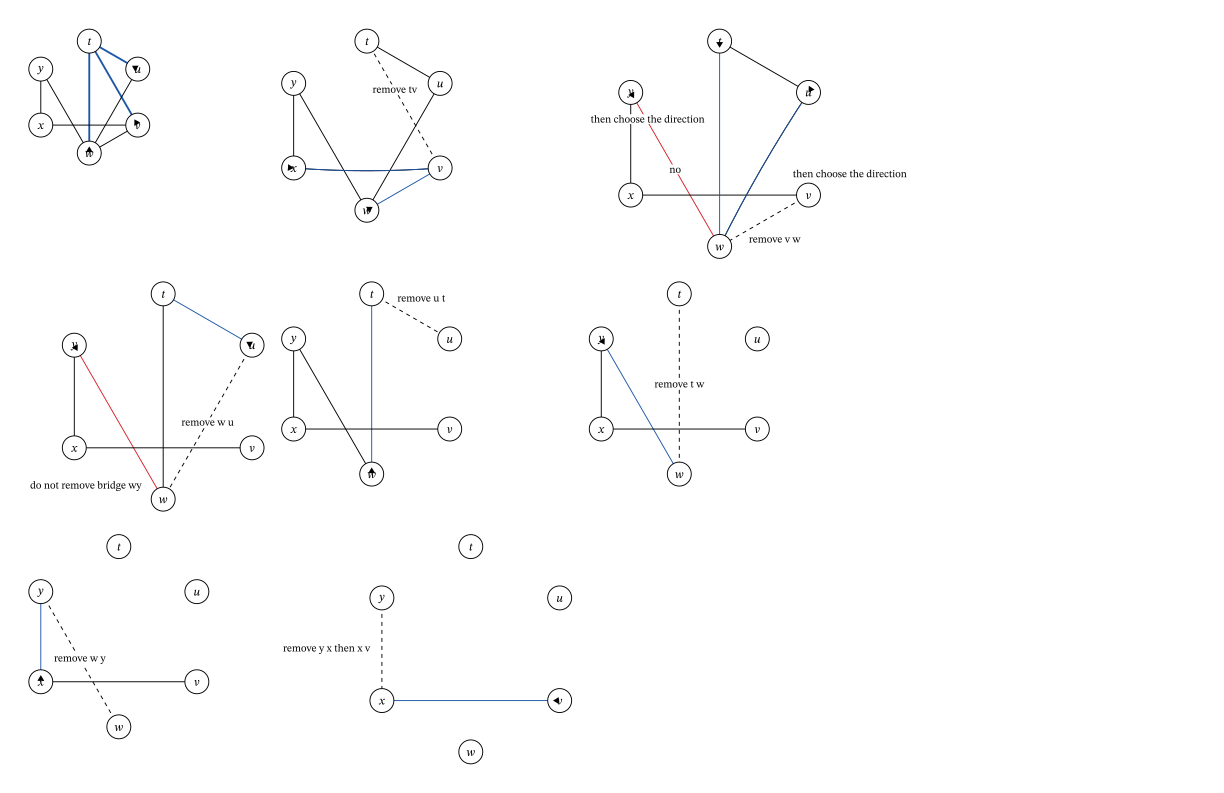
The Euler trail that was found in Figure 12.142 is t → v → w → u → t → w → y → x → v.
In the previous section, we found Euler circuits using an algorithm that involved joining circuits together into one large circuit. You can also use Fleury’s algorithm to find Euler circuits in any graph with vertices of all even degree. In that case, you can start at any vertex that you would like to use.
Step 1: Begin at any vertex.
Step 2: Remove an edge between the vertex and any adjacent vertex that is NOT a bridge, unless there is no other choice, making a note of the edge you removed. Repeat this step until all edges are removed.
Step 3: Write out the Euler circuit using the sequence of vertices and edges that you found. For example, if you removed ab, bc, cd, de, and ea, in that order, then the Euler circuit is a → b → c → d → e → a.
Key Terms
- algorithm
- Fleury’s algorithm
- Euler trail
- bridge
- local bridge
Key Concepts
- An Euler trail exists whenever a graph has exactly two vertices of odd degree.
- When a bridge is removed from a graph, the number of components increases.
- A bridge is never part of a circuit.
- When a local bridge is removed from a graph, the distance between vertices increases.
- An edge that is part of a triangle is never a local bridge.
Videos
Adapted from Contemporary Mathematics by OpenStax (openstax.org), licensed under CC BY-NC-SA 4.0. Changes were made. License: CC-BY-NC-SA-4.0.