Figure 2.9Just like solving a puzzle, a computer programmer must consider all potential solutions in order to account for each possible outcome.Just like solving a puzzle, a computer programmer must consider all potential solutions in order to account for each possible outcome. (credit: modification of work “Deadline Xmas 2010” by Allan Henderson/Flickr, CC BY 2.0)
Learning Objectives
After completing this section, you should be able to:
Interpret and apply negations, conjunctions, and disjunctions.
Construct a truth table using negations, conjunctions, and disjunctions.
Construct a truth table for a compound statement and interpret its validity.
Are you familiar with the Choose Your Own Adventure book series written by Edward Packard? These gamebooks allow the reader to become one of the characters and make decisions that affect what happens next, resulting in different sequences of events in the story and endings based on the choices made. Writing a computer program is a little like what it must be like to write one of these books. The programmer must consider all the possible inputs that a user can put into the program and decide what will happen in each case, then write their program to account for each of these possible outcomes.
A truth table is a graphical tool used to analyze all the possible truth values of the component logical statements to determine the validity of a statement or argument along with all its possible outcomes. The rows of the table correspond to each possible outcome for the given logical statement identified at the top of each column. A single logical statement has two possible truth values, true or false. In truth tables, a capital T will represent true values, and a capital F will represent false values.
In this section, you will use the knowledge built in Statements and Quantifiers and Compound Statements to analyze arguments and determine their truth value and validity. A logical argument is valid if its conclusion follows from its premises, regardless of whether those premises are true or false. You will then explore the truth tables for negation, conjunction, and disjunction, and use these truth tables to analyze compound logical statements containing these connectives.
Interpret and Apply Negations, Conjunctions, and Disjunctions
The negation of a statement will have the opposite truth value of the original statement. When is true, is false, and when is false, is true.
A conjunction is a logical and statement. For a conjunction to be true, both statements that make up the conjunction must be true. If at least one of the statements is false, the and statement is false.
A disjunction is a logical inclusive or statement, which means that a disjunction is true if one or both statements that form it are true. The only way a logical inclusive or statement is false is if both statements that form the disjunction are false.
In the next example, you will apply the dominance of connectives to find the truth values of compound statements containing negations, conjunctions, and disjunctions and use a table to record the results. When constructing a truth table to analyze an argument where you can determine the truth value of each component statement, the strategy is to create a table with two rows. The first row contains the symbols representing the components that make up the compound statement. The second row contains the truth values of each component below its symbol. Include as many columns as necessary to represent the value of each compound statement. The last column includes the complete compound statement with its truth value below it.
Construct Truth Tables to Analyze All Possible Outcomes
Recall from Statements and Questions that the negation of a statement will always have the opposite truth value of the original statement; if a statement is false, then its negation is true, and if a statement is true, then its negation is false. To create a truth table for the negation of statement , add a column with a heading of , and for each row, input the truth value with the opposite value of the value listed in the column for , as depicted in the table below.
Negation
T
F
F
T
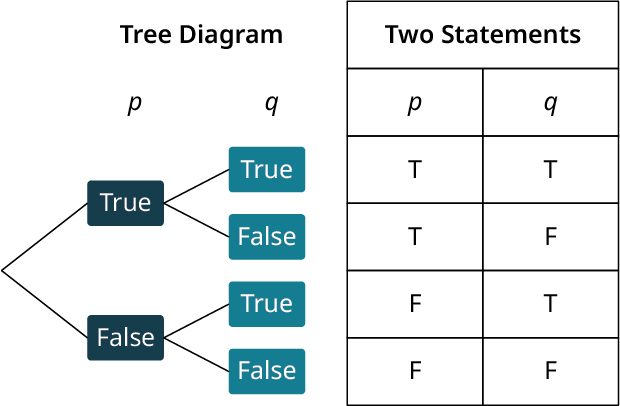
Conjunctions and disjunctions are compound statements formed when two logical statements combine with the connectives “and” and “or” respectively. How does that change the number of possible outcomes and thus determine the number of rows in our truth table? The multiplication principle, also known as the fundamental counting principle, states that the number of ways you can select an item from a group of items and another item from a group with items is equal to the product of and . Because each proposition and has two possible outcomes, true or false, the multiplication principle states that there will be possible outcomes: {TT, TF, FT, FF}.
The tree diagram and table in Figure 2.10 demonstrate the four possible outcomes for two propositions and .
Figure 2.10
A conjunction is a logical and statement. For a conjunction to be true, both the statements that make up the conjunction must be true. If at least one of the statements is false, the and statement is false.
A disjunction is a logical inclusive or statement. Which means that a disjunction is true if one or both statements that make it are true. The only way a logical inclusive or statement is false is if both statements that make up the disjunction are false.
Conjunction (AND)
Disjunction (OR)
T
T
T
T
T
T
T
F
F
T
F
T
F
T
F
F
T
T
F
F
F
F
F
F
Determine the Validity of a Truth Table for a Compound Statement
A logical statement is valid if it is always true regardless of the truth values of its component parts. To test the validity of a compound statement, construct a truth table to analyze all possible outcomes. If the last column, representing the complete statement, contains only true values, the statement is valid.
Key Terms
Truth table
Multiplication principle
Valid
Key Concepts
Determine the true values of logical statements involving negations, conjunctions, and disjunctions.
The negation of a logical statement has the opposite true value of the original statement.
A conjunction is true when both and are true, otherwise it is false.
A disjunction is false when both and are false, otherwise it is true.
Know how to construct a truth table involving negations, conjunctions, and disjunctions and apply the dominance of connectives to determine the truth value of a compound logical statement containing, negations, conjunctions, and disjunctions.
Negation
Conjunction (AND)
Disjunction (OR)
T
F
T
T
T
T
T
T
F
T
T
F
F
T
F
T
F
T
F
F
T
T
F
F
F
F
F
F
A logical statement is valid if it is always true. Know how to construct a truth table for a compound statement and use it to determine the validity of compound statements involving negations, conjunctions, and disjunctions.
Adapted from Contemporary Mathematics by OpenStax (openstax.org), licensed under CC BY-NC-SA 4.0. Changes were made. License: CC-BY-NC-SA-4.0.
These eBooks are a prerelease and are not yet certified conformant with WCAG 2.1 AA or ADA Title II. Every page is built against an automated accessibility gate, and the published editions will meet ADA Title II requirements when they release in late September 2026. If something is unusable, please tell us.