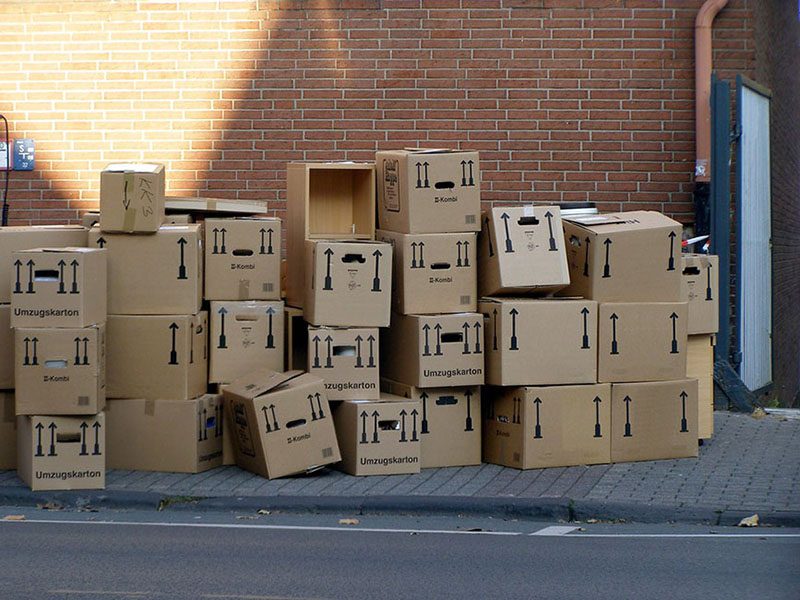
Figure 9.9Packing cartons sit on a loading dock ready to be filled.Packing cartons sit on a loading dock ready to be filled. (credit: “boxing day” by Erich Ferdinand/Flickr, CC BY 2.0)
Learning Objectives
After completing this section, you should be able to:
Identify reasonable values for volume applications.
Convert between like units of measures of volume.
Convert between different unit values.
Solve application problems involving volume.
Volume is a measure of the space contained within or occupied by three-dimensional objects. It could be a box, a pool, a storage unit, or any other three-dimensional object with attributes that can be measured in the metric unit for distance–meters. For example, when purchasing an SUV, you may want to compare how many cubic units of cargo the SUV can hold.
Cubic units indicate that three measures in the same units have been multiplied together. For example, to find the volume of a rectangular prism, you would multiply the length units by the width units and the height units to determine the volume in square units:
Note that to accurately calculate volume, each of the measures being multiplied must be of the same units. For example, to find a volume in cubic centimeters, each of the measures must be in centimeters.
Reasonable Values for Volume
Because volume is determined by multiplying three lengths, the magnitude of difference between different cubic units is exponential. In other words, while a meter is 100 times greater in length than a centimeter, a cubic meter, m3, is times greater in area than a cubic centimeter, cm3. This relationship between benchmark metric volume units is shown in the following table.
Units
Relationship
Conversion Rate
km3 to m3
1 km3 = 1,000,000,000 m3
m3 to dm3
1 m3 = 1,000 dm3
dm3 to cm3
1 cm3 = 1,000 dm3
cm3 to mm3
1 cm3 = 1,000 mm3
To have an essential understanding of metric volume, you must be able to identify reasonable values for volume. When testing for reasonableness you should assess both the unit and the unit value. Only by examining both can you determine whether the given volume is reasonable for the situation.
Converting Like Units of Measures for Volume
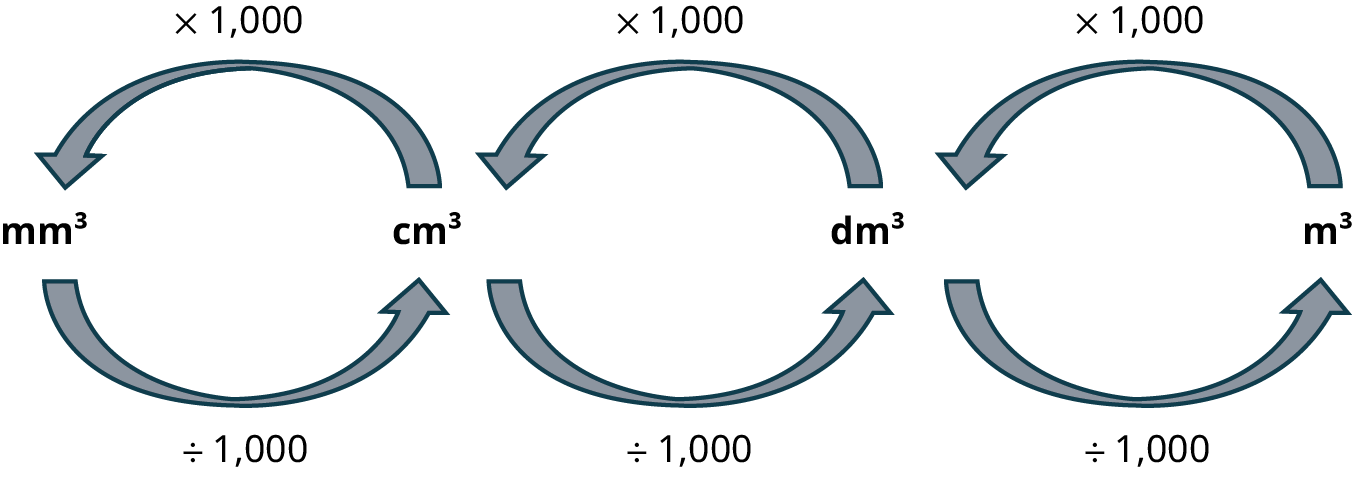
Just like converting units of measure for distance, you can convert units of measure for volume. However, the conversion factor, the number used to multiply or divide to convert from one volume unit to another, is different from the conversion factor for metric distance units. Recall that the conversion factor for volume is exponentially relative to the conversion factor for distance. The most frequently used conversion factors are illustrated in Figure 9.11.
Figure 9.11Common Conversion Factors for Metric Volume Units
Understanding Other Metric Units of Volume
When was the last time you purchased a bottle of soda? Was the volume of the bottle expressed in cubic centimeters or liters? The liter (L) is a metric unit of capacity often used to express the volume of liquids. A liter is equal in volume to 1 cubic decimeter. A milliliter is equal in volume to 1 cubic centimeter. So, when a doctor orders 10 cc (cubic centimeters) of saline to be administered to a patient, they are referring to 10 mL of saline.
The most frequently used factors for converting from cubic meters to liters are listed in Table 9.2.
Table 9.2
m3 to L
m3 to mL
Solving Application Problems Involving Volume
Knowing the volume of an object lets you know just how much that object can hold. When making a bowl of punch you might want to know the total amount of liquid a punch bowl can hold. Knowing how many liters of gasoline a car’s tank can hold helps determine how many miles a car can drive on a full tank. Regardless of the application, understanding volume is essential to many every day and professional tasks.
Key Terms
volume
cubic units
Key Concepts
Volume is a measure of the space contained within or occupied by three-dimensional objects.
Volume is measured in cubic units; the base unit for volume in the metric system is cubic meters (m3)
The liter (L) is a metric unit of capacity but is often used to express the volume of liquids. One liter is equivalent to one cubic decimeter, which is the volume of a cube measuring .
Formulas
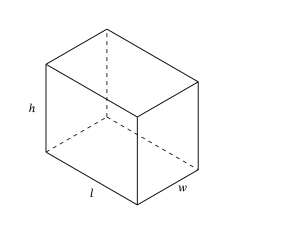
To determine the volume of a rectangular prism:
Figure 9.13Rectangular Prism with Height , Length , and Width Labeled
You can convert between metric volume units and metric capacity units using the relationships shown in Table 9.2.
Adapted from Contemporary Mathematics by OpenStax (openstax.org), licensed under CC BY-NC-SA 4.0. Changes were made. License: CC-BY-NC-SA-4.0.
These eBooks are a prerelease and are not yet certified conformant with WCAG 2.1 AA or ADA Title II. Every page is built against an automated accessibility gate, and the published editions will meet ADA Title II requirements when they release in late September 2026. If something is unusable, please tell us.