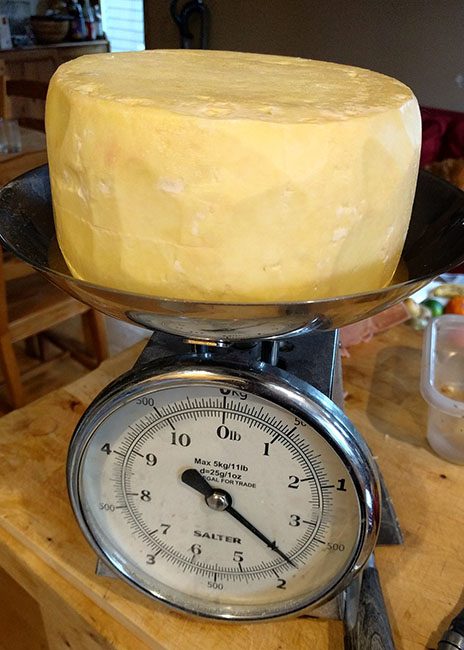
Figure 9.2A scale that measures weight in both metric and customary units.A scale that measures weight in both metric and customary units. (credit: “Weighing the homemade cheddar” by Ruth Hartnup/Flickr, CC BY 2.0)
Learning Objectives
After completing this section, you should be able to:
Identify units of measurement in the metric system and their uses.
Order the six common prefixes of the metric system.
Convert between like unit values.
Even if you don’t travel outside of the United States, many specialty grocery stores utilize the metric system. For example, if you want to make authentic tamales you might visit the nearest Hispanic grocery store. While shopping, you discover that there are two brands of masa for the same price, but one bag is marked 1,200 g and the other 1 kg. Which one is the better deal? Understanding the metric system allows you to understand that 1,200 grams is equivalent to 1.2 kg, so the 1,200 g bag is the better deal.
Units of Measurement in the Metric System
Units of measurement provide common standards so that regardless of where or when an object or substance is measured, the results are consistent. When measuring distance, the units of measure might be feet, meters, or miles. Weight might be expressed in terms of pounds or grams. Volume or capacity might be measured in gallons, or liters. Understanding how metric units of measure relate to each other is essential to understanding the metric system:
The metric unit for distance is the meter (m). A person’s height might be written as 1.8 meters (1.8 m). A meter slightly longer than a yard (3 feet), while a centimeter is slightly less than half an inch.
The metric unit for area is the square meter (m2). The area of a professional soccer field is 7,140 square meters (7,140 m2).
The metric base unit for volume is the cubic meter (m3). However, the liter (L), which is a metric unit of capacity, is used to describe the volume of liquids. Soda is often sold in 2-liter (2 L) bottles.
The gram (g) is a metric unit of mass but is commonly used to express weight. The weight of a paper clip is approximately 1 gram (1 g).
The metric unit for temperature is degrees Celsius (°C). The temperature on a warm summer day might be 24 °C.
While the U.S. Customary System of Measurement uses ounces and pounds to distinguish between weight units of different sizes, in the metric system a base unit is combined with a prefix, such as kilo– in kilogram, to identify the relationship between smaller or larger units.
While there are other base units in the metric system, our discussions in this chapter will be limited to units used to express length, area, volume, weight, and temperature.
Metric Prefixes
Unlike the U.S. Customary System of Measurement in which 12 inches is equal to 1 foot and 3 feet are equal to 1 yard, the metric system is structured so that the units within the system get larger or smaller by a power of 10. For example, a centimeter is , or 100 times smaller than a meter, while the kilometer is 103, or 1,000 times larger than a meter.
The metric system combines base units and unit prefixes reasonable to the size of a measured object or substance. The most used prefixes are shown in Table 9.1. An easy way to remember the order of the prefixes, from largest to smallest, is the mnemonic King Henry Died From Drinking Chocolate Milk.
Table 9.1
Prefix
kilo–
hecto–
deca–
base unit
deci–
cent–
milli–
Abbreviation
Magnitude
Converting Metric Units of Measure
Imagine you order a textbook online and the shipping detail indicates the weight of the book is 1 kg. By attaching the letter “k” to the base unit of gram (g), the unit used to express the measure is or 1,000 times greater than a gram. One kilogram is equivalent to 1,000 grams.
The tip of a highlighter measures approximately 1 cm. The letter “c” attached to the base unit of meter (m) means the unit used to express the measure is of a meter. One meter is equivalent to 100 centimeters.
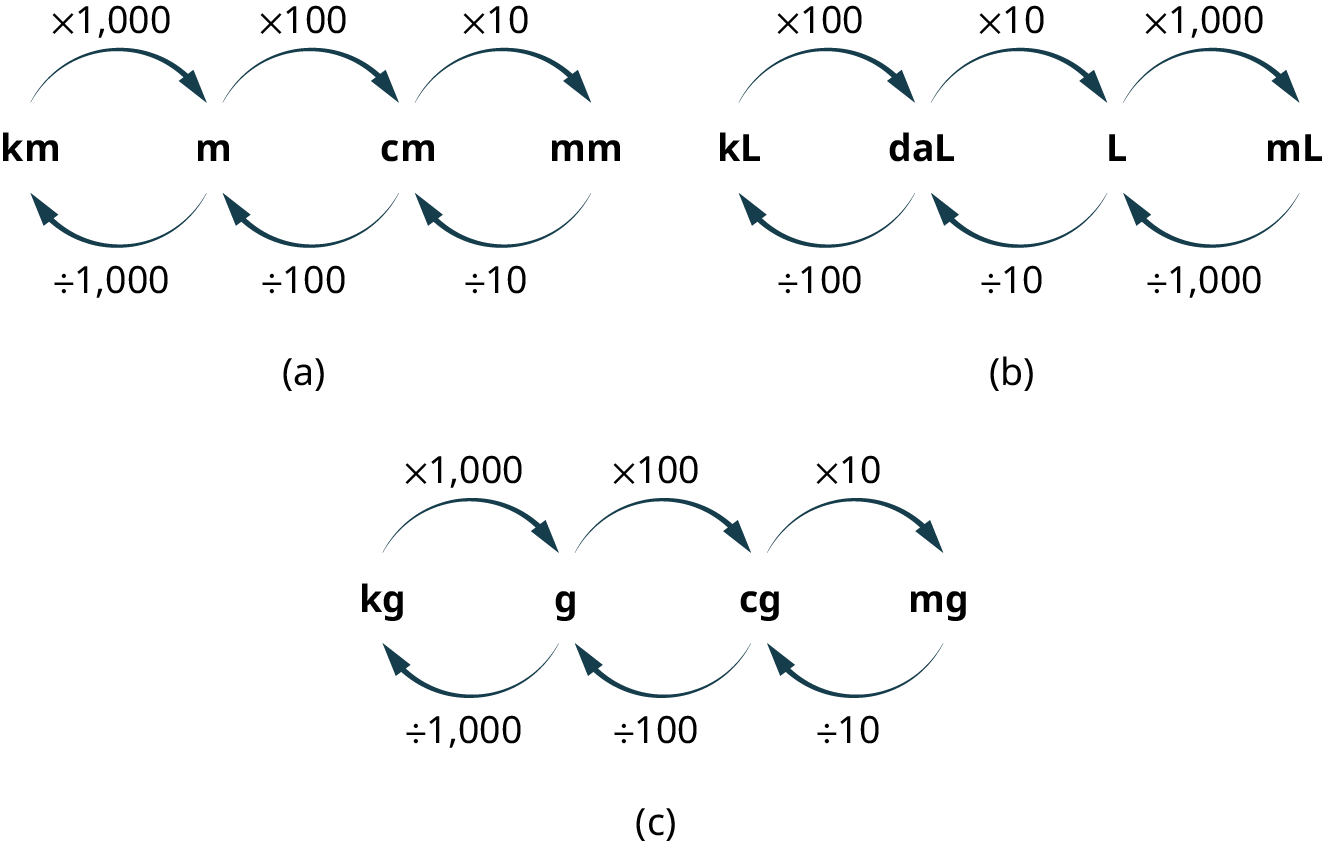
A conversion factor is used to convert from smaller metric units to bigger metric units and vice versa. It is a number that when used with multiplication or division converts from one metric unit to another, both having the same base unit. In the metric system, these conversion factors are directly related to the powers of 10. The most common used conversion factors are shown in Figure 9.4.
Figure 9.4Common Metric Conversion Factors for (a) Meters, (b) Liters, and (c) Grams
Key Terms
metric system
meter (m)
gram (g)
liter (L)
square meter (m2)
cubic meter (m3)
degrees Celsius (°C)
conversion factor
Key Concepts
The metric system is decimal system of weights and measures based on base units of meter, liter, and gram. The system was first proposed in 1670 and has since been adopted as the International System of Units and used in nearly every country in the world.
Each successive unit on the metric scale is 10 times larger than the previous one. To convert between units with the same base unit, you must either multiply or divide by a power of 10.
The most used prefixes are listed in Table 9.1. An easy way to remember the order of the prefixes, from largest to smallest, is the mnemonic King Henry Died from Drinking Chocolate Milk.
You can convert between unit sizes with the same base unit using the conversion factors shown in Figure 9.4.
Adapted from Contemporary Mathematics by OpenStax (openstax.org), licensed under CC BY-NC-SA 4.0. Changes were made. License: CC-BY-NC-SA-4.0.
These eBooks are a prerelease and are not yet certified conformant with WCAG 2.1 AA or ADA Title II. Every page is built against an automated accessibility gate, and the published editions will meet ADA Title II requirements when they release in late September 2026. If something is unusable, please tell us.