
11.1 Voting Methods
Learning Objectives
After completing this section, you should be able to:
- Apply plurality voting to determine a winner.
- Apply runoff voting to determine a winner.
- Apply ranked-choice voting to determine a winner.
- Apply Borda count voting to determine a winner.
- Apply pairwise comparison and Condorcet voting to determine a winner.
- Apply approval voting to determine a winner.
- Compare and contrast voting methods to identify flaws.
Today is the day that you begin your quest to collaborate on the constitution of Imaginaria! Let’s begin by thinking about the selection of a leader who can serve as president. It seems straightforward; if the majority of citizens prefer a particular candidate, that candidate should win. But not all votes are decided by a simple majority. Why not? What are the options?
Majority versus Plurality Voting
When an election involves only two options, a simple majority is a reasonable way to determine a winner. A majority is a number equaling more than half, or greater than 50 percent of the total.
Let’s take a look at the outcomes of U.S. presidential elections to understand more. Table 11.1 displays the results of the 2000 U.S. presidential election. Like most presidential elections, this election involved more than two options. If that is the case, is it possible that no single candidate will receive more than half of the votes cast?
| Candidate (Party Label) | Popular Vote Total |
|---|---|
| Al Gore (Democrat) | 50,999,897 |
| George W. Bush (Republican) | 50,456,002 |
| Ralph Nader (Green) | 2,882,955 |
| Patrick J. Buchanan (Reform/Independent) | 448,895 |
| Harry Browne (Libertarian) | 384,431 |
| Howard Phillips (Constitution) | 98,020 |
| Other | 134,900 |
| Total: | 105,405,100 |
Unlike in the 2000 U.S. presidential election, a candidate won the majority of votes in the 2020 election (see Table 11.1). It is a common occurrence for no single candidate to receive a majority of the votes in an election with more than two candidates. When this occurs, the candidate with the largest portion of the votes is said to have a plurality.
Your plans for Imaginarian elections will likely include primary elections, or preliminary elections to select candidates for a principal or general election. Table 11.2 displays the results of the 2018 U.S. Senate Republican primary for Maryland.
| Top Four Republican Candidates | Votes | Percentage of Party Votes |
|---|---|---|
| Cambell, Tony | 51,426 | 29.22% |
| Chaffee, Chris | 42,328 | 24.05% |
| Grigorian, Christina J. | 30,756 | 17.48% |
| Graziani, John R. | 15,435 | 8.77% |
| Total Votes | 175,981 | 100% |
Consider how election by plurality, not majority, is the most common method of selecting candidates for public office.
Runoff Voting
Has your family ever debated what to have for dinner? Suppose your family is deciding on a restaurant and exactly half of you want to have pizza but the other half want hamburgers. How do you decide when the result is a tie? You need a tiebreaker!
Will the new democracy of Imaginaria need tiebreakers? When no candidate satisfies the requirements to win the election, a runoff election, or second election, is held to determine a winner.
How would runoff voting work in Imaginaria? There are many types of runoff voting systems, which are voting systems that utilize a runoff election when the first round does not result in a winner. The method for implementing a runoff election can vary widely, particularly in the criteria used to determine whether a candidate will be on the ballot in the second election. For example, a two-round system is a runoff voting system in which only the top candidates advance to the runoff election. In some two-round systems, only the top two candidates are on the second ballot, or it may be any candidate who secures a certain percentage of the vote will advance. The Hare Method is another runoff voting system in which only the candidate(s) with the very least votes are eliminated. This can potentially result in several rounds of runoff elections.
Steps to Determine Winner by Plurality or Majority Election with Runoff
To determine the winner by plurality or when a majority election with runoff occurs, we take these three steps:
Step 1: If a majority is required to win the election, determine the number of votes needed to achieve a majority. This is the least whole number greater than 50 percent of the total votes. If a majority is not required, move to Step 2.
Step 2: Count the number of votes for each candidate in the current round of voting. If a single candidate has enough votes to win a plurality, or a majority as appropriate, then you are done! Otherwise, eliminate a predetermined number of candidates based on the rules of the election. Elimination conditions may vary. For example, the rules may state that the candidate(s) with the fewest votes will be eliminated (as in the Hare method), or that only the candidates meeting a certain threshold will move on (as in a two-round system). Once the appropriate candidates are eliminated, move on to Step 3.
Step 3: Hold a runoff election. If the runoff is simulated using a list of voter’s preferences, renumber the preferences to reflect the remaining number of options in such a way that the original order of preference is retained. Then repeat Step 2.
Note: The second and third steps may be repeated as many times as necessary for voting procedures that allow multiple runoffs.
Ranked-Choice Voting
In Example 4 and Your Turn 11.4, you were given a list that ordered each voter’s preferences. This ordering is called a preference ranking. A ballot in which a voter is required to give an ordering of their preferences is a ranked ballot, and any voting system in which a voter uses a ranked ballot is referred to as ranked voting.
The vote for the Academy Awards uses a ranked ballot. The table below provides an example of a ranked ballot for the 2020 Academy Award nominees for Best Director.
| Candidate for Best Director | Rank top choice as 1, next choice as 2, and so on. | ||||
|---|---|---|---|---|---|
| Martin Scorsese, The Irishman | 1 | 2 | 3 | 4 | 5 |
| Todd Phillips, Joker | 1 | 2 | 3 | 4 | 5 |
| Sam Mendes, 1917 | 1 | 2 | 3 | 4 | 5 |
| Quentin Tarantino, Once Upon a Time in Hollywood | 1 | 2 | 3 | 4 | 5 |
| Bong Joon-ho, Parasite | 1 | 2 | 3 | 4 | 5 |
As you decide on the voting methods that will be used in your new democracy, budget must be a consideration. You might consider a particular type of ranked voting called ranked-choice voting (RCV), which simulates a series of runoff elections without the usual time and expense involved when voters must repeatedly return to the polls, like we did in Example 4.
The method of ranked-choice voting (RCV), also called instant runoff voting (IRV), is a version of the Hare Method, using preference ranking so that, if no single candidate receives a majority, the least popular selections can be eliminated and the results can be recounted, without the need for more elections.
As we explore examples of ranked voting, we will summarize the voters’ preference rankings using a table in which the top row shows the number of ballots that ranked the options in the same order. Let’s practice interpreting the information in this type of table.
Now that we’ve covered how to read a summary of preference rankings, let’s practice using the ranked-choice method to determine the winner of an election. Recall that ranked-choice voting is still the Hare Method where the candidate with the very least number of votes is eliminated each round until a majority is attained. The difference here is that the voters have completed a ranked ballot, so they don't have to visit the polls multiple times. Here are the steps for ranked-choice voting.
Steps to Determine Winner by Ranked-Choice Voting
To determine the winner when ranked-choice voting occurs, we take these three steps:
Step 1: Determine the number of votes needed to achieve a majority. This is the least whole number greater than 50 percent of the total votes.
Step 2: Count the number of first place votes for each candidate. If a candidate has a majority, that candidate wins the election and we are done! Otherwise, eliminate the candidate(s) with the fewest votes and complete Step 3.
Step 3: Reallocate the votes to the remaining candidates, and repeat Step 2.
Borda Count Voting
Ranked-choice voting is one type of ranked voting that simulates multiple runoffs based on ranked ballots. Another type of ranked voting is the Borda count method, which uses ranked ballots that award candidates points corresponding to the number of candidates ranked lower on each ballot.
To understand how this works, let’s review the favorite colors of our kindergarten class from the table below. Let’s focus on the votes represented by the first column of the preference summary.
| Number of Ballots | 4 | 6 | 4 | 7 |
|---|---|---|---|---|
| Red | 2 | 6 | 2 | 5 |
| Blue | 1 | 2 | 1 | 4 |
| Green | 6 | 5 | 5 | 2 |
| Yellow | 5 | 4 | 6 | 3 |
| Purple | 4 | 3 | 4 | 1 |
| Pink | 3 | 1 | 3 | 6 |
Each student had six options. This first column tells us that four students ranked blue as their first choice, red as their second choice, pink as their third choice, purple as their fourth choice, yellow as their fifth choice, and green as their sixth choice. Blue was ranked higher than other colors. For each of the four students who completed their ballot in this way, blue would receive five points. Since there were four ballots with this ordering, blue would receive points from the first column. To determine the total points for each candidate, we have to find the sum of the points they received in each column.
To determine the winner of a contest using the Borda count method, we must compare total number of points earned by each candidate. The candidate with the most points is the winner. Each row of the preference summary corresponds to a single candidate. To find the number of points received by a particular candidate in the preference summary, or their Borda score, we will need to focus on the row in which that candidate appears.
Before we practice determining the winner of a Borda count election, let’s examine how to find the Borda score for a single candidate.
Now let’s determine the winner of an election by comparing the Borda scores for each of the candidates.
The Borda count method may seem too complicated to even consider using for Imaginaria, but each voting method has its own pros and cons. The Borda count method, for example, favors compromise candidates over divisive candidates. A compromise candidate is not the first choice of most of the voters, but is more acceptable to the population as a whole than the other candidates. A divisive candidate is simultaneously the first choice of a large portion of the voters and the last choice of another large portion of the voters.
In Example 8, Candidate A was ranked first by 225 voters, but was ranked last by 185 voters. No voters ranked Candidate A as second or third. It appears that, although Candidate A had the majority of first place votes, there was a significant minority who strongly disliked them. Candidate A was a divisive candidate. Candidate B, on the other hand, was the second choice of every voter, making Candidate B a good compromise. The Borda count method chose Candidate B, a compromise candidate, that was more acceptable to the population as a whole. This scenario is cited by both opponents and proponents of the Borda count method.
Pairwise Comparison and Condorcet Voting
We have discussed two kinds of ranked voting methods so far: ranked-choice and Borda count. A third type of ranked voting is the pairwise comparison method, in which the candidates receive a point for each candidate they would beat in a one-on-one election and half a point for each candidate they would tie. If one candidate earns more points than the others, then that candidate wins. This method is one of several Condorcet voting methods, which are methods in which candidates are ranked and then compared pairwise to each other, a candidate having to beat all others in order to win. These methods vary in the way candidates are scored, and there is not always a clear winner. A candidate who wins each possible pairing is known as a Condorcet candidate. These terms are named after the Marquis de Condorcet, a French philosopher and mathematician who preferred the pairwise comparison method to the Hare method and made public arguments in its favor.
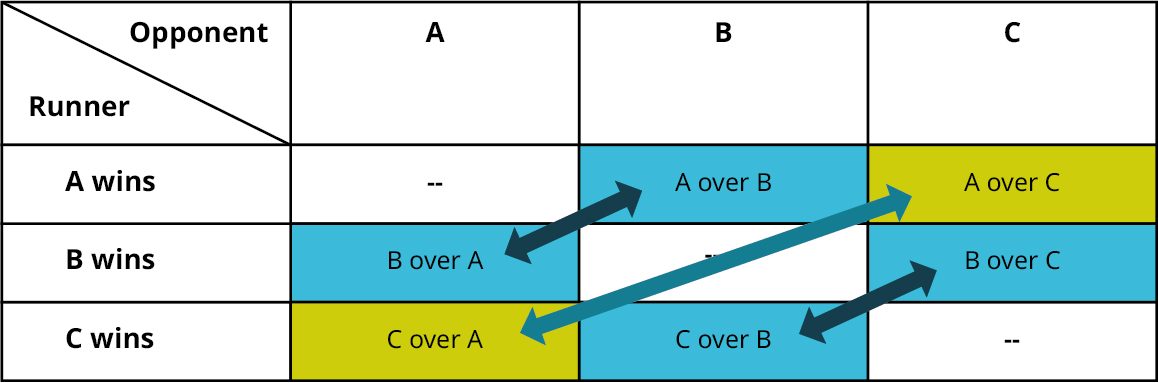
If you include a Condorcet voting method in the constitution of Imaginaria, the election supervisors may want to use a pairwise comparison matrix like the one in Figure 11.3. It’s a tool used to list the number of wins associated with each pairing of two candidates. Each candidate will receive a point for each win and a half a point for each tie. Each pairing is listed twice, once for the number of wins of a candidate over a particular challenger and once for the number of wins of the challenger over that candidate.
Steps to Determine a Winner by Pairwise Comparison Method Using a Matrix
To determine the winner when the pairwise comparison method is used, we take these three steps:
Step 1: On the matrix, indicate a losing matchup by crossing out a box, , and tie match ups by drawing a slash through the box, .
Step 2: Award each candidate 1 point for a win, half a point for a tie, and 0 points for a loss.
Step 3: Identify the winner, which is the candidate with the most points.
Before you decide on the pairwise comparison method for Imaginaria, review what’s involved in constructing a pairwise comparison matrix from a summary of ranked ballots. Then we can use the matrix to determine the winner of the election. Does the winner using the Borda method still win?
Three Key Questions
Before you decide if you want to use the pairwise comparison method for Imaginarian elections, let’s consider three questions that might affect your decision.
- Is there always a winner?
- If there is a winner, is the winner always a Condorcet candidate?
- If there is a Condorcet candidate, does that candidate always win?
Let’s think about why these questions might be important to you if you chose the pairwise comparison method. First, if no candidate meets the criteria to win an election, you will need a backup plan such as a runoff election. Second, if the winner is not a Condorcet candidate, then there is at least one candidate who beat the winner in a pairwise matchup and the supporters of that candidate might question the validity of the election. Finally, if there is a Condorcet candidate who beat every other candidate in a pairwise matchup, it is reasonable to conclude that it would be unfair for anyone else to win. The rest of the examples in this section should illustrate these key concepts.
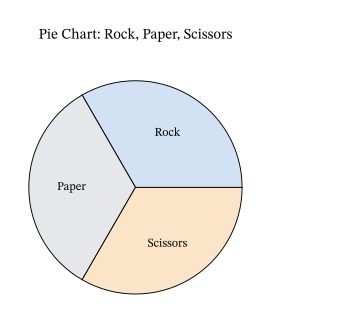
Example 10 illustrates the answer to the first key question. The pairwise comparison method does not always result in a winner. For example, much like the game of Rock, Paper, Scissors, it is possible for a cyclic pattern to emerge in which each candidate beats the next until the last candidate who beats the first.
Now, you have the answer to the second key question. The pairwise comparison matrix in YOUR TURN 11.10 is an example of a scenario where a winner is not a Condorcet candidate.
The answer to the third question is not as clear. If there is a Condorcet candidate, does that candidate win? So far, we have not come across a contradictory example where the Condorcet candidate didn't win, but we cannot know with certainty that it is not possible by looking at examples. Instead, we will need to use some reasoning. Let’s review some particular cases of elections with a certain number of candidates, and then we will try to generalize the scenario to an election with candidates.
Let’s consider a general case where there are candidates. One of the candidates is a Condorcet candidate. Since the Condorcet candidate wins all matchups, the Condorcet candidate wins points. Since each of the other candidates lost to the Condorcet candidate, the most a single candidate could win is . Since the Condorcet candidate won points and each other candidate won points or fewer, the Condorcet candidate is the winner. You have your answer to the third key question! If there is a Condorcet candidate, that candidate is always the winner.
Approval Voting
The last type of voting system you will consider for your budding democracy is an approval voting system. In this system, each voter may approve any number of candidates without rank or preference for one over another (among the approved candidates), and the candidate approved by the most voters wins. This voting system has aspects in common with plurality voting and Condorcet voting methods, but it has characteristics that distinguish it from both. An approval voting ballot lists the candidates and provides the option to approve or not approve each candidate.
The term “approval voting” was not used until the 1970s Brams, Steven J.; Fishburn, Peter C. (2007), Approval Voting, Springer-Verlag, p. xv, ISBN 978-0-387-49895-9, although its use has been documented as early as the 13th century (Brams, Steven J. (April 1, 2006). The Normative Turn in Public Choice (PDF) (Speech). Presidential Address to Public Choice Society. New Orleans, Louisiana.) Approval voting has the appeal of being simpler than ranked voting methods. It also allows an individual voter to support more than one candidate equally. This has appeal for those who do not want a split vote among a few mainstream candidates to lead to the election of a fringe candidate. It also has appeal for those who want an underdog to have a chance of success because voters will not worry about wasting their vote on a candidate who is not believed likely to win.
Compare and Contrast Voting Methods to Identify Flaws
Wow! We have covered a lot of options for the voting methods. Now, you need to decide which one is best for Imaginaria. Imaginarians might consider characteristics of certain voting systems desirable and others undesirable. In some cases, voters may consider these undesirable traits to be flaws in a voting system that are significant enough to motivate them to reject that system. If you are feeling a bit overwhelmed by this decision, maybe it would help to read about the experiences of others who have faced similar questions.
Consider the 2000 U.S. presidential election in which Green Party candidate Ralph Nader and Reform Party candidate Pat Buchanan were on the ballet running against the mainstream candidates, Democrat Al Gore and Republican George W. Bush. The voting results for Florida are given in Table 11.3.
| Candidate | Party | Votes | Percentage |
|---|---|---|---|
| (G) George W. Bush | Republican | 2,912,790 | 48.85% |
| (A) Al Gore | Democrat | 2,912,253 | 48.84% |
| (R) Ralph Nader | Green | 97,488 | 1.63% |
| (P) Pat Buchanan | Reform | 17,484 | 0.29% |
| (H) Harry Brown | Libertarian | 16,415 | 0.28% |
| (O) 7 Other Candidates | Other | 6,680 | 0.11% |
| Total | 5,963,110 |
In more than one state, Buchanan was able to split the Republican vote enough to allow Gore to win that state. Nader split the Democrat vote in Florida and New Hampshire by enough votes to prevent Gore from winning those states. Had Gore won either state, he would have had enough electoral votes to win the election. Instead, Bush won. This is an example of a flaw in the plurality system of voting: the spoiler.
A spoiler is a less popular candidate who takes votes from a more popular candidate with similar positions, swinging the race to another candidate with vastly different views that they would not support. This encourages voters not to vote for the candidate that they perceive to be the best, but instead for the candidate they can live with who they perceive to have a better chance of winning. Some voters may prefer a method such as approval voting, which does not have this trait in common with plurality voting.
The results in Example 14 and Your Turn 11.14 highlight one of the characteristics of approval voting. Ralph Nader moved up from a distant third place finish to a close second place finish when Al Gore’s supporters approved him on their ballots. In this way, fringe candidates have a better chance of winning, which some voters consider a flaw but others consider a benefit.
Another aspect of approval voting systems that is a concern to many voters is that candidates in approval elections might encourage their loyal supporters to approve them and only them to avoid giving support to any other candidate. If this occurred, the election in effect becomes a traditional plurality election. This is a flaw that cannot occur in an instant runoff system since all candidates are ranked.
The election in Example 15 involves a scenario in which there are two extreme candidates, Planet A and Planet B, and a moderate candidate, Planet C. The supporters of the extreme candidates prefer the moderate candidate to the other extremist ones. This makes Planet C a compromise candidate. In this case, both the plurality method and ranked-choice voting resulted in the election of one of the extreme candidates, but the Borda count method elected the compromise candidate in this scenario. Depending on a person’s perspective, this may be perceived as a flaw in either ranked-choice and plurality systems, or the Borda count method.
In Fairness in Voting Methods, we will analyze the fairness of each voting system in greater detail using objective measures of fairness.
Key Terms
- majority
- plurality
- runoff election
- runoff voting system
- two-round system
- Hare Method
- preference ranking
- ranked ballot
- ranked-choice voting (RCV)
- instant runoff voting (IRV)
- Borda count method
- Borda score
- Compromise candidate
- divisive candidate
- pairwise comparison method
- Condorcet voting methods
- Condorcet candidate
- approval voting system
- approval voting ballot
- spoiler
Key Concepts
- In plurality voting, the candidate with the most votes wins.
- When a voting method does not result in a winner, runoff voting can be used to do so.
- Ranked-choice voting, also known as instant runoff voting, is one type of ranked voting system.
- The Borda count method is a type of ranked voting system in which each candidate is given a Borda score based on the number of candidates ranked lower than them on each ballot.
- When pairwise comparison is used, the winner will be the Condorcet candidate if one exists.
- Approval voting allows voters to give equally weighted votes to multiple candidates.
- When a voter finds a characteristic of a particular voting method unappealing, they may consider that characteristic a flaw in the voting method and look for an alternative method that does not have that characteristic.
Videos
Adapted from Contemporary Mathematics by OpenStax (openstax.org), licensed under CC BY-NC-SA 4.0. Changes were made. License: CC-BY-NC-SA-4.0.