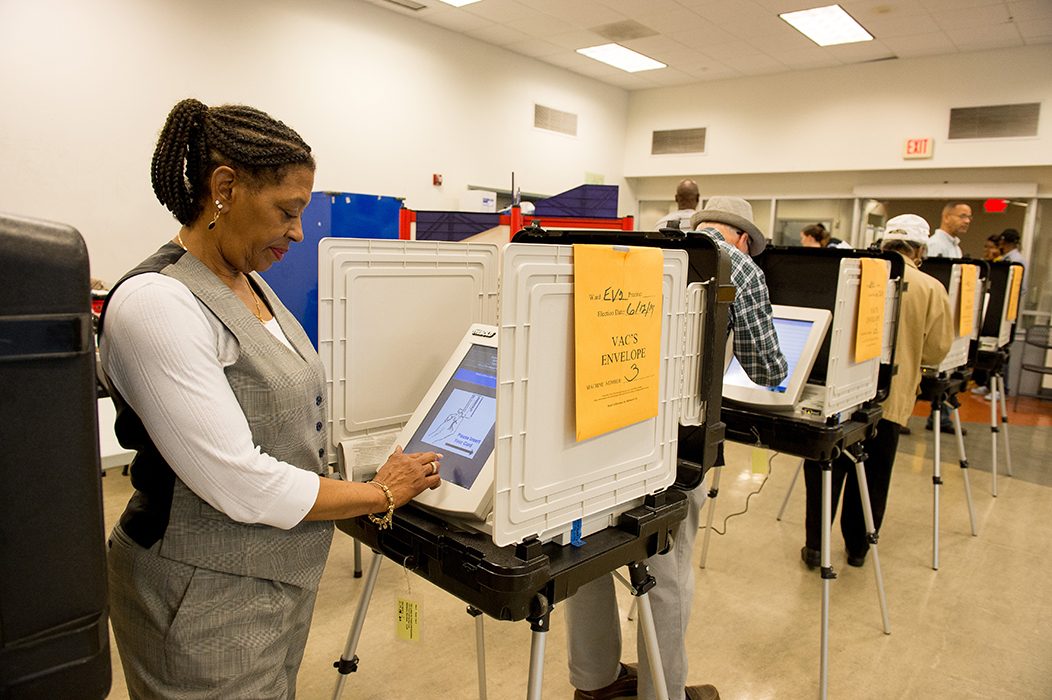
Figure 11.10Citizens strive to ensure their voting system is fair.Citizens strive to ensure their voting system is fair. (credit: “Governor Votes Early” by Maryland GovPics/Flickr, CC BY 2.0)
Learning Objectives
After completing this section, you should be able to:
Compare and contrast fairness of voting using majority criterion.
Compare and contrast fairness of voting using head-to-head criterion.
Compare and contrast fairness of voting using monotonicity criterion.
Compare and contrast fairness of voting using irrelevant alternatives criterion.
Apply Arrow’s Impossibility Theorem when evaluating voting fairness.
Now that we’ve covered a variety of voting methods and discussed their differences and similarities, you might be leaning toward one method over another. You will need to convince the other founders of Imaginaria that your preference will be the best for the country. Before your collaborators approve the inclusion of a voting method in the constitution, they will want to know that the voting method is a fair method. In this section, we will formally define the characteristics of a fair system. We will analyze each voting previously discussed to determine which characteristics of fairness they have, and which they do not. In order to guarantee one ideal, we must often sacrifice others.
The Majority Criterion
One of the most fundamental concepts in voting is the idea that most voters should be in favor of a candidate for a candidate to win, and that a candidate should not win without majority support. This concept is known as the majority criterion.
With respect to the four main ranked voting methods we have discussed—plurality, ranked-choice, pairwise comparison, and the Borda count method—we will explore two important questions:
Which of these voting systems satisfy the majority criterion and which do not?
Is it always “fair” for a voting system to satisfy the majority criterion?
Keep in mind that this criterion only applies when one of the candidates has a majority. So, the examples we will analyze will be based on scenarios in which a single candidate has more than 50 percent of the vote.
From Example 1, it appears that the plurality and ranked-choice voting methods satisfy the majority criterion. In general, the majority candidate always wins in a plurality election because the candidate that has more than half of the votes has more votes than any other candidate. The same is true for ranked-choice voting; and there will never be a need for a second round when there is a majority candidate. Let’s examine how some of the other voting methods stand up to the majority criterion.
Example 2 demonstrates a concept that we also saw in Borda Count Voting—the Borda method frequently favors the compromise candidate over the divisive candidate. This can happen even when the divisive candidate has a majority, as it did in this example. Although a majority of the voters were in favor of McDonald’s, a significant minority was strongly opposed to McDonald’s, ranking it last. Since the Borda score includes all rankings, this strong opposition has an impact on the outcome of the election.
Pairwise comparison will always satisfy the majority criterion because the candidate with the majority of first-place votes wins each pairwise matchup. While it is possible for the majority candidate to win by the Borda count method, it is not guaranteed. So, the Borda method fails the majority criterion. A summary of each voting method as it relates to the majority criterion is found in the following table.
Voting Method
Majority Criterion
Plurality
Satisfies
Ranked-choice
Satisfies
Pairwise comparison
Satisfies
Borda count
Violates
If you prefer the Borda method, you might argue that its failure to satisfy the majority criterion is actually one of its strengths. As we saw in Example 1 and Example 2, the majority have the power to vote for their own benefit at the expense of the minority. While four students were very enthusiastic about McDonald’s, three students were strongly opposed to McDonald’s. It is reasonable to say that the better option would be Burger King, the compromise candidate, which everyone ranked highly and no one strongly opposed. The Borda method is designed to favor a candidate that is acceptable to the population as a whole. In this way, the Borda method avoids a downfall of strict majority rule known as the tyranny of the majority, which occurs when a minority of a population is treated unfairly because their situation is different from the situation of the majority.
The people of Imaginaria should know that the power of the majority to vote their will has serious implications for other groups. For example, according to the UCLA School of Law Williams Institute, the LGBTQ+ community in the United States makes up approximately 4.5 percent of the population. When elections occur that include issues that affect the LGBTQ+ community, members of the LGBTQ+ community depend on the 95.5 percent of the population who do not identify as LGBTQ+ to consider their perspectives when voting on issues such as same-sex marriage, the use of public restrooms by transgender people, and adoption by same-sex couples.
Head-to-Head Criterion
Another fairness criterion you must consider as you select a voting method for Imaginaria is the Condorcet criterion, also known as the head-to-head criterion. An election method satisfies the Condorcet criterion provided that the Condorcet candidate wins the election whenever a Condorcet candidate exists. A Condorcet method is any voting method that satisfies the Condorcet criterion.
Recall from Three Key Questions that not every election has a Condorcet candidate; the Condorcet criterion will not apply to every election. Also recall that a Condorcet candidate cannot lose an election by pairwise comparison. So, the pairwise comparison voting method is said to satisfy the Condorcet criterion.
As we have seen, the plurality method, ranked-choice voting, and the Borda count method each fail the Condorcet criterion in some circumstances. Of the four main ranked voting methods we have discussed, only the pairwise comparison method satisfies the Condorcet criterion every time. A summary of each voting method as it relates to the Condorcet criterion is found in the following table.
Voting Method
Condorcet Criterion
Plurality
Violates
Ranked-choice
Violates
Pairwise comparison
Satisfies
Borda count
Violates
Monotonicity Criterion
The citizens of Imaginaria might be surprised to learn that it is possible for a voter to cause a candidate to lose by ranking that candidate higher on their ballot. Is that fair? Most voters would say, “Absolutely not!!” This is an example of a violation of the fairness criterion called the monotonicity criterion, which is satisfied when no candidate is harmed by up-ranking nor helped by down-ranking, provided all other votes remain the same.
Consider a scenario in which voters are permitted a first round that is not binding, and then they may change their vote before the second round. Such a first round can be called a “straw poll.” Now, let’s suppose that a particular candidate won the straw poll. After that, several voters are convinced to increase their support, or up-rank, that winning candidate and no voters decrease that support. It is reasonable to expect that the winner of the first round will also win the second. Similarly, if some of the voters decide to decrease their support, or down-rank, a losing candidate, it is reasonable to expect that candidate will still lose in the second round.
You might be wondering why it’s called the monotonicity criterion. In mathematics, the term monotonicity refers to the quality of always increasing or always decreasing. For example, a person’s age is monotonic because it always increases, whereas a person’s weight is not monotonic because it can increase or decrease. If the only changes to the votes for a particular candidate after a straw poll are in one direction, this change is considered monotonic.
If you are going to make an informed decision about which voting method to use in Imaginaria, you need to know which of the four main ranked voting methods we have discussed—plurality, ranked-choice, pairwise comparison, and the Borda count method—satisfy the monotonicity criterion.
The last few examples illustrate that the plurality method, pairwise comparison voting, and the Borda count method each satisfy the monotonicity criterion. Of the four main ranked voting methods we have discussed, only the ranked-choice method violates the monotonicity criterion. A summary of each voting method as it relates to the Condorcet criterion is found in the table below.
Voting Method
Monotonicity Criterion
Plurality
Satisfies
Ranked-choice
Violates
Pairwise comparison
Satisfies
Borda count
Satisfies
Irrelevant Alternatives Criterion
We have covered a lot about voting fairness, but there is one more fairness criterion that you and the other Imaginarians should know. Consider this well-known anecdote that is sometimes attributed to the American philosopher Sidney Morgenbesser:
A man is told by his waiter that the dessert options this evening are blueberry pie or apple pie. The man orders the apple pie. The waiter returns and tells him that there is also a third option, cherry pie. The man says, “In that case, I would like the blueberry pie.” (Gaming the Vote: Why Elections Aren’t Fair (and What We Can Do About It), William Pound stone, p. 50, ISBN 0-8090-4893-0)
This story illustrates the concept of the Irrelevant Alternatives Criterion, also known as the Independence of Irrelevant Alternatives Criterion (IIA), which means that the introduction or removal of a third candidate should not change or reverse the rankings of the original two candidates relative to one another. In particular, if a losing candidate is removed from the race or if a new candidate is added, the winner of the race should not change.
We have seen that all four of the main voting systems we are working with fail the Irrelevant Alternatives Criterion (IIA). A summary of each voting method as it relates to the IIA criterion is found in the table below.
Voting Method
Irrelevant Alternatives Criterion
Plurality
Violates
Ranked-choice
Violates
Pairwise comparison
Violates
Borda count
Violates
You might be wondering if there is a voting system you could recommend for Imaginaria that satisfies all the fairness criteria. If there is one, it remains to be discovered and it is not a voting system that is based solely on preference rankings. In 1972, Harvard Professor of Economics Kenneth J. Arrow received the Nobel Prize in Economics for proving Arrow’s Impossibility Theorem, which states that any voting system, either existing or yet to be created, in which the only information available is the preference rankings of the candidates, will fail to satisfy at least one of the following fairness criteria: the majority criterion, the Condorcet criterion, the monotonicity criterion, and the independence of irrelevant alternatives criterion. This theorem only applies to a specific category of voting systems—those for which the preference ranking is the only information collected. There are other types of voting systems to which the Impossibility Theorem does not apply. For example, there is a class of voting systems called Cardinal voting systems that allow for rating the candidates in some way.
“Rating” is different from “ranking” because a voter can give different candidates the same rating. Consider the five-star rating systems used by various industries, or the thumbs up/thumbs down rating system used on YouTube. Could there be a Cardinal voting system that does not violate any of the fairness criteria we have discussed? It’s possible, but more research must be done in order to prove it.
Key Terms
majority criterion
tyranny of the majority
Condorcet criterion
Condorcet method
monotonicity criterion
up-rank
down-rank
independence of irrelevant alternatives criterion (IIA)
Arrow’s Impossibility Theorem
cardinal voting system
Key Concepts
There are several common measures of voting fairness, including the majority criterion, the head-to head criterion, the monotonicity criterion, and the irrelevant alternatives criterion.
According to Arrow’s Impossibility Theorem, each voting method in which the only information is the order of preference of the voters will violate one of the fairness criteria.
Adapted from Contemporary Mathematics by OpenStax (openstax.org), licensed under CC BY-NC-SA 4.0. Changes were made. License: CC-BY-NC-SA-4.0.
These eBooks are a prerelease and are not yet certified conformant with WCAG 2.1 AA or ADA Title II. Every page is built against an automated accessibility gate, and the published editions will meet ADA Title II requirements when they release in late September 2026. If something is unusable, please tell us.