
13.4 Math and Music

Learning Objectives
After completing this section, you should be able to:
- Describe the basics of frequency related to sound.
- Describe the basics of pitch as it relates to music.
- Describe and evaluate musical notes, half-steps, whole steps, and octaves.
- Describe and find frequencies of octaves.
“The world’s most famous and popular language is music.”
Psy, South Korean singer, rapper, songwriter, and record producer
Imagine a world without music and many of us would struggle to fill the void. Music uplifts, inspires, heals, and generally adds dimension to virtually every aspect of our lives. But what is music? For some it is a song; for others it may be the sounds of birds or the rhythmic sound of drumming or a myriad of other sounds. Whatever you consider music, it is all around us and is an integral part of our lives. “Music can raise someone’s mood, get them excited, or make them calm and relaxed. Music also—and this is important—allows us to feel nearly or possibly all emotions that we experience in our lives. The possibilities are endless” (Galindo, 2009).
What music you listen to can impact your mood and emotions. In similar fashion, the music we choose can often tell those around us something about our current moods and emotions. Consider the music you may have been listening to as you today or even as you are reading this text. What cues to your mood do your music selections share? Albert Einstein is quoted as saying, “If I were not a physicist, I would probably be a musician. I often think in music. I live my daydreams in music. I see my life in terms of music.” What clues do your recent music choices say about your mood or how your day is going?
Basics of Frequency as It Relates to Sound
Every sound is created by an object vibrating and these vibrations travel in waves that are captured by our ears. Some vibrations we may be able to see, such as a plucked guitar string moving, whereas other vibrations we may not be able to see, such as the sound created when we hold our breath when accidentally dropping our cell phone on a hard floor. We don’t see the vibrations of our cell phone hitting the floor; however, any audible sound created in the fall is the result of vibrations in the form of sound waves, which can be pictured similarly to waves moving through the ocean.
The waves of sounds each have a frequency, or rate of vibration of sound waves, that measures the number of waves completed in a single second and are measured in hertz (Hz; one Hz is one cycle per second). Louder sounds have stronger vibrations or are created closer to our ear. The further an ear is from the source of the sound, the quieter the sound will appear.
Sounds range in frequency from 16 Hz to ultrasonic values, with humans able to hear sounds in a frequency range of about 20 Hz to 20,000 Hz. Adults lose the ability to hear the upper end of the range and typically top out in the ability to hear in a frequency of 15,000–17,000 Hz. Sounds with a frequency above 17,000 Hz are less likely to be heard by adults while still being audible to children.
While frequency plays a key role in audible sounds, so too does the sound level, which can be measured in decibels (dB), which are the units of measure for the intensity of a sound or the degree of loudness. As a sound level increases, the decibel level increases.
A person with average hearing can hear sounds down to 0 dB. Those with exceptionally good hearing can hear even quieter sounds, down to approximately –5 dB. The following table includes sample sounds with their related decibel values.
| Sound | Decibels (dB) |
|---|---|
| Firecrackers | 140 |
| Take-off of military jet from aircraft carrier | 130 |
| Clap of thunder | 120 |
| Auto horn standing next to the vehicle | 110 |
| Outboard motor | 100 |
| Motorcycle | 90 |
| Noise inside a car in city traffic | 80 |
| Typical washing machine | 70 |
| Public conversation, such as at a restaurant | 60 |
| Private conversation | 50 |
| Hum of a computer with fan blowing | 40 |
| Quiet whisper | 30 |
| Swishing leaves | 20 |
| Regular breathing | 10 |
| Lowest typical sound audible by teenagers | 0 |
Basics of Pitch
When considering the various sound levels the human ear can hear, the ear perceives sound both from the frequency level and the pitch of a sound. The quality of the sound is referred to as pitch, the tonal quality of a sound and how high or low the tone. Sounds with a high frequency have a high pitch, such as 900 Hz, and sounds with a low pitch have a low frequency, such as 50 Hz.
Let’s take a look at frequency and pitch using a string instrument such as a guitar or piano. When a string is plucked on a guitar or a key is played on a piano, the related string vibrates at a frequency that is related to the length and thickness of the string. The frequency is measurable and has a singular value. The pitch of the note played is open for interpretation, as the pitch is a function of personal opinion.
Note Values, Half-Steps, Whole Steps, and Octaves
“There are not more than five musical notes, yet the combinations of these five give rise to more melodies than can ever be heard.”
Sun Tzu, Chinese strategist
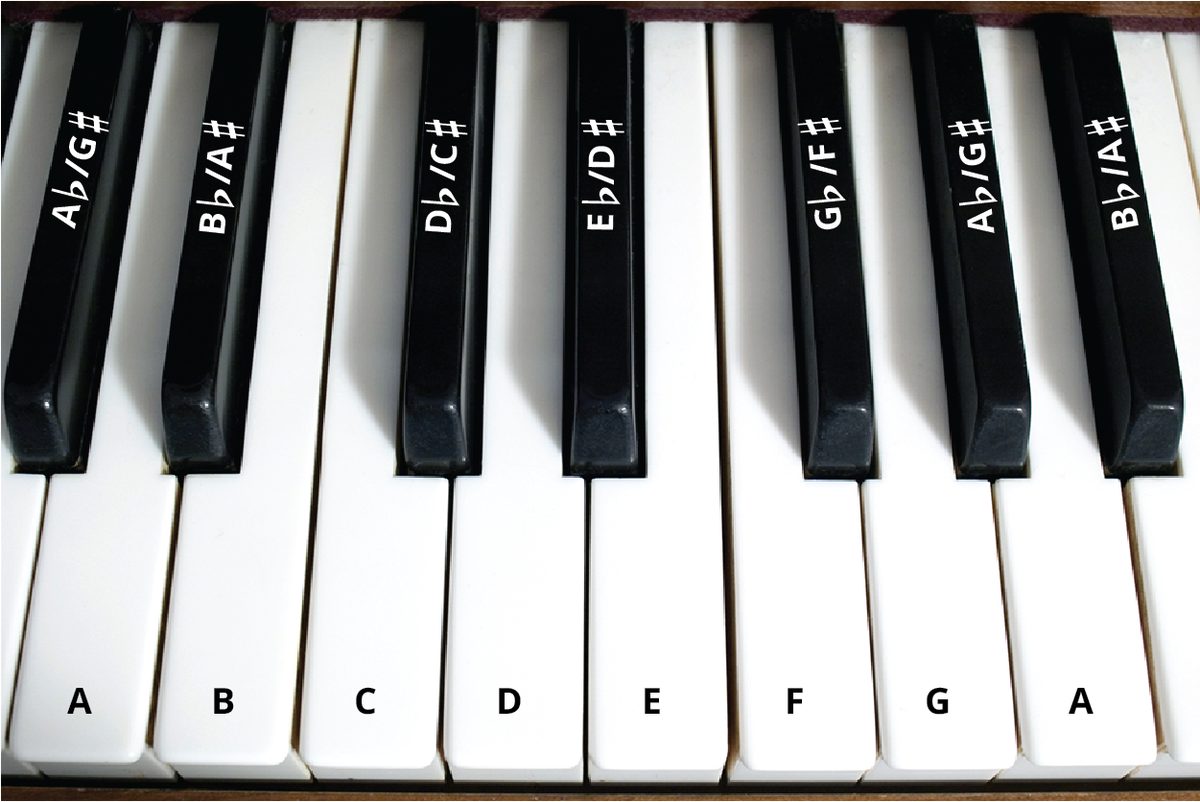
Moving our exploration to note values, the frequency of all notes is well defined by a specific and unique frequency for each note that is measurable. We will explore keys on a keyboard to discuss notes that have the same relationships with any instrument or musical piece.
Let’s look at Figure 13.14. The white keys are labeled with the letters A–G and the photo begins with middle C, which can be found in the middle of a keyboard. This labeling of the keys repeats across an entire keyboard and keys to the right have a higher pitch and frequency than keys to the left. Each of the keys correlates to a musical note.
Movement up or down between any two consecutive keys (black and white) or notes constitutes a half-step. Movement of one half-step sometimes involves a sharp (#) or a flat (♭) symbol. For example, D# is one half-step above D and D♭ is one half-step below D. Note that this is not always true as one half-step above B is C, and one half-step below F is E. In similar fashion, a whole step is movement up or down between any two half-steps on a keyboard.
You may have noticed that there are eight letters of the alphabet used to label notes. Selecting any one note and counting up 12 half-steps you will find that the numbering for notes begins at the same value as you started from. This collection of 12 consecutive half-notes is called an octave and is a basic foundational component in music theory.
Frequencies of Octaves
Notes that are one octave apart have the same name and are related in frequency values. Given the frequency of any note, the frequency of same note one octave higher is doubled and this pattern continues as you move up and down the notes on a keyboard or any other musical instrument. Song writers and singers use this knowledge to change the pitch of a note up or down to align with a person’s vocal range. Regardless of which C is played or sung, the pitch is the same and the frequency is related by a power or two.
Labeled keys on a keyboard are numbered for ease in identification. For example, middle C is labeled as C4 on a full keyboard as it is the fourth C from the left in a set of eight notes. The frequency of C4 is 262 Hz, rounded to the nearest whole number.
We have explored some basics components of frequency, pitch, note relationships, and octaves, which are building blocks of music. It may be exciting to learn that the mathematical relationships found in music are vast and grow in complexity beyond the math commonly studied in high school.
Key Terms
- frequency
- pitch
- Hertz
- decibel
- half-step
- whole step
- flat
- sharp
- octave
Key Concepts
- As frequency of a sound increases, the pitch of the sound increases.
- Hertz is a unit of measurement for frequency.
- Decibel is a unit of measurement for the intensity of sound.
- Half-steps and whole-steps describe one type of movement between two notes on a keyboard.
- Octaves are a collection of any 12 consecutive notes, which is a foundation in music theory.
Adapted from Contemporary Mathematics by OpenStax (openstax.org), licensed under CC BY-NC-SA 4.0. Changes were made. License: CC-BY-NC-SA-4.0.