
2.1 Statements and Quantifiers

Learning Objectives
After completing this section, you should be able to:
- Identify logical statements.
- Represent statements in symbolic form.
- Negate statements in words.
- Negate statements symbolically.
- Translate negations between words and symbols.
- Express statements with quantifiers of all, some, and none.
- Negate statements containing quantifiers of all, some, and none.
Have you ever built a club house, tree house, or fort with your friends? If so, you and your friends likely started by gathering some tools and supplies to work with, such as hammers, saws, screwdrivers, wood, nails, and screws. Hopefully, at least one member of your group had some knowledge of how to use the tools correctly and helped to direct the construction project. After all, if your house isn't built on a strong foundation, it will be weak and could possibly fall apart during the next big storm. This same foundation is important in logic.
In this section, we will begin with the parts that make up all logical arguments. The building block of any logical argument is a logical statement, or simply a statement. A logical statement has the form of a complete sentence, and it must make a claim that can be identified as being true or false.
When making arguments, sometimes people make false claims. When evaluating the strength or validity of a logical argument, you must also consider the truth values, or the identification of true or false, of all the statements used to support the argument. While a false statement is still considered a logical statement, a strong logical argument starts with true statements.
Identifying Logical Statements

An example of logical statement with a false truth value is, “All roses are red.” It is a logical statement because it has the form of a complete sentence and makes a claim that can be determined to be either true or false. It is a false statement because not all roses are red: some roses are red, but there are also roses that are pink, yellow, and white. Requests, questions, or directives may be complete sentences, but they are not logical statements because they cannot be determined to be true or false. For example, suppose someone said to you, “Please, sit down over there.” This request does not make a claim and it cannot be identified as true or false; therefore, it is not a logical statement.
Representing Statements in Symbolic Form
When analyzing logical arguments that are made of multiple logical statements, symbolic form is used to reduce the amount of writing involved. Symbolic form also helps visualize the relationship between the statements in a more concise way in order to determine the strength or validity of an argument. Each logical statement is represented symbolically as a single lowercase letter, usually starting with the letter .
To begin, you will practice how to write a single logical statement in symbolic form. This skill will become more useful as you work with compound statements in later sections.
Negating Statements
Consider the false statement introduced earlier, “All roses are red.” If someone said to you, “All roses are red,” you might respond with, “Some roses are not red.” You could then strengthen your argument by providing additional statements, such as, “There are also white roses, yellow roses, and pink roses, to name a few.”
The negation of a logical statement has the opposite truth value of the original statement. If the original statement is false, its negation is true, and if the original statement is true, its negation is false. Most logical statements can be negated by simply adding or removing the word not. For example, consider the statement, “Emma Stone has green eyes.” The negation of this statement would be, “Emma Stone does not have green eyes.” The table below gives some other examples.
| Logical Statement | Negation |
|---|---|
| Gordon Ramsey is a chef. | Gordon Ramsey is not a chef. |
| Tony the Tiger does not have spots. | Tony the Tiger has spots. |
The way you phrase your argument can impact its success. If someone presents you with a false statement, the ability to rebut that statement with its negation will provide you with the tools necessary to emphasize the correctness of your position.
Negating Logical Statements Symbolically
The symbol for negation, or not, in logic is the tilde, ~. So, not is represented as . To negate a statement symbolically, remove or add a tilde. The negation of not (not ) is . Symbolically, this equation is
Translating Negations Between Words and Symbols
In order to analyze logical arguments, it is important to be able to translate between the symbolic and written forms of logical statements.
Expressing Statements with Quantifiers of All, Some, or None
A quantifier is a term that expresses a numerical relationship between two sets or categories. For example, all squares are also rectangles, but only some rectangles are squares, and no squares are circles. In this example, all, some, and none are quantifiers. In a logical argument, the logical statements made to support the argument are called premises, and the judgment made based on the premises is called the conclusion. Logical arguments that begin with specific premises and attempt to draw more general conclusions are called inductive arguments.
Consider, for example, a parent walking with their three-year-old child. The child sees a cardinal fly by and points it out. As they continue on their walk, the child notices a robin land on top of a tree and a duck flying across to land on a pond. The child recognizes that cardinals, robins, and ducks are all birds, then excitedly declares, "All birds fly!" The child has just made an inductive argument. They noticed that three different specific types of birds all fly, then synthesized this information to draw the more general conclusion that all birds can fly. In this case, the child's conclusion is false.
The specific premises of the child's argument can be paraphrased by the following statements:
- Premise: Cardinals are birds that fly.
- Premise: Robins are birds that fly.
- Premise: Ducks are birds that fly.
The general conclusion is: “All birds fly!”
All inductive arguments should include at least three specific premises to establish a pattern that supports the general conclusion. To counter the conclusion of an inductive argument, it is necessary to provide a counter example. The parent can tell the child about penguins or emus to explain why that conclusion is false.
On the other hand, it is usually impossible to prove that an inductive argument is true. So, inductive arguments are considered either strong or weak. Deciding whether an inductive argument is strong or weak is highly subjective and often determined by the background knowledge of the person making the judgment. Most hypotheses put forth by scientists using what is called the “scientific method” to conduct experiments are based on inductive reasoning.
In the following example, we will use quantifiers to express the conclusion of a few inductive arguments.
Negating Statements Containing Quantifiers
Recall that the negation of a statement will have the opposite truth value of the original statement. There are four basic forms that logical statements with quantifiers take on.
- All are .
- Some are .
- No are .
- Some are not .
The negation of logical statements that use the quantifiers all, some, or none is a little more complicated than just adding or removing the word not.
For example, consider the logical statement, “All oranges are citrus fruits.” This statement expresses as a subset relationship. The set of oranges is a subset of the set of citrus fruit. This means that there are no oranges that are outside the set of citrus fruit. The negation of this statement would have to break the subset relationship. To do this, you could say, “At least one orange is not a citrus fruit.” Or, more concisely, “Some oranges are not citrus fruit.” It is tempting to say "No oranges are citrus fruit," but that would be incorrect. Such a statement would go beyond breaking the subset relationship, to stating that the two sets have nothing in common. The negation of " is a subset of " would be to state that " is not a subset of ," as depicted by the Venn diagram in Figure 2.4.
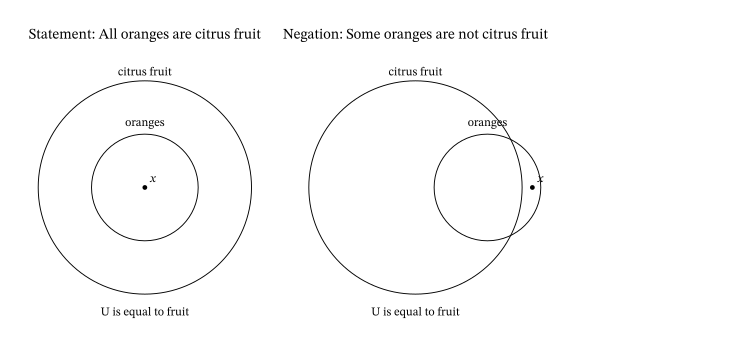
The statement, “All oranges are citrus fruit,” is true, so its negation, “Some oranges are not citrus fruit,” is false.
Now, consider the statement, “No apples are oranges.” This statement indicates that the set of apples is disjointed from the set of oranges. The negation must state that the two are not disjoint sets, or that the two sets have a least one member in common. Their intersection is not empty. The negation of the statement, “ intersection is the empty set,” is the statement that " intersection is not empty," as depicted in the Venn diagram in Figure 2.5.
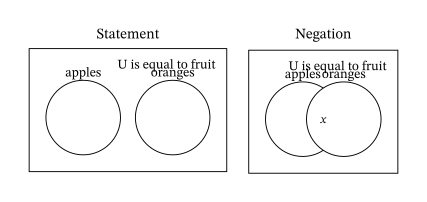
The negation of the true statement “No apples are oranges,” is the false statement, “Some apples are oranges.”
Table 2.2 summarizes the four different forms of logical statements involving quantifiers and the forms of their associated negations, as well as the meanings of the relationships between the two categories or sets and .
| Logical Statements with Quantifiers | Negation of Logical Statements w/Quantifiers |
|---|---|
| Form: All are . Means: is a subset of , All zebras have stripes. (True) | Form: Some are not . Means: is not a subset of , Some zebras do not have stripes. (False) |
| Form: Some are . Means: intersection is not empty, Some fish are sharks. (True) | Form: No are . Means: intersection is empty, No fish are sharks. (False) |
| Form: No are . Means: intersection is empty, No trees are evergreens. (False) | Form: Some are . Means: intersection is not empty, Some trees are evergreens. (True) |
| Form: Some are not . Means: is not a subset of , Some horses are not mustangs. (True) | Form: All are . Means: is a subset of , All horses are mustangs. (False) |
We covered sets in great detail in Chapter 1. To review, " is a subset of " means that every member of set is also a member of set . The intersection of two sets and is the set of all elements that they share in common. If intersection is the empty set, then sets and do not have any elements in common. The two sets do not overlap. They are disjoint.
Key Terms
- logic
- logical statement
- truth values
- symbolic form
- negation of a logical statement
- quantifier
- premises
- conclusion
- inductive logical arguments
Key Concepts
- Logical statements have the form of a complete sentence and make claims that can be identified as true or false.
- Logical statements are represented symbolically using a lowercase letter.
- The negation of a logical statement has the opposite truth value of the original statement.
- Be able to
- Determine whether a sentence represents a logical statement.
- Write and translate logical statements between words and symbols.
- Negate logical statements, including logical statements containing quantifiers of all, some, and none.
video
Adapted from Contemporary Mathematics by OpenStax (openstax.org), licensed under CC BY-NC-SA 4.0. Changes were made. License: CC-BY-NC-SA-4.0.