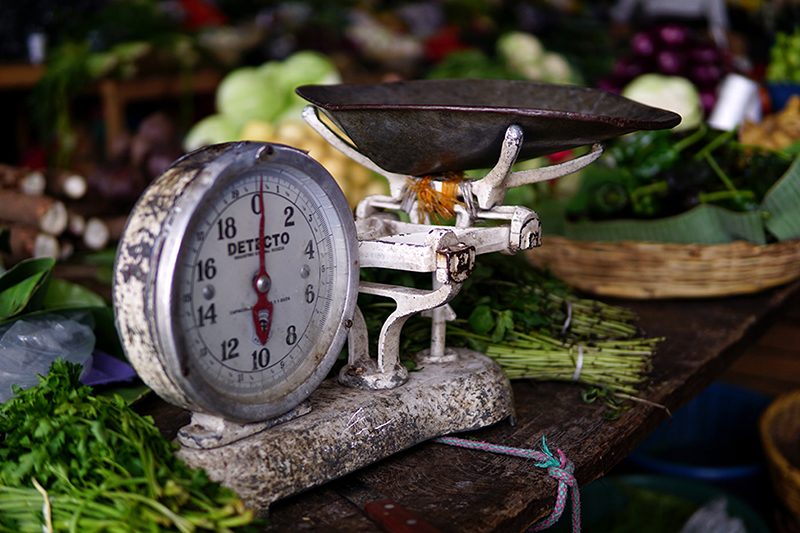
Figure 9.14Weight scale at the local Antigua marketWeight scale at the local Antigua market (credit: “Weight scale at the local Antigua market” by Lucía García González/Flickr, CC0 1.0 Public Domain Dedication)
Learning Objectives
After completing this section, you should be able to:
Identify reasonable values for weight applications.
Convert units of measures of weight.
Solve application problems involving weight.
In the metric system, weight is expressed in terms of grams or kilograms, with a kilogram being equal to 1,000 grams. A paper clip weighs about 1 gram. A liter of water weighs about 1 kilogram. In fact, in the same way that 1 liter is equal in volume to 1 cubic decimeter, the kilogram was originally defined as the mass of 1 liter of water. In some cases, particularly in scientific or medical settings where small amounts of materials are used, the milligram is used to express weight. At the other end of the scale is the metric ton (mt), which is equivalent to 1,000 kilograms. The average car weighs about 2 metric tons.
Any discussion about metric weight must also include a conversation about mass. Scientifically, mass is the amount of matter in an object whereas weight is the force exerted on an object by gravity. The amount of mass of an object remains constant no matter where the object is. Identical objects located on Earth and on the moon will have the same mass, but the weight of the objects will differ because the moon has a weaker gravitational force than Earth. So, objects with the same mass will weigh less on the moon than on Earth.
Since there is no easy way to measure mass, and since gravity is just about the same no matter where on Earth you go, people in countries that use the metric system often use the words mass and weight interchangeably. While scientifically the kilogram is only a unit of mass, in everyday life it is often used as a unit of weight as well.
Reasonable Values for Weight
To have an essential understanding of metric weight, you must be able to identify reasonable values for weight. When testing for reasonableness, you should assess both the unit and the unit value. Only by examining both can you determine whether the given weight is reasonable for the situation.
Converting Like Units of Measures for Weight
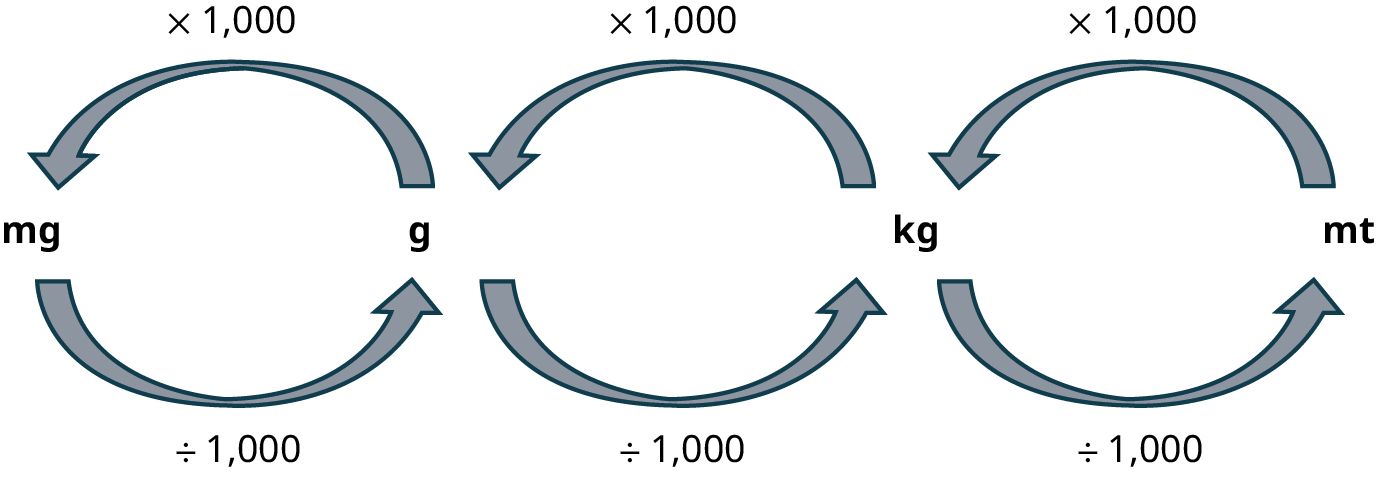
Just like converting units of measure for distance, you can convert units of measure for weight. The most frequently used conversion factors for metric weight are illustrated in Figure 9.15.
Figure 9.15Common Conversion Factors for Metric Weight Units
Solving Application Problems Involving Weight
From children’s safety to properly cooking a pie, knowing how to solve problems involving weight is vital to everyday life. Let’s review some ways that knowing how to work with metric weight can facilitate important decisions and delicious eating.
Key Terms
mass
Key Concepts
Mass is the amount of matter in an object whereas weight is the force exerted on an object by gravity. The mass of an object never changes; the weight of an object changes depending on the force of gravity. An object with the same mass would weigh less on the moon than on Earth because the moon’s gravity is less than that of Earth.
In the metric system, weight and mass are often used interchangeably and are expressed in terms in grams or kilograms.
You can convert between metric weight units using the conversion factors shown in Figure 9.15.
Adapted from Contemporary Mathematics by OpenStax (openstax.org), licensed under CC BY-NC-SA 4.0. Changes were made. License: CC-BY-NC-SA-4.0.
These eBooks are a prerelease and are not yet certified conformant with WCAG 2.1 AA or ADA Title II. Every page is built against an automated accessibility gate, and the published editions will meet ADA Title II requirements when they release in late September 2026. If something is unusable, please tell us.