
9.5 Measuring Temperature
Learning Objectives
After completing this section, you should be able to:
- Convert between Fahrenheit and Celsius.
- Identify reasonable values for temperature applications.
- Solve application problems involving temperature.
When you touch something and it feels warm or cold, what is that really telling you about that substance? Temperature is a measure of how fast atoms and molecules are moving in a substance, whether that be the air, a stove top, or an ice cube. The faster those atoms and molecules move, the higher the temperature.
In the metric system, temperature is measured using the Celsius (°C) scale. Because temperature is a condition of the physical properties of a substance, the Celsius scale was created with 100 degrees separating the point at which water freezes, 0 °C, and the point at which water boils, 100 °C. Scientifically, these are the points at which water molecules change from one state of matter to another—from solid (ice) to liquid (water) to gas (water vapor).
Converting Between Fahrenheit and Celsius Temperatures
Understanding how to convert between Fahrenheit and Celsius temperatures is an essential skill in understanding metric temperatures. You likely know that below 32 °F means freezing temperatures and perhaps that the same holds true for 0 °C. While it may be difficult to recall that water boils at 212 °F, knowing that it boils at 100 °C is a fairly easy thing to remember.
But what about all the temperatures in between? What is the temperature in degrees Celsisus on a scorching summer day? What about a cool autumn afternoon? If a recipe instructs you to preheat the oven to 350 °F, what Celsius temperature do you set the oven at?
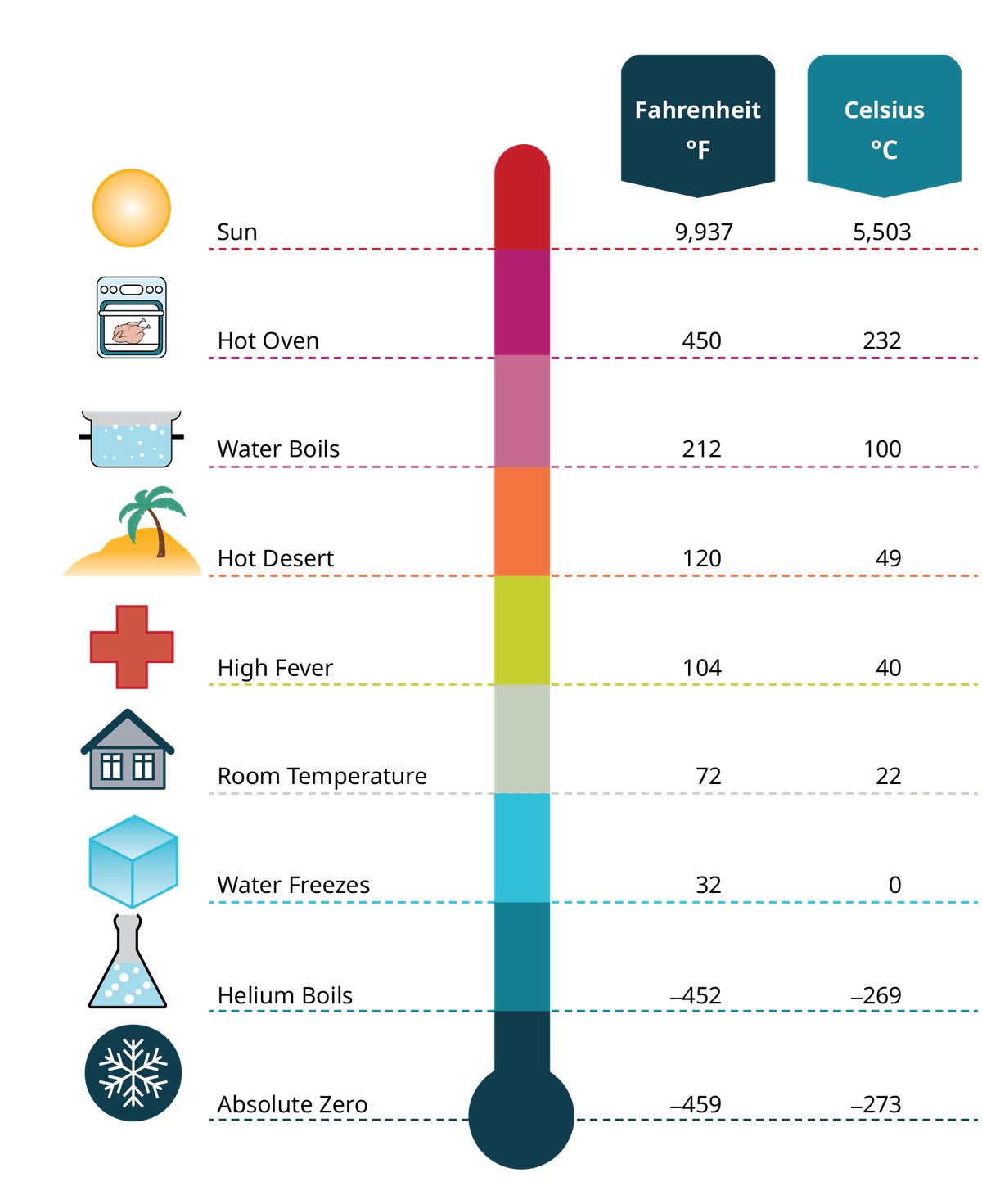
Figure 9.17 lists common temperatures on both scales, because we don’t use Celsius temperatures daily it’s difficult to remember them. Fortunately, we don’t have to. Instead, we can convert temperatures from Fahrenheit to Celsius and from Celsius to Fahrenheit using a simple algebraic expression.
Reasonable Values for Temperature
While knowing the exact temperature is important in most cases, sometimes an approximation will do. When trying to assess the reasonableness of values for temperature, there is a quicker way to convert temperatures for an approximation using mental math. These simpler formulas are listed in Table 9.4.
Solving Application Problems Involving Temperature
Whether traveling abroad or working in a clinical laboratory, knowing how to solve problems involving temperature is an important skill to have. Many food labels express sizes in both ounces and grams. Most rulers and tape measures are two-sided with one side marked in inches and feet and the other in centimeters and meters. And while many thermometers have both Fahrenheit and Celsius scales, it really isn’t practical to pull out a thermometer when cooking a recipe that uses metric units. Let’s review at few instances where knowing how to fluently use the Celsius scale helps solve problems.
Key Terms
- temperature
Key Concepts
- Temperature is a measure of how fast atoms and molecules are moving in a substance, whether that be the air, a stove top, or an ice cube. The faster those atoms and molecules move, the higher the temperature.
- In the metric system, temperature is measured using the Celsius (°C) scale.
- The Celsius scale was created with 100 degrees separating the point at which water freezes, 0 °C, and the point at which water boils, 100 °C. Scientifically, these are the points at which water molecules change from one state of matter to another—from solid (ice) to liquid (water) to gas (water vapor).
Videos
Formulas
To convert temperature from Fahrenheit to Celsius:
To convert temperature from Celsius to Fahrenheit:
To estimate temperature from Fahrenheit to Celsius:
To estimate temperature from Celsius to Fahrenheit:
Projects
Cooking
- Take a favorite recipe that uses customary measures and convert the measures and cooking temperature to the metric system.
- Find a recipe that uses metric measures and convert the measures and cooking temperature to the U.S. Customary System of Measurement, using cups, tablespoons, or teaspoons as required.
- What did you observe? Was it easier to convert from one system to another? Which system allows for more precise measurements? What kitchen tools would you need in your kitchen if you used the metric system?
Shopping
- Compare the average gas price in California to the average gas price in Puerto Rico.
- What conversions did you need to make to do the comparison?
- Do you think that the price of the gasoline is affected by the units in which it is sold?
Sports
- What system of measurement is used for track and field events? Why do you think this system is used?
- What system of measurement is used for football? Why do you think this system is used?
- Research various sports records. Which units of measurement is used? What do you think influenced the unit of measure used?
Adapted from Contemporary Mathematics by OpenStax (openstax.org), licensed under CC BY-NC-SA 4.0. Changes were made. License: CC-BY-NC-SA-4.0.