In Laws of Exponents, we used the first law of exponents to multiply two or more monomials. In this section, we review techniques for multiplying and factoring polynomials of several terms.
Polynomials
A polynomial is a sum of terms in which all the exponents on the variables are whole numbers and no variables appear in the denominator or under a radical. The expressions
are all examples of polynomials in one variable.
An algebraic expression consisting of one term of the form , where is a constant and is a whole number, is called a monomial. For example,
are monomials. A polynomial is just a sum of one or more monomials.
A polynomial with exactly two terms, such as , is called a binomial. A polynomial with exactly three terms, such as or , is called a trinomial. We have no special names for polynomials with more than three terms.
In a polynomial containing only one variable, the greatest exponent that appears on the variable is called the degree of the polynomial. If there is no variable at all, then the polynomial is called a constant, and the degree of a constant is zero.
We can evaluate a polynomial just as we evaluate any other algebraic expression: We replace the variable with a number and simplify the result.
Products of Polynomials
To multiply polynomials, we use a generalized form of the distributive property:
To multiply a polynomial by a monomial, we multiply each term of the polynomial by the monomial.
Products of Binomials
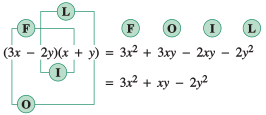
Products of binomials occur so frequently that it is worthwhile to learn a shortcut for this type of multiplication. We can use the following scheme to perform the multiplication mentally. (See Figure.)
This process is sometimes called the FOIL method, where FOIL represents
Factoring
We sometimes find it useful to write a polynomial as a single term composed of two or more factors. This process is the reverse of multiplication and is called factoring. For example, observe that
We will only consider factorization in which the factors have integer coefficients.
Common Factors
We can factor a common factor from a polynomial by using the distributive property in the form
We first identify the common factor. For example, each term of the polynomial
contains the monomial as a factor; therefore,
Next, we insert the proper polynomial factor within the parentheses. This factor can be determined by inspection. We ask ourselves for monomials that, when multiplied by , yield , , and , respectively, and obtain
We can check the result of factoring an expression by multiplying the factors. In the example above,
Opposite of a Binomial
It is often useful to factor from the terms of a binomial.
Hence, we have the following important relationship.
That is, and are opposites or negatives of each other.
Polynomial Division
We can divide one polynomial by a polynomial of lesser degree. The quotient will be the sum of a polynomial and a simpler algebraic fraction.
If the divisor is a monomial, we can simply divide the monomial into each term of the numerator.
If the denominator is not a monomial, we can use a method similar to the long division algorithm used in arithmetic.
When using polynomial division, it helps to write the polynomials in descending powers of the variable. If the numerator is missing any terms, we can insert terms with zero coefficients so that like powers will be aligned. For example, to perform the division
we first write the numerator in descending powers as . We then insert between and and set up the quotient as
We then proceed as in Example. You can check that the quotient is
Section Summary
Vocabulary
Look up the definitions of new terms in the Glossary.
Polynomial
Common factor
Degree
Constant
Trinomial
Monomial
Binomial
SKILLS
Practice each skill in the exercises listed.
Identify polynomials: #1–12
Evaluate polynomials: #13–20
Multiply polynomials: #21–42
Factor out a common factor: #43–68
Divide polynomials: #69–80
Exercises A.7
For Problems 1-8, identify the polynomial as a monomial, a binomial, or a trinomial. Give the degree of the polynomial.
Binomial; 3
Monomial; 4
Trinomial; 2
Trinomial; 3
Which of the expressions in Problems 9-12 are not polynomials?
b and c
a, b, c
For Problems 13-20, evaluate the polynomial function for the given values of the variable.
For Problems 21-42, write the product as a polynomial and simplify.
For Problems 43-60, factor completely. Check your answers by multiplying factors.
For Problems 61-68, supply the missing factors or terms.
For Problems 69-80, divide.
Modeling, Functions, and Graphs by Katherine Yoshiwara (yoshiwarabooks.org), GNU Free Documentation License 1.2 or later. Adapted for the XYZ HTML edition with the authors' permission (recorded 2026-07-04). License: GFDL-1.2-or-later.
These eBooks are a prerelease and are not yet certified conformant with WCAG 2.1 AA or ADA Title II. Every page is built against an automated accessibility gate, and the published editions will meet ADA Title II requirements when they release in late September 2026. If something is unusable, please tell us.