
10.13 The Real Number System
Subsets of the Real Numbers
The numbers associated with points on a number line are called the real numbers. The set of real numbers is denoted by . You are already familiar with several types, or subsets, of real numbers:
- The set of natural, or counting numbers, as its name suggests, consists of the numbers where "" indicates that the list continues without end.
- The set of whole numbers consists of the natural numbers and zero: .
- The set of integers consists of the natural numbers, their negatives, and zero: .
All of these numbers are subsets of the rational numbers.
Rational Numbers
A number that can be expressed as the quotient of two integers where , is called a rational number. The integers are rational numbers, and so are common fractions. Some examples of rational numbers are and . The set of rational numbers is denoted by .
Every rational number has a decimal form that either terminates or repeats a pattern of digits. For example,
and
where the pattern of digits is repeated endlessly. We use the repeater bar notation to write a repeating decimal fraction:
Irrational Numbers
Some real numbers cannot be written in the form , where and are integers. For example, the number is not equal to any common fraction. Such numbers are called irrational numbers. Examples of irrational numbers are and .
The decimal form of an irrational number never terminates, and its digits do not follow a repeating pattern, so it is impossible to write down an exact decimal equivalent for an irrational number. However, we can obtain decimal approximations correct to any desired degree of accuracy by rounding off. A graphing calculator gives the decimal representation of as . This is not the exact value of , but for most calculations it is quite adequate.
Some th roots are rational numbers and some are irrational numbers. For example,
are rational numbers because they are equal to and , respectively. On the other hand,
are irrational numbers. We can use a calculator to obtain decimal approximations for each of these numbers:
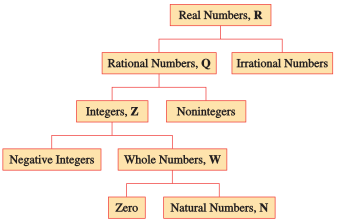
The subsets of the real numbers are related as shown in Figure. Every natural number is also a whole number, every whole number is an integer, every integer is a rational number, and every rational number is real. Also, every real number is either rational or irrational.
Properties of the Real Numbers
The real numbers have several useful properties governing the operations of addition and multiplication. If , , and represent real numbers, then each of the following equations is true:
These properties do not mention subtraction or division. But we can define subtraction and division in terms of addition and multiplication. For example, we can define the difference as follows:
where , the additive inverse (or opposite) of , is the number that satisfies
Similarly, we can define the quotient :
where , the multiplicative inverse (or reciprocal) of , is the number that satisfies
Division by zero is not defined.
Order Properties of the Real Numbers
Real numbers obey properties about order, that is, properties about inequalities. The familiar inequality symbols, and , have the following properties:
- If and are any real numbers, then one of three things is true:
- (Transitive property) For real numbers , , and ,
We also have three properties that are useful for solving inequalities:
- If , then .
- If and , then .
- If and , then .
Section Summary
Vocabulary
Look up the definitions of new terms in the Glossary.
- Real number
- Multiplicative inverse
- Additive inverse
- Distributive property
- Whole number
- Natural number
- Reciprocal
- Opposite
- Irrational number
- Integers
- Counting number
- Transitive property
- Commutative property
- Terminating decimal
- Rational number
- Identity property
- Associative property
- Repeater bar
SKILLS
Practice each skill in the exercises listed.
- Identify types of numbers: #1–12
- Write the decimal form of a fraction: #13–20
- Use the properties governing arithmetic operations: #21–40
- Use the properties of order: #41–46
Exercises A.13
For Problems 1-12, name the subsets of the real numbers to which the number belongs
Rationals
Irrationals
Integers
Whole numbers
Whole numbers
Irrationals
For Problems 13-20, write the rational number in decimal form. Does the decimal terminate or does it repeat a pattern?
, terminates
, repeats a pattern
, terminates
, repeats a pattern
For Problems 21-30, fill in the blank according to the indicated property.
Commutative property
Associative property
Associative property
Commutative property
Commutative property
Commutative property
Associative property
Associative property
Commutative property
Commutative property
For Problems 31-40, use the commutative and associative properties to compute mentally.
For Problems 41-46, fill in the blank with the correct symbol: <, >, or .
If , then
If , then
If , then
If , then
Modeling, Functions, and Graphs by Katherine Yoshiwara (yoshiwarabooks.org), GNU Free Documentation License 1.2 or later. Adapted for the XYZ HTML edition with the authors' permission (recorded 2026-07-04). License: GFDL-1.2-or-later.