
Chapter 5: Logarithmic Functions
In Exponential Functions, we used logarithms to solve exponential equations. In this chapter, we consider logarithmic functions as models in their own right. We also study another base for exponential and logarithmic functions, the natural base , which is the most useful base for many scientific applications.
In 1885, the German philosopher Hermann Ebbinghaus conducted one of the first experiments on memory, using himself as a subject. He memorized lists of nonsense syllables and then tested his memory of the syllables at intervals ranging from 20 minutes to 31 days. After one hour, he remembered less than 50% of the items, but he found that the rate of forgetting leveled off over time. He modeled his data by the function
| Time elapsed | Percent remembered |
|---|---|
| minutes | |
| hour | |
| hours | |
| day | |
| days | |
| days | |
| days |
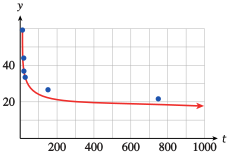
Ebbinghaus's model uses a logarithmic function. The graph of the data, shown above with in minutes and in percents, is called the "forgetting curve." Ebbinghaus's work, including his application of the scientific method to his research, provides part of the foundation of modern psychology.
Modeling, Functions, and Graphs by Katherine Yoshiwara (yoshiwarabooks.org), GNU Free Documentation License 1.2 or later. Adapted for the XYZ HTML edition with the authors' permission (recorded 2026-07-04). License: GFDL-1.2-or-later.