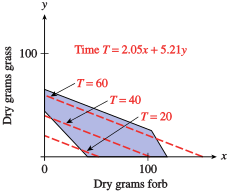
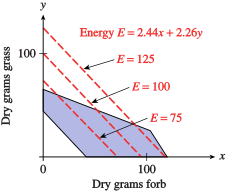
Linear programming is an application of linear systems developed in the 1940s to solve complex optimization problems during wartime operations. Today, linear programming is used in scheduling and allocation of resources, in shipping and telecommunications networks, and in the selection of stocks and bonds for portfolios. In 1980, the computer scientist Laszlo Lovasz said, “If one would take statistics about which mathematical problem is using up most of the computer time in the world,... the answer would probably be linear programming.”
George Dantzig (1914–2005) invented the simplex method for solving linear programming problems in 1947. His first application of the method was to determine an adequate diet of least cost. This problem involved 9 equations in 77 unknowns and took 120 days to solve using the desk calculators available at the time.
In this chapter, we use a graphing technique to solve problems in two unknowns. For example, the diet of the Columbian ground squirrel consists of two foods: grass and forb (a type of flowering weed). Small animals spend most of their time foraging for food, but they must also be alert for predators. Which foraging strategy favors survival: Should the squirrel try to satisfy its dietary requirements in minimum time, thus minimizing its exposure to predators and the elements, or should it try to maximize its intake of nutrients?
Using linear programming, Gary Belovsky of Notre Dame University identified the optimal amounts of forb and grass for each foraging strategy. We can compare those solutions to the squirrel's actual diet to see which strategy the squirrel favors.
Modeling, Functions, and Graphs by Katherine Yoshiwara (yoshiwarabooks.org), GNU Free Documentation License 1.2 or later. Adapted for the XYZ HTML edition with the authors' permission (recorded 2026-07-04). License: GFDL-1.2-or-later.
These eBooks are a prerelease and are not yet certified conformant with WCAG 2.1 AA or ADA Title II. Every page is built against an automated accessibility gate, and the published editions will meet ADA Title II requirements when they release in late September 2026. If something is unusable, please tell us.