
8.1 Systems of Linear Equations in Two Variables
Systems of linear equations are some of the most useful and widely used mathematical tools for solving problems. Systems involving hundreds of variables and equations are not uncommon in applications such as scheduling airline flights or routing telephone calls.
We begin our study by reviewing linear systems.
Solving Systems by Graphing
A biologist wants to know the average weights of two species of birds in a wildlife preserve. She sets up a feeder whose platform is actually a scale and mounts a camera to monitor the feeder. She waits until the feeder is occupied only by members of the two species she is studying, doves and blue jays. Then she takes a picture, which records the number of each species on the scale and the total weight registered.
From her two best pictures, she obtains the following information. The total weight of three blue jays and six doves is ounces, and the total weight of five blue jays and two doves is ounces. Using these data, the biologist estimates the average weight of a blue jay and of a dove. She begins by assigning variables to the two unknown quantities:
Because there are two variables, the biologist must write two equations about the weights of the birds. In each of the two photos,
Thus,
This pair of equations is an example of a linear system of two equations in two unknowns (or a linear system, for short). A solution to the system is an ordered pair of numbers, , that satisfies both equations in the system.
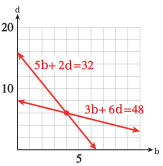
Recall that every point on the graph of an equation represents a solution to that equation. A solution to both equations corresponds to a point on both graphs. Therefore, a solution to the system is a point where the two graphs intersect.
From the figure above, it appears that the intersection point is , so we expect that the values and form the solution to the system. We can check by verifying that these values satisfy both equations in the system.
Both equations are true, so we conclude that the average weight of a blue jay is ounces, and the average weight of a robin is ounces.
Which points on the graphs satisfy both equations in a system?
_____
Their intersection points
Which points on the graphs satisfy both equations in a system?
- Their -intercepts
- Their -intercepts
- Their intersection points
- None of the points
We can obtain graphs for the equations in a system quickly and easily using a calculator.
How can you verify that a given point is the solution of a system?
_____
We show that a point makes both equations true to verify that it is the solution of a system of two equations.
How can you verify that a given point is the solution of a system?
- Add the equations together.
- Show that it makes one of the equations true.
- Show that it makes both equations true.
- Subtract the equations.
- Solve the system of equations by graphing. Use the window
Answer: _____
Enter the solution as an ordered pair.
is the intersection point.
- Solve the system of equations by graphing. Use the window
- Verify algebrically that your solution satisfies both equations.
is the intersection point.
What do the points on the graph of an equation represent?
_____
What do the points on the graph of an equation represent?
Solve the system of equations
by graphing. Use the intersect feature in the window
Answer: _____
Enter the solution as an ordered pair.
is the intersection point.
Solve the system of equations
by graphing. Use the intersect feature in the window
is the intersection point.
Solving Systems Algebraically
In previous algebra courses, you learned two algebraic techniques for solving linear systems: substitution and elimination. See Algebra Skills Refresher Linear Systems in Two Variables if you would like to review these techniques.
It took Leon hours to fly the same distance that Marlene drove in hours. Leon flies miles per hour faster than Marlene drives. At what speed did each travel?
- Let be Leon's speed (mph), let be Marlene's speed (mph), and fill in the table.
Rate Time Distance Leon _____ _____ _____ Marlene _____ _____ _____ - Write one equation about the Leon's and Marlene's speeds.
Equation: _____ - Write a second equation about distances.
Equation: _____ - Solve the system and answer the question in the problem.
_____ Enter your solution as an ordered pair.
Leon traveled at a speed of _____ mph, and Marlene traveled at a speed of _____ mph.
Rate Time Distance Leon Marlene - or
- . Leon flies at mph; Marlene drives at mph.
It took Leon hours to fly the same distance that Marlene drove in hours. Leon flies miles per hour faster than Marlene drives. At what speed did each travel?
- Let be Leon's speed (mph), let be Marlene's speed (mph), and fill in the table.
Rate Time Distance Leon Marlene - Write one equation about Leon's and Marlene's speeds.
- Write a second equation about distances.
- Solve the system and answer the question in the problem.
Rate Time Distance Leon Marlene - or
- . Leon flies at mph; Marlene drives at mph.
When is the substitution method easier to use than the elimination method. Why?
_____
When is the substitution method easier to use than the elimination method. Why?
Inconsistent and Dependent Systems
Because two straight lines do not always intersect at a single point, a system of linear equations does not always have a unique solution. In fact, there are three possibilities, as illustrated below.
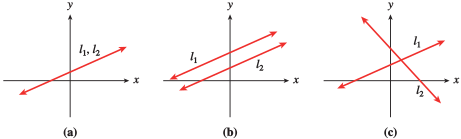
- The graphs may be the same line, as shown in figure (a).
- The graphs may be parallel but distinct lines, as shown in figure (b).
- The graphs may intersect in one and only one point, as shown in figure (c).
A system with no solutions, such as the system in Example, is called inconsistent. A system of linear equations is inconsistent when the two equations correspond to parallel lines. This situation occurs when the lines have the same slope but different -intercepts.
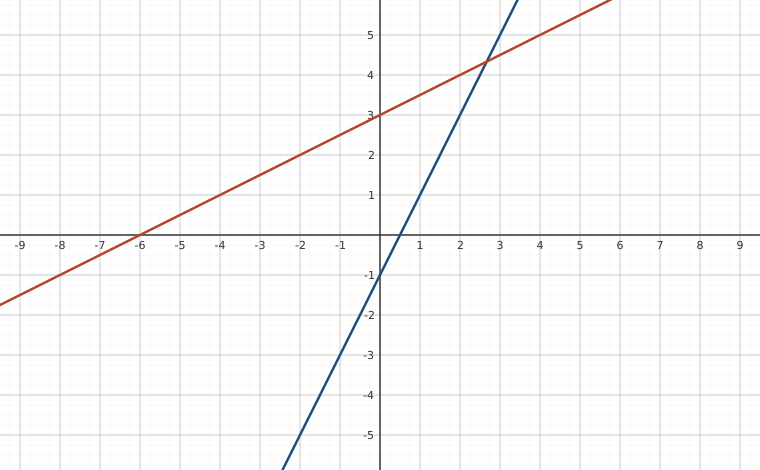
Without graphing, show that the following system is inconsistent:
_____
Both lines have slope .
Without graphing, show that the following system is inconsistent:
Both lines have slope .
A linear system with infinitely many solutions is called dependent. A system is dependent when the two equations actually describe the same line. This situation occurs when the two lines have the same slope and the same -intercept.
Here is a summary of the three cases for a system of linear equations.
- Graph the system by hand, using either the intercept method or the slope-intercept method.
- Identify the system as dependent, inconsistent, or consistent and independent.
_____
- A graph is below.
- Inconsistent: The graph consists of parallel lines.
Graph for part (a)
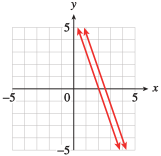
- Graph the system by hand, using either the intercept method or the slope-intercept method.
- Identify the system as dependent, inconsistent, or consistent and independent.
- Inconsistent: The graph consists of parallel lines.
It is not always easy to tell from the equations themselves whether there is one solution, no solution, or infinitely many solutions. However, the method of elimination will reveal which of the three cases applies.
We generalize the results from Example as follows.
If a system is inconsistent, the two lines:
_____
If a system is inconsistent, the two lines are parallel.
If a system is inconsistent, the two lines:
- are parallel.
- are perpendicular.
- intersect.
- have the same graph.
The following Practice 6 illustrates a dependent system.
The following Practice 6 illustrates a dependent system.
- Use the method of elimination to solve the system
Elimination results in _______________. - Verify that both equations have the same graph.
_____
- Elimination results in .
- Both equations have slope-intercept form .
- Use the method of elimination to solve the system
- Verify that both equations have the same graph.
- Elimination results in .
- Both equations have slope-intercept form .
Explain how to use linear combinations to identify inconsistent and dependent systems.
_____
Explain how to use linear combinations to identify inconsistent and dependent systems.
Applications
Many practical problems involve two or more unknown quantities.
Etienne plans to open a coffee house, and he has $ to spend on furniture. A table costs $, and a chair costs $. Etienne will buy four chairs for each table. How many tables can he buy?
- Let represent the number of tables Etienne should buy, and let represent the number of chairs. Write an equation about the cost of the furniture.
_____ - Write a second equation about the number of tables and chairs.
_____ - Graph both equations, solve the system, and answer the question in the problem. (Find the intercepts of the graphs to help you choose a window.)
_____, _____
_____
- . Etienne should buy 8 tables and 32 chairs.
Etienne plans to open a coffee house, and he has $ to spend on furniture. A table costs $, and a chair costs $. Etienne will buy four chairs for each table. How many tables can he buy?
- Let represent the number of tables Etienne should buy, and let represent the number of chairs. Write an equation about the cost of the furniture.
- Write a second equation about the number of tables and chairs.
- Graph both equations, solve the system, and answer the question in the problem. (Find the intercepts of the graphs to help you choose a window.)
- . Etienne should buy 8 tables and 32 chairs.
Being unable to read exact coordinates from a graph is not always a disadvantage. In many situations, fractional values of the unknowns are not acceptable.
The manager for Books for Cooks plans to spend $300 stocking a new diet cookbook. The paperback version costs her $5, and the hardback costs $10. She finds that she will sell three times as many paperbacks as hardbacks. How many of each should she buy?
- Let represent the number of hardbacks and the number of paperbacks she should buy. Write an equation about the cost of the books.
_____ - Write a second equation about the number of each type of book.
_____ - Graph both equations and solve the system. (Find the intercepts of the graphs to help you choose a window.) Answer the question in the problem.
_____, _____
_____
- . The manager should buy hardbacks and paperbacks.
The manager for Books for Cooks plans to spend $300 stocking a new diet cookbook. The paperback version costs her $5, and the hardback costs $10. She finds that she will sell three times as many paperbacks as hardbacks. How many of each should she buy?
- Let represent the number of hardbacks and the number of paperbacks she should buy. Write an equation about the cost of the books.
- Write a second equation about the number of each type of book.
- Graph both equations and solve the system. (Find the intercepts of the graphs to help you choose a window.) Answer the question in the problem.
- . The manager should buy hardbacks and paperbacks.
An Application from Economics
The owner of a retail business must try to balance the demand for his product from consumers with the supply he can obtain from manufacturers. Supply and demand both vary with the price of the product: Consumers usually buy fewer items if the price increases, but manufacturers will be willing to supply more units of the product if its price increases.
The demand function gives the number of units of the product that consumers will buy in terms of the price per unit. The supply function gives the number of units that the producer will supply in terms of the price per unit. The price at which the supply and demand are equal is called the equilibrium price. This is the price at which the consumer and the producer agree to do business.
What is an equilibrium price?
_____
The price at which supply equals demand
What is an equilibrium price?
- A fair and balanced price
- The price that yields maximum profit
- The price at which supply equals demand
- The price at which revenue equals costs
Sanaz can afford to produce pairs of hand-painted sunglasses if she can sell them at dollars per pair, and the market will buy at dollars a pair.
- Write the supply and demand equations for the sunglasses.
Supply equation: _____
Demand equation: _____ - Find the equilibrium price and the number of sunglasses Sanaz will produce and sell at that price.
Equilibrium price: $_____
At the equilibrium price, Sanaz will sell _____ sunglasses
- The Supply equation is , the Demand equation is .
- The equilibrium price is $34, and at that price, Sanaz will sell 1190 sunglasses
Sanaz can afford to produce pairs of hand-painted sunglasses if she can sell them at dollars per pair, and the market will buy at dollars a pair.
- Write the supply and demand equations for the sunglasses.
- Find the equilibrium price and the number of sunglasses Sanaz will produce and sell at that price.
- The Supply equation is , the Demand equation is .
- The equilibrium price is $34, and at that price, Sanaz will sell 1190 sunglasses
Section Summary
Vocabulary
Look up the definitions of new terms in the Glossary.
- Linear system
- Solution of a system
- Intersection point
- Equilibrium point
- Dependent
- Inconsistent
- Consistent and independent
- Demand equation
- Supply equation
CONCEPTS
- We can solve a linear system by graphing. The solution is the intersection point of the two graphs.
- A linear system may be inconsistent (has no solution), dependent (has infinitely many solutions), or consistent and independent (has one solution).
- We can use a system of equations to solve problems involving two unknown quantities.
- In economics, the price at which the supply and demand are equal is called the equilibrium price.
STUDY QUESTIONS
- How can you test whether is a solution to a system of two linear equations?
- Do two lines always intersect in one point? Explain.
- When is a system useful for solving an applied problem?
- Name two algebraic methods for solving a linear system.
- What is the result of performing elimination on a dependent system?
- Explain the terms demand function, supply function, and equilibrium price.
SKILLS
Practice each skill in the Homework problems listed.
- Solve a linear system by graphing: #1–14, 31–34
- Identify inconsistent and dependent systems: #15–20
- Write a system of two linear equations to solve a problem: #21–30
Homework 8.1
In Problems 1–4, solve each system of equations using the graphs given. Verify algebraically that your solution satisfies both equations.
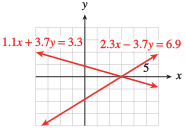
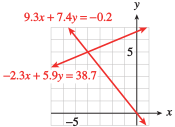
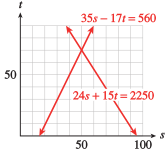
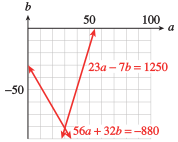
In Problems 5–8, solve each system of equations by graphing. Use the window
Verify algebraically that your solution satisfies both equations.
In Problems 9–14, graph each system by hand, using either the intercept method or the slope-intercept method. Identify the system as dependent, inconsistent, or consistent and independent.
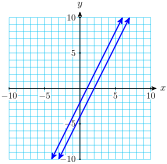
Inconsistent
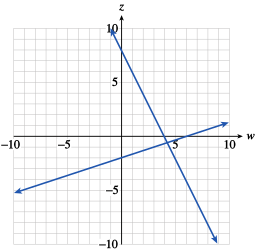
Consistent and independent
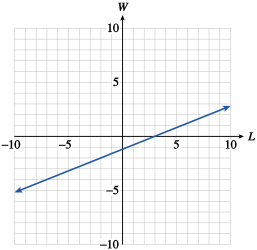
Dependent
Use linear combinations to identify each system in Problems 15–20 as dependent, inconsistent, or consistent and independent. (See Algebra Skills Refresher Linear Systems in Two Variables to review linear combinations.)
Inconsistent
Consistent and independent
Consistent and independent
Solve Problems 21–30 by graphing a system of equations.
Dash Phone Company charges a monthly fee of $, plus $ per minute for long distance calls. Friendly Phone Company charges $ per month, plus $ per minute for long-distance calls.
- Write an equation for Dash Phone Company's monthly bill if you talk long distance for minutes.
- Write an equation for Friendly Phone Company's monthly bill if you talk long distance for minutes.
- Graph both equations in the window and solve the system. How many minutes of long-distance calls would result in equal bills from the two companies?
- min
The Olympus Health Club charges an initial fee of $ and $ monthly dues. The Valhalla Health Spa charges $ initially and $ per month.
- Write an equation for the cost of belonging to Olympus Health Club for months.
- Write an equation for the cost of belonging to Valhalla Health Spa for months.
- Graph both equations in the window and solve the system. After how many months of membership would the costs of belonging to the two clubs be equal?
Yasuo can afford to produce bushels of wheat if he can sell them at cents per bushel, and the market will buy bushels at cents per bushel.
- What is the supply equation?
- What is the demand equation?
- Graph both equations and solve the system. Find the equilibrium price and the number of bushels of wheat Yasuo can sell at that price.
- ¢ per bushel, bushels
Mel's Pool Service can clean pools per week if it charges dollars per pool, and the public will book pool cleanings at dollars per pool.
- What is the supply equation?
- What is the demand equation?
- Graph both equations and solve the system. Find the equilibrium price and the number of pools Mel will clean at that price.
The Aquarius jewelry company determines that each production run to manufacture a pendant involves an initial set-up cost of $ and $ for each pendant produced. The pendants sell for $ each.
- Express the cost of production in terms of the number of pendants produced.
- Express the revenue in terms of the number of pendants sold.
- Graph the revenue and cost on the same set of axes. How many pendants must be sold for the Aquarius company to break even on a particular production run?
- pendants
The Bread Alone Bakery has a daily overhead of $. It costs $ to bake each loaf of bread, and the bread sells for $ per loaf.
- Express the cost in terms of the number of loaves baked.
- Express the revenue in terms of the number of loaves baked.
- Graph the revenue and cost on the same set of axes. How many loaves must the bakery sell to break even on a given day?
The admissions at a Bengals' baseball game was for adults and for students. The ticket office took in for paid admissions. How many adults and how many students attended the game?
- Write algebraic expressions to fill in the table.
Number of
ticketsCost per
ticketRevenue Adults Students Total - Write an equation about the number of tickets sold.
- Write a second equation about the revenue from the tickets.
- Graph both equations and solve the system.
Number of
ticketsCost per
ticketRevenue Adults Students Total — - adults, students
There were passengers on an airplane flight for which first-class fare was and tourist fare was . If the revenue for the flight totaled , how many first-class and how many tourist passengers paid for the flight?
- Write algebraic expressions to fill in the table.
Number of
ticketsCost per
ticketRevenue First-Class Tourist Total - Write an equation about the number of tickets sold.
- Write a second equation about the revenue from the tickets.
- Graph both equations and solve the system.
Earthquakes simultaneously send out two types of waves, called P waves and S waves, but the two types travel at different speeds. A seismograph records arrival of P waves from an earthquake, and ninety seconds later the seismograph receives S waves from the same earthquake. The P waves travel at miles per second, and S waves at miles per second. How far is the seismograph from the earthquake?
- Let represent the time in seconds for the P to arrive at the seismograph, and the distance in miles between the earthquake and seismograph. Fill in the table.
Rate Time Distance P waves S waves - Write an equation about how far the S waves travel.
- Write a second equation about how far the P waves travel.
- Solve the system and answer the question in the problem.
Rate Time Distance P waves S waves y - : The seismograph is miles from the earthquake.
Thelma and Louise start together and drive in the same direction, Thelma driving twice as fast as Louise. At the end of hours, they are miles apart. How fast is each traveling?
- Choose variables for the unknown quantities, and fill in the table.
Rate Time Distance Thelma Louise - Write one equation about Thelma's and Louise's speeds.
- Write a second equation about distances.
- Solve the system and answer the question in the problem.
In Problems 31–34, solve each system of equations by graphing. Find the intercepts of each graph to help you choose a suitable window, then use the intersect feature to locate the solution.
Modeling, Functions, and Graphs by Katherine Yoshiwara (yoshiwarabooks.org), GNU Free Documentation License 1.2 or later. Adapted for the XYZ HTML edition with the authors' permission (recorded 2026-07-04). License: GFDL-1.2-or-later.