
8.2 Systems of Linear Equations in Three Variables
Some problems involve three (or more) unknown quantities, and efficient techniques for solving linear systems in many variables are available. In this section, we solve systems of three linear equations in three variables.
Linear Systems
A solution to an equation in three variables, such as
is an ordered triple of numbers that satisfies the equation. For example, and are solutions to the equation above, but is not. You can verify this by substituting the coordinates into the equation to see if a true statement results.
As with the two-variable case, a single linear equation in three variables has infinitely many solutions.
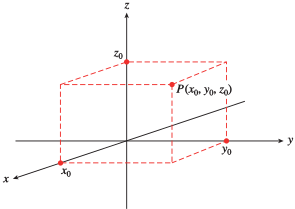
An ordered triple can be represented geometrically as a point in space using a three-dimensional Cartesian coordinate system, as shown below. In this coordinate system, the graph of a linear equation in three variables is a plane, and the fact that there are infinitely many solutions to the equation tells us that that there are infinitely many points in the corresponding plane.
A solution to a system of three linear equations in three variables is an ordered triple that satisfies each equation in the system. That triple represents a point that must lie on all three graphs. The figure below shows the different ways in which three planes may intersect in space.
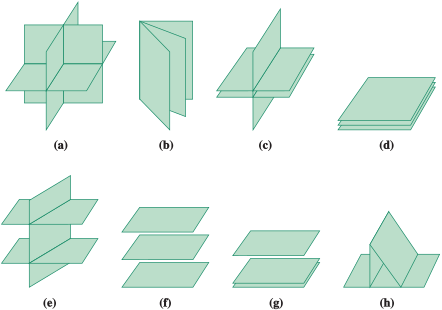
- In figure (a), the three planes intersect in a single point, so the corresponding system of three equations has a unique solution.
- In figures (b), (c), and (d), the intersection is either a line or an entire plane, so the corresponding system has infinitely many solutions. Such a system is called dependent.
- In figures (e), (f), (g), and (h), the three planes have no common intersection, so the corresponding system has no solution. In this case, the system is said to be inconsistent.
It is impractical to solve systems by graphing. Even when technology for producing three-dimensional graphs is available, we cannot read coordinates on such graphs with any confidence. Thus, we will restrict our attention to algebraic methods of solving such systems.
What is a solution to a 3x3 linear system?
_____
What is a solution to a 3x3 linear system?
Back-Substitution
When we review our algebraic methods for systems—substitution and linear combinations—we find features common to both. In both methods, we obtain an equation in one variable. Once we have solved for that variable, we substitute the value into an earlier equation to find the other variable.
One strategy for solving a system extends this idea to include a third variable and a third equation. The following special case illustrates the substitution part of the procedure.
The technique used in Example is called back-substitution. It works in the special case where one of the equations involves exactly one variable, and a second equation involves that same variable and just one other variable. A linear system with these properties is said to be in triangular form. If we can transform a system into triangular form, we can use back-substitution to complete the solution.
Use back-substitution to solve the system
Solution: _____
Enter you solution as an ordered triple.
Use back-substitution to solve the system
What sort of system can be solved by back-substitution?
_____
A triangular system
What sort of system can be solved by back-substitution?
- Any linear system
- A triangular system
- A dependent system
- A complex system
Gaussian Reduction
We can use linear combinations to reduce a system to triangular form and then use back-substitution to find the solutions. Our strategy will be to eliminate one of the variables from each of the three equations by considering them in pairs. This results in a system that we can solve using elimination. As an example, consider the system
- This system is already in standard form. We can choose any one of the three variables to eliminate first. For this example, we will eliminate .
- Choose two of the equations, say (1) and (2), and use a linear combination: We multiply Equation (1) by and add the result to Equation (2) to produce Equation (4).
- Now we have an equation involving only two variables. But we need two equations in two unknowns to find the solution. So we choose a different pair of equations, say (1) and (3), and eliminate again. We multiply Equation (1) by and add the result to Equation (3) to obtain Equation (5).
- We now form a system with our new Equations (4) and (5).
We eliminate either or to obtain an equation in a single variable. If we choose to eliminate , we add times Equation (4) to times Equation (5) to obtain Equation (6).
- Now we can start solving for the variables. To keep things organized, we form a triangular system: Choose one of the original equations (in three variables), one of the equations from our system, and our final equation in one variable. We choose Equations (1), (4), and (6).
This new system is in triangular form, and it has the same solutions as the original system. We complete the solution by back-substitution. Solve Equation (6) to find . Substituting for in Equation (4), we find
Finally, we substitute for and for into Equation (1) to find The solution to the system is the ordered triple . You can verify that this triple satisfies all three of the original equations.
After we eliminate one variable from a pair of equations, what is the next step?
_____
Eliminate the same variable from a different pair of equations.
After we eliminate one variable from a pair of equations, what is the next step?
- Eliminate a different variable from the same pair of equations.
- Eliminate the same variable from a different pair of equations.
- Eliminate a different variable from a different pair of equations.
- Substitute into the third equation.
The method described above for putting a linear system into triangular form is called Gaussian reduction, after the German mathematician Carl Gauss. We summarize our method for solving a linear system as follows.
Use Gaussian reduction to solve the system
Follow the steps suggested below:
- Clear the fractions from Equation (2). _____
- Eliminate from Equations (1) and (2). _____
- Eliminate from Equations (1) and (3). _____
- Eliminate from your new system. _____
- Form a triangular system and solve by back-substitution.
Solution: _____ Give your answer as an ordered triple.
Use Gaussian reduction to solve the system
Follow the steps suggested below:
- Clear the fractions from Equation (2).
- Eliminate from Equations (1) and (2).
- Eliminate from Equations (1) and (3).
- Eliminate from your new system.
- Form a triangular system and solve by back-substitution.
What should you do if one of the original equations in a 3x3 system is "missing" one of the variables?
_____
What should you do if one of the original equations in a 3x3 system is "missing" one of the variables?
Inconsistent and Dependent Systems
The results in Systems of Linear Equations in Two Variables for identifying dependent and inconsistent systems can be extended to linear systems. If at any step in forming linear combinations we obtain an equation of the form
then the system is inconsistent and has no solution. If we obtain an equation of the form
then the system is dependent and has infinitely many solutions.
Decide whether the system is inconsistent, dependent, or consistent and independent.
_____
Inconsistent
Decide whether the system is inconsistent, dependent, or consistent and independent.
Inconsistent
What does it mean if you obtain an equation of the form , ?
_____
The system has no solution.
What does it mean if you obtain an equation of the form , ?
- The system has no solution.
- The system is dependent.
- The solution is .
- The system is triangular.
Decide whether the system is inconsistent, dependent, or consistent and independent.
_____
Dependent
Decide whether the system is inconsistent, dependent, or consistent and independent.
Dependent
Explain how you know immediately that the following system is dependent:
_____
Explain how you know immediately that the following system is dependent:
Applications
Here are some problems that can be modeled by a system of three linear equations. When writing such systems, we must be careful to find three independent equations describing the conditions of the problem.
A manufacturer of office supplies makes three types of file cabinet: two-drawer, four-drawer, and horizontal. The manufacturing process is divided into three phases: assembly, painting, and finishing.
- A two-drawer cabinet requires 3 hours to assemble, 1 hour to paint, and 1 hour to finish.
- The four-drawer model takes 5 hours to assemble, 90 minutes to paint, and 2 hours to finish.
- The horizontal cabinet takes 4 hours to assemble, 1 hour to paint, and 3 hours to finish.
The manufacturer employs enough workers for 500 hours of assembly time, 150 hours of painting, and 230 hours of finishing per week. How many of each type of file cabinet should he make in order to use all the hours available?
- Represent the number of each model of file cabinet by a different variable.
Number of two-drawer cabinets: Number of four-drawer cabinets: Number of horizontal cabinets: - Organize the information into a table. (Convert all times to hours.)
2-Drawer 4-Drawer Horizontal Total available Assembly _____ _____ _____ _____ Painting _____ _____ _____ _____ Finishing _____ _____ _____ _____
Write three equations describing the time constraints in each of the three manufacturing phases. For example, the assembly phase requires hours for the two-drawer cabinets, hours for the four-drawer cabinets, and hours for the horizontal cabinets, and the sum of these times should be the time available, hours.Assembly time: _____ Painting time: _____ Finishing time: _____ - Solve the system. Follow the steps suggested below.
- Clear the fractions from the second equation.
_____ (2) - Subtract Equation (1) from times Equation (3) to obtain a new Equation (4).
_____ (4) - Subtract Equation (2) from twice Equation (3) to obtain a new Equation (5).
_____ (5) - Equations (4) and (5) form a system in and . Subtract Equation (5) from Equation (4) to obtain a new Equation (6).
_____ (6) - Form a triangular system with Equations (3), (4), and (6). Use back-substitution to complete the solution.
_____ Enter the solution as an ordered triple.
- Clear the fractions from the second equation.
- You should have found the following solution: The manufacturer should make two-drawer cabinets, four-drawer cabinets, and horizontal cabinets.
| Assembly time: | ||
|---|---|---|
| Painting time: | ||
| Finishing time: |
Clear the fractions from the second equation.
; then:
,
,
, , , so the solution is .
A manufacturer of office supplies makes three types of file cabinet: two-drawer, four-drawer, and horizontal. The manufacturing process is divided into three phases: assembly, painting, and finishing.
- A two-drawer cabinet requires 3 hours to assemble, 1 hour to paint, and 1 hour to finish.
- The four-drawer model takes 5 hours to assemble, 90 minutes to paint, and 2 hours to finish.
- The horizontal cabinet takes 4 hours to assemble, 1 hour to paint, and 3 hours to finish.
The manufacturer employs enough workers for 500 hours of assembly time, 150 hours of painting, and 230 hours of finishing per week. How many of each type of file cabinet should he make in order to use all the hours available?
- Represent the number of each model of file cabinet by a different variable.
Number of two-drawer cabinets: Number of four-drawer cabinets: Number of horizontal cabinets: - Organize the information into a table. (Convert all times to hours.)
2-Drawer 4-Drawer Horizontal Total available Assembly Painting Finishing
Write three equations describing the time constraints in each of the three manufacturing phases. For example, the assembly phase requires hours for the two-drawer cabinets, hours for the four-drawer cabinets, and hours for the horizontal cabinets, and the sum of these times should be the time available, hours.Assembly time: Painting time: Finishing time: - Solve the system. Follow the steps suggested below.
- Clear the fractions from the second equation.
- Subtract Equation (1) from times Equation (3) to obtain a new Equation (4).
- Subtract Equation (2) from twice Equation (3) to obtain a new Equation (5).
- Equations (4) and (5) form a system in and . Subtract Equation (5) from Equation (4) to obtain a new Equation (6).
- Form a triangular system with Equations (3), (4), and (6). Use back-substitution to complete the solution.
- You should have found the following solution: The manufacturer should make two-drawer cabinets, four-drawer cabinets, and horizontal cabinets.
, , , so the solution is .
Section Summary
Vocabulary
Look up the definitions of new terms in the Glossary.
- Ordered triple
- Gaussian reduction
- Triangular form
- Back-substitution
CONCEPTS
- The solution to a linear system is an ordered triple.
- A system in triangular form can be solved by back-substitution.
- Gaussian reduction is a generalized form of the elimination method that can be used to reduce a linear system to triangular form.
- linear systems may be inconsistent or dependent.
STUDY QUESTIONS
- How can you check whether an ordered triple is a solution of a system?
- In order to solve by back-substitution, does the shortest equation in a triangular system have to be at the bottom?
- After you have eliminated one variable from two of the equations in a linear system, what is the next step?
- How would you start Gaussian reduction on a linear system if the first equation has only two variables?
SKILLS
Practice each skill in the Homework problems listed.
- Solve a triangular system by back-substitution: #1–6
- Solve a linear system by Gaussian reduction: #7–20
- Identify inconsistent and dependent systems: #21–30
- Write a solve a linear system to solve an applied problem: #31–40
Homework 8.2
Use back-substitution to solve Problems 1–6.
Use Gaussian reduction to solve Problems 7–20.
Solve the systems in Problems 21–30. If the system is inconsistent or dependent, say so.
Inconsistent
Inconsistent
Solve Problems 31–40 by using a system of equations.
- Identify three unknown quantities and choose variables to represent them.
- If appropriate, make a table organizing the information in the problem.
- Write three equations about the variables in the problem.
- Solve the system and answer the question in the problem.
A box contains $ in nickels, dimes, and quarters. There are coins in all, with times as many nickels as dimes. How many coins of each kind are there?
nickels, dimes, quarters
Vanita has $ in -dollar, -dollar, and -dollar bills. There are bills in all, with more -dollar bills than -dollar bills. How many bills of each kind does she have?
The perimeter of a triangle is inches. Side is inches shorter than side , and side is inches longer than side . Find the lengths of the sides of the triangle.
in, in, in
One angle of a triangle measures more than a second angle, and the third angle is more than six times the measure of the smallest angle. Find the measure of each angle.
Vegetable Medley is made of carrots, green beans, and cauliflower. The package says that cup of Vegetable Medley provides milligrams of vitamin C and milligrams of calcium.
- One cup of carrots contains milligrams of vitamin C and milligrams of calcium.
- One cup of green beans contains milligrams of vitamin C and milligrams of calcium.
- One cup of cauliflower contains milligrams of vitamin C and milligrams of calcium.
How much of each vegetable is in cup of Vegetable Medley?
cup carrots, cup green beans, cup cauliflower
The Java Shoppe sells a house brand of coffee that is only caffeine for $ per pound. The house brand is a mixture of:
- Colombian coffee that sells for $ per pound and is caffeine,
- French roast that sells for $ per pound and is caffeine,
- and Sumatran that sells for $ per pound and is caffeine.
How much of each variety is in a pound of house brand?
The ABC Psychological Testing Service offers three types of reports on test results: score only, evaluation, and narrative report.
- Each score-only test takes minutes to score using an optical scanner and minute to print the interpretation.
- Each evaluation takes minutes to score, minutes to analyze, and minutes to print.
- Each narrative report takes minutes to score, minutes to analyze, and minutes to print.
If ABC Services uses its optical scanner hours per day, has hours in which to analyze results, and has hours of printer time available per day, how many of each type of report can it complete each day when it is using all its resources?
score only, evaluations, narrative report
Reliable Auto Company wants to ship Status Sedans to three major dealers in Los Angeles, Chicago, and Miami. From past experience, Reliable figures that it will sell twice as many sedans in Los Angeles as in Chicago. It costs $ to ship a sedan to Los Angeles, $ to Chicago, and $ to Miami. If Reliable Auto has $ to pay for shipping costs, how many sedans should it ship to each city?
Ace, Inc. produces three kinds of wooden rackets: tennis rackets, Ping-Pong paddles, and squash rackets. After the pieces are cut, each racket goes through three phases of production: gluing, sanding, and finishing.
- A tennis racket takes hours to glue, hours to sand, and hours to finish.
- A Ping-Pong paddle takes hour to glue, hour to sand, and hour to finish.
- A squash racket takes hours to glue, hours to sand, and hours to finish.
Ace has available labor-hours in its gluing department, labor-hours in sanding, and labor-hours in finishing per day. How many of each racket should it make in order to use all the available personnel?
tennis, Ping Pong, squash
A farmer has acres on which to plant wheat, corn, and soybeans. The seed costs $ for an acre of wheat, $ for an acre of corn, and $ for an acre of soybeans. An acre of wheat requires acre-feet of water during the growing season, while an acre of corn requires acre-feet and an acre of soybeans requires acre-feet. If the farmer has $ to spend on seed and can count on acre-feet of water, how many acres of each crop should he plant in order to use all his resources?
Modeling, Functions, and Graphs by Katherine Yoshiwara (yoshiwarabooks.org), GNU Free Documentation License 1.2 or later. Adapted for the XYZ HTML edition with the authors' permission (recorded 2026-07-04). License: GFDL-1.2-or-later.