
Chapter 3: Power Functions
We next turn our attention to a large and useful family of functions called power functions. This family includes transformations of several of the basic functions, such as
The first function gives the gravitational force, , exerted by the sun on an object at a distance, . The second function gives the speed of sound, , in terms of the air temperature, .
By extending our definition of exponent to include negative numbers and fractions, we will be able to express such functions in the form . Here is an example of a power function with a fractional exponent.
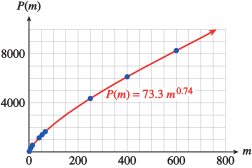
In 1932, Max Kleiber published a remarkable equation for the metabolic rate of an animal as a function of its mass. The table at right shows the mass of various animals in kilograms and their metabolic rates, in kilocalories per day. A plot of the data, resulting in the famous “mouse-to-elephant” curve, is shown in the figure.
| Animal | Mass (kg) | Metabolic rate (kcal/day) |
|---|---|---|
| Baboon | ||
| Cat | ||
| Chimpanzee | ||
| Cow | ||
| Dog | ||
| Elephant | ||
| Guinea pig | ||
| Human | ||
| Mouse | ||
| Pig | ||
| Polar bear | ||
| Rabbit | ||
| Rat | ||
| Sheep |
Kleiber modeled his data by the power function
where is the metabolic rate and is the mass of the animal. Kleiber's rule initiated the use of allometric equations, or power functions of mass, in physiology.
Modeling, Functions, and Graphs by Katherine Yoshiwara (yoshiwarabooks.org), GNU Free Documentation License 1.2 or later. Adapted for the XYZ HTML edition with the authors' permission (recorded 2026-07-04). License: GFDL-1.2-or-later.