
3.2 Integer Exponents
Recall that a positive integer exponent tells us how many times its base occurs as a factor in an expression. For example,
What meaning can we assign to a negative exponent?
Negative Exponents
Study the list of powers of shown in Table (a) and observe the pattern as we move up the list from bottom to top. Each time the exponent increases by 1 we multiply by another factor of . We can continue up the list as far as we like.
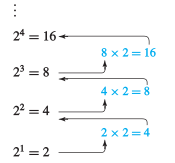
a.
If we move back down the list, we divide by at each step, until we get to the bottom of the list, .
What if we continue the list in the same way, dividing by each time we decrease the exponent? The results are shown in Table (b).
As we continue to divide by , we generate fractions whose denominators are powers of . In particular,
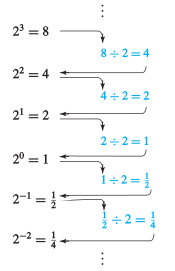
b.
Based on these observations, we make the following definitions.
These definitions tell us that if the base is not zero, then any number raised to the zero power is , and that a negative exponent denotes a reciprocal.
Which of these is equivalent to ?
_____
is equivalent to .
Which of these expressions is equivalent to ?
Write each expression without using negative exponents.
- _____
- _____
Write each expression without using negative exponents.
In the next example, we see how to evaluate expressions that contain negative exponents and how to solve equations involving negative exponents.
Solve the equation
_____
Enter "root(n,x)" for .
Solve the equation
Rewrite without a negative exponent, clear the fraction, then isolate the variable, to find
Explain why , if
_____
Explain why , if
Power Functions
The functions that describe direct and inverse variation are part of a larger family of functions called power functions.
Examples of power functions are
In addition, the basic functions
which we studied in Modeling with Functions can be written as
Their graphs are shown below. Note that the domains of power functions with negative exponents do not include zero.
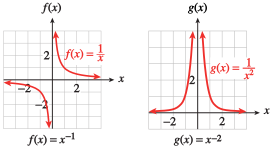
Write each function as a power function in the form .
For this exercise, enter rational numbers in decimal form. For example, enter "0.5" rather than "1/2".
- _____
- _____
- _____
Write each function as a power function in the form .
Which statement is true about power functions?
_____
They can describe direct or inverse variation.
Which statement is true about power functions?
- They can describe direct or inverse variation.
- They involve a power of the output variable.
- The -intercept must be a positive number.
- They include all linear and quadratic functions.
Most applications are concerned with positive variables only, so many models use only the portion of the graph in the first quadrant.
The function is an example of an inverse square law, because varies inversely with the square of . Such laws are fairly common in physics and its applications, because gravitational and other forces behave in this way. Here is a more modern example of an inverse square law.
Cell phone towers typically transmit signals at 10 watts of power. The signal strength varies inversely with the square of distance from the tower, and 1 kilometer away the signal strength is 0.8 picowatt. (A picowatt is watt.) Cell phones can receive a signal as small as 0.01 picowatt. How far can you be from the nearest tower and still hope to have cell phone reception?
About _____ km
About 9 km
Cell phone towers typically transmit signals at 10 watts of power. The signal strength varies inversely with the square of distance from the tower, and 1 kilometer away the signal strength is 0.8 picowatt. (A picowatt is watt.) Cell phones can receive a signal as small as 0.01 picowatt. How far can you be from the nearest tower and still hope to have cell phone reception?
where is in picowatts and is in kilometers. If , we solve for to find is about 9 km.
What is an inverse square law? Give an example.
_____
What is an inverse square law? Give an example.
Working with Negative Exponents
A negative exponent denotes the reciprocal of a power. Thus, to simplify a fraction with a negative exponent, we compute the positive power of its reciprocal.
Simplify _____
Simplify
Dividing by a power with a negative exponent is equivalent to multiplying by a power with a positive exponent.
Write each expression without using negative exponents.
- _____
- _____
Write each expression without using negative exponents.
Laws of Exponents
The laws of exponents apply to all integer exponents, positive, negative, and zero. When we allow negative exponents, we can simplify the rule for computing quotients of powers.
For example, by applying this new version of the law for quotients, we find
which is consistent with our previous version of the rule,
Which of these is equivalent to ?
_____
Which of these is equivalent to ?
For reference, we restate the laws of exponents below. The laws are valid for all integer exponents and , and for .
You can check that each of the calculations in Example is shorter when we use negative exponents instead of converting the expressions into algebraic fractions.
Which of the following is not one of the laws of exponents?
_____
The equation is not one of the laws of exponents.
Which of the following is not one of the laws of exponents?
Simplify by applying the laws of exponents. Write without negative exponents.
- _____
- _____
Simplify by applying the laws of exponents. Write without negative exponents.
At the start of this section, we saw that , and in fact as long as . Now we can see that this definition is consistent with the laws of exponents. The quotient of any (nonzero) number divided by itself is . But by applying the second law of exponents, we also have
Thus,
For example,
Give a numerical example to show why we cannot add or subtract terms with the same variable but different exponents.
_____
Give a numerical example to show why we cannot add or subtract terms with the same variable but different exponents.
Section Summary
Vocabulary
Look up the definitions of new terms in the Glossary.
- Power function
- Inverse square law
CONCEPTS
- A negative exponent denotes a reciprocal: , if .
- Any number (except zero) raised to the zero power is : , if .
- A function of the form , where and are constants, is called a power function.
STUDY QUESTIONS
- Explain the difference between each pair of expressions.
- and
- and
- and
- Write a power function for " varies inversely with the cube of ."?
- Explain why it makes sense to define .
- Why is zero excluded from the domain of ?
- Choose a value for to show that the following statement is false:
SKILLS
Practice each skill in the Homework problems listed.
- Simplify expressions with negative exponents: #1–12
- Solve equations involving negative exponents: #19–24
- Write formulas for power functions: #17 and 18, 25–34
- Evaluate and analyze power functions: #13–16, 25–34
- Apply the laws of exponents to simplify expressions: #35–62
Homework 3.2
Make a table showing powers of from to . Illustrate why defining makes sense.
Each time increases by , we multiply the power in the bottom row by .
Make a table showing powers of from to . Illustrate why defining makes sense.
For Problems 3–6, compute each power.
For Problems 7–12, write without negative exponents and simplify.
Use your calculator to fill in the tables in Problems 13 and 14. Round your answers to two decimal places.
- What happens to the values of as the values of increase? Explain why.
- What happens to the values of as the values of decrease toward ? Explain why.
- The values of decrease, because is the reciprocal of .
- The values of increase toward infinity, because is the reciprocal of .
- What happens to the values of as the values of increase? Explain why.
- What happens to the values of as the values of decrease toward ? Explain why.
- Use your calculator to graph each of the following functions on the window
- Which functions have the same graph? Explain your results.
b. (ii), (iii), and (iv) have the same graph, because they represent the same function.
- Use your calculator to graph each of the following functions on the window
- Which functions have the same graph? Explain your results.
For Problems 17–18, write each expression as a power function using negative exponents.
For Problems 19–24, solve.
or
or
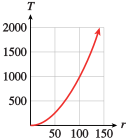
When an automobile accelerates, the power, , needed to overcome air resistance varies directly with a power of the speed, .
- Use the data and the graph to find the scaling exponent and the constant of variation. Then write a formula for as a power function of .
(mph) (watts) 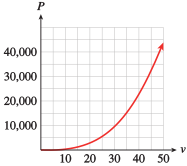
- Find the speed that requires watts of power.
- If you increase your speed by , by what factor does the power requirement increase?
- mph
The power, , generated by a windmill varies directly with a power of wind velocity, .
- Use the data and the graph to find the scaling exponent and the constant of variation. Then write a formula for as a power function of .
(mph) (watts) 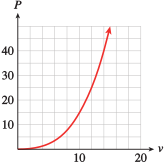
- Find the wind velocity needed to generate watts of power.
- If the wind speed drops by half, what happens to the power generated?
The “Rule of 70” is used to estimate how long it takes an investment to double in value when interest is compounded annually. The doubling time, , is inversely proportional to the interest rate, . (Note that is expressed as a percent, not as a decimal fraction. For example, if the interest rate is , then .)
- Use the data and the graph to find the constant of proportionality and write as a power function of .
(mph) (watts) - If the interest rate increases from to , how will the doubling time change?
- It decreases by about years.
The f-stop setting on a camera regulates the size of the aperture and thus the amount of light entering the camera. The f-stop is inversely proportional to the diameter, , of the aperture.
- Use the data and the graph to find the constant of proportionality and write as a power function of . Values of have been rounded to one decimal place.
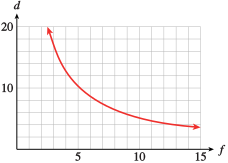
- Why are the f-stop settings labeled with the values given in the table? Hint: As you stop down the aperture from one f-value to the next, by what factor does increase?
The Stefan-Boltzmann law relates the total amount of radiation emitted by a star to its temperature, , in kelvins, by the following formula:
where is the radius of the star, is its luminosity, and is a constant governing radiation. (See Algebra Skills Refresher Scientific Notation to review scientific notation.)
- Write a formula for luminosity as a power function of temperature for a fixed radius.
- The radius of the Sun is meters, and its luminosity is watts. Calculate the temperature of the Sun.
- K
Poiseuille's law for the flow of liquid through a tube can be used to describe blood flow through an artery. The rate of flow, , in liters per minute is proportional to the fourth power of the radius, , divided by the length, , of the artery.
- Write a formula for the rate of flow as a power function of radius.
- If the radius and length of the artery are measured in centimeters, then the constant of variation, , is determined by blood pressure and viscosity. If a certain artery is centimeters long, what should its radius be in order to allow a blood flow of liters per minute?
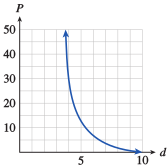
Airplanes use radar to detect the distances to other objects. A radar unit transmits a pulse of energy, which bounces off a distant object, and the echo of the pulse returns to the sender. The power, , of the returning echo is inversely proportional to the fourth power of the distance, , to the object. A radar operator receives an echo of watts from an aircraft nautical miles away.
- Express the power of the echo received in picowatts. ( picowatt watts.)
- Write a function that expresses in terms of d using negative exponents. Use picowatts for the units of power.
- Complete the table of values for the power of the echo received from objects at various distances.
(nautical miles) (picowatts) - Radar units can typically detect signals as low as watts. How far away is an aircraft whose echo is watts? Hint: Convert watts to picowatts.
- Sketch a graph of as a function of . Use units of picowatts on the vertical axis.
- picowatts
(nautical miles) (picowatts) - nautical miles
The lifetime of a star is roughly inversely proportional to the cube of its mass. Our Sun, which has a mass of one solar mass, will last for approximately billion years.
- Write a power function for the lifetime, , of a star in terms of its mass, .
- Sketch a graph of the function using units of solar mass on the horizontal axis.
- How long will a star that is times as massive as the Sun last?
- One solar mass is about kilograms. Rewrite your formula for with the units of mass in kilograms.
- How long will a star that is half as massive as the Sun last?
The amount of force or thrust generated by the propeller of a ship is a function of two variables: the diameter of the propeller and its speed, in rotations per minute. The thrust, , in pounds, is proportional to the square of the speed, , and the fourth power of the diameter, , in feet.
- Write a formula for the thrust in terms of the speed if the diameter of the propeller is feet.
- A propeller of diameter feet generates a thrust of pounds at rotations per minute. Find the constant of variation in the formula for thrust.
- Sketch a graph of the thrust as a function of the propeller speed for a propellor of diameter feet. If the speed of the propeller is doubled, by what factor does the thrust increase?
Refer to Problem 33.
- Write a formula for the thrust, , in terms of the diameter of the propeller if its speed is rotations per minute.
- A propeller of diameter feet generates a thrust of pounds at rotations per minute. Find the constant of variation in the formula for thrust.
- Sketch a graph of the thrust as a function of the diameter of the propeller at a speed of rotations per minute. If the diameter of the propeller is doubled, by what factor does the thrust increase?
For Problems 35–40, use the laws of exponents to simplify and write without negative exponents.
For Problems 41–44, write each expression as a sum of terms of the form .
For Problems 45–50, use the distributive law to write each product as a sum of power functions.
For Problems 51–54, factor as indicated, writing the second factor with positive exponents only.
- Is it true that ? Explain why or why not.
- Give a numerical example to support your answer.
- No, because is not .
- Let , , then , but
- Is it true that ? Explain why or why not.
- Give a numerical example to support your answer.
- Show that .
- Show that .
- Write as an algebraic fraction. Justify your answer.
- Show that .
- If , show that .
By rewriting the expressions in Problems 59–62 as fractions, verify that the laws of exponents hold for negative exponents. Show where you apply the corresponding law for positive exponents. Here is the fourth law as an example:
Modeling, Functions, and Graphs by Katherine Yoshiwara (yoshiwarabooks.org), GNU Free Documentation License 1.2 or later. Adapted for the XYZ HTML edition with the authors' permission (recorded 2026-07-04). License: GFDL-1.2-or-later.