
3.5 Joint Variation
Functions of Two or More Variables
So far, we have studied functions that relate values of an output variable to values of a single input variable. But it is not uncommon for an output variable to depend on two or more inputs. Many familiar formulas describe functions of several variables.
For example, the perimeter of a rectangle depends on its length and width. The volume of a cylinder depends on its radius and height. The distance you travel depends on your speed and the time you spent traveling. Each of these formulas can be written with function notation.
Which is true about a function of two variables?
_____
A function of two variables has two inputs and one output.
Which statement is true about a function of two variables?
- It has one input and two outputs.
- It has two inputs and one output.
- It has two inputs and two outputs.
- None of the above.
The maximum height that the water stream from a fire hose can reach depends on the water pressure and the diameter of the nozzle, and is given by the function
where is the nozzle pressure in psi, and is measured in -inch increments over the standard nozzle diameter of inch.
- Evaluate and explain what it means.
_____
_____ - What nozzle pressure is needed to reach a height of feet with a -inch nozzle?
__________
- . With nozzle diameter inch and nozzle pressure psi, the water will reach feet.
- The -inch nozzle is three increments over the standard nozzle diameter of inch. We solve for when and : psi
The maximum height that the water stream from a fire hose can reach depends on the water pressure and the diameter of the nozzle, and is given by the function
where is the nozzle pressure in psi, and is measured in -inch increments over the standard nozzle diameter of inch.
- Evaluate and explain what it means.
- What nozzle pressure is needed to reach a height of feet with a -inch nozzle?
- . With nozzle diameter inch and nozzle pressure psi, the water will reach feet.
- The -inch nozzle is three increments over the standard nozzle diameter of inch. We solve for when and : psi
Tables of Values
Just as for functions of a single variable, we can use tables to describe functions of two variables, . The row and column headings show the values of the two input variables, and the table entries show the values of the output variable.
A retirement plan requires employees to put aside a fixed amount of money each year until retirement. The amount accumulated, , includes 8% annual interest on employee's annual contribution, . is a function of and the number of years, , that the employee makes contributions, so .
| Retirement Fund Balance | |||||
| Number of years of contributions | |||||
| Annual contribution | |||||
- How much will an employee accumulate if she contributes $500 a year for 40 years? (Do not enter any commas. For example, enter "10000" for 10,000.
$_____
Write your answer with function notation:
_____,__________ - How much must she contribute each year in order to accumulate $573,770 after 50 years? $_____
Write your answer with function notation.
_____,__________ - Find a value of that solves the equation .
_____
What does this equation tell you about the retirement fund?
_____
- $129,528,
- $1000,
- 20 years. If you contribute $2500 per year for 20 years, you will accumulate $137,286.
A retirement plan requires employees to put aside a fixed amount of money each year until retirement. The amount accumulated, , includes 8% annual interest on employee's annual contribution, . is a function of and the number of years, , that the employee makes contributions, so .
| Retirement Fund Balance | |||||
| Number of years of contributions | |||||
| Annual contribution | |||||
- How much will an employee accumulate if she contributes $500 a year for 40 years? Write your answer with function notation.
- How much must she contribute each year in order to accumulate $573,770 after 50 years? Write your answer with function notation.
- Find a value of that solves the equation . What does this equation tell you about the retirement fund?
- $129,528,
- $1000,
- 20 years. If you contribute $2500 per year for 20 years, you will accumulate $114,405.
Joint Variation
Sometimes we can find patterns relating the entries in a table.
| Maximum Load (kilograms) | ||||||
| Depth (cm) | ||||||
| Width (cm) | ||||||
- For the table in the previous example, consider the column corresponding to a beam depth of cm. Graph as a function of when the depth is constant at .
- Find a formula for as a function of for .
_____
- A graph of the line is below.
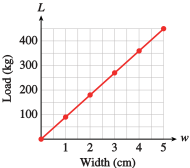
- For the table in the previous example, consider the column corresponding to a beam depth of cm. Graph as a function of when the depth is constant at .
- Find a formula for as a function of for .
In Practice 3, you should find that the load varies directly with width when the depth is centimeters. In fact, the load varies directly with width for any fixed depth.
In Practice 3, you should find that the load varies directly with width when the depth is centimeters. In fact, the load varies directly with width for any fixed depth.
In Example, we saw that the load varies with the square of depth when the width is centimeters, and this relationship also holds for any value of . Consequently, we can find a constant such that
This relationship between variables is an example of joint variation.
Which of the following functions represents joint variation, where is a constant?
_____
Which of the following functions represents joint variation, where is a constant?
The cost, , of tiling a rectangular floor depends on the dimensions (length and width) of the floor, so . The table shows the costs in dollars for some dimensions.
| Cost of Tiling a Floor | ||||||
| Length (ft) | ||||||
| Width (ft) | ||||||
- Consider the row corresponding to feet in width. Does cost vary directly with length? _____
- Consider the column corresponding to a length of feet. Does the cost vary directly with width? _____
- Given that the cost varies jointly with the length and width of the floor, find a formula for .
_____
- Yes
- Yes
The cost, , of tiling a rectangular floor depends on the dimensions (length and width) of the floor, so . The table shows the costs in dollars for some dimensions.
| Cost of Tiling a Floor | ||||||
| Length (ft) | ||||||
| Width (ft) | ||||||
- Consider the row corresponding to feet in width. Does cost vary directly with length?
- Consider the column corresponding to a length of feet. Does the cost vary directly with width?
- Given that the cost varies jointly with the length and width of the floor, find a formula for .
- Yes
- Yes
Explain the difference between the symbols and .
_____
Explain the difference between the symbols and .
Graphs
It is possible to make graphs in three dimensions for functions of two variables, but we will not do that here. Instead, we will represent such functions graphically by holding one of the two variables constant.
We can represent a function of two variables by
_____
all of the above.
We can represent a function of two variables by
- a table of values.
- a graph in three dimensions.
- several graphs in two dimensions.
- all of the above.
The period of a satellite orbiting the Earth varies directly with the radius of the orbit and inversely with the speed of the satellite.
- Write a formula for the period, , as a function of orbital radius, , and velocity, . Your formula should contain a constant of variation (whose value we will determine later).
_____ - GPS satellites orbit at an altitude of kilometers and a speed of 233 kilometers per minute. The period of a GPS satellite is 11 hours and 58 minutes. Find the constant of variation in your formula for . (The radius of the Earth is 6360 km.)
_____ - Satellites in polar orbits are used to measure ozone concentrations in the atmosphere. One such satellite orbits at an altitude of 833 km and has a period of 101.2 minutes. What is the speed of this satellite?
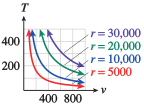
Speed: __________ - Graph as a function of for , , , and .
- We first convert the period to minutes, then we substitute values into our formula and solve for to find that . (Actually, .)
- km/min
- A graph is below.
The period of a satellite orbiting the Earth varies directly with the radius of the orbit and inversely with the speed of the satellite.
- Write a formula for the period, , as a function of orbital radius, , and velocity, .
- GPS satellites orbit at an altitude of kilometers and a speed of 232 kilometers per minute. The period of a GPS satellite is 11 hours and 58 minutes. Find the constant of variation in your formula for . (The radius of the Earth is 6360 km.)
- Satellites in polar orbits are used to measure ozone concentrations in the atmosphere. One such satellite orbits at an altitude of 833 km and has a period of 101.2 minutes. What is the speed of this satellite?
- Graph as a function of for , , , and .
- We first convert the period to minutes, then we substitute values into our formula and solve for to find that . (Actually, .)
- km/min
Section Summary
Vocabulary
Look up the definitions of new terms in the Glossary.
- Function of two variables
- Joint variation
CONCEPTS
- The notation indicates that is a function of two variables, and .
- We can use a table with rows and columns to display the output values for a function of two variables.
- We can represent a function of two variables graphically by showing a set of graphs for several fixed values of one of the variables.
STUDY QUESTIONS
- Explain the difference between the symbols and .
- Why is it true that , but not usually true that ?
- If varies jointly with and , and we hold one of the input variables constant, what will the graph look like?
- What is wrong with the statement " varies jointly with and , so ?
SKILLS
Practice each skill in the Homework problems listed.
- Evaluate the formula for a function of two or more variables, and interpret the result: #1–6
- Evaluate a function of two variables from a table: #7–10
- Write a formula for joint variation: #11–18
- Graph a function of two variables by fixing values of one of the variables: #11, 12, 15, 16, 19, 20
Homework 3.5
Melody Airlines charges $ for a coach ticket from San Francisco to Seattle, and $ for a first-class ticket.
- Write a function of two variables for the revenue, , that Melody Airlines will collect from the flight.
- The airplane has first-class seats and coach seats. What is the maximum revenue the airline can collect? Write your answer with function notation.
- dollars is the maximum revenue.
A manufacturing firm calculates its profit (or loss) by subtracting the cost of production from its revenue. The firm can produce 100 items per week, with fixed costs (overhead) of $.
- Write a function for the firm's weekly profit, , if they charge a price of dollars per item and it costs them dollars to produce each item.
- If each item costs $ to produce, what price should the firm charge in order to make a profit? Write your answer with function notation.
Archaeologists can calculate the size of a pot from just a fragment, or sherd, of the original. If and are the dimensions of an arc of a circle, as shown in the figure, then the radius of the entire circle is given by the function
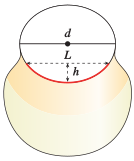
- A pottery sherd has dimensions inches and inch. What was the radius of the whole pot? Write your answer with function notation.
- Does vary directly with ? Why or why not?
- Show that the formula gives the correct value for when the sherd is actually a semicircle. Hint: What are the values of and in this case?
- inches
- No: We do not have for any constant .
- When and , .
The surface area of a cylinder is a function of its diameter and height,
- What is the surface area of a cylindrical oatmeal container with diameter inches and height inches? Write your answer with function notation.
- Write a formula in terms of for the surface area of a cylinder whose height is equal to its diameter.
- How does the surface area of the cylinder in part (b) compare with the surface area of a sphere of the same diameter? Sketch both surfaces with the same center.
The Dubois formula is used to estimate the surface area, , of a person in terms of his or her weight and height. A good estimate of surface area is critical to some forms of cancer treatment. In square centimeters, is given by
where is in kilograms and is in centimeters.
- Use the Dubois formula to estimate the surface area of a person who weighs kg and is cm tall.
- Does surface area increase more rapidly with weight or with height?
- What percent increase in surface area does a increase in weight produce?
- sq cm
- Height
In the 1970s, McNeill Alexander proposed a relationship between an animal's running speed, , its hip height, , and its stride length, . If stride and hip height are measured in meters, the running speed is given in meters per second by
- What is the speed of a racehorse whose hip height is meters and stride length is meters?
- A cheetah can run at meters per second. If its hip height is meters, what is its stride length?
- A pronghorn antelope has the same stride length as a cheetah and its hip height is greater than the cheetah's. How does its running speed compare to a cheetah's?
If you walk for exercise, the number of calories, , you burn per mile depends on your walking speed, , and your weight, .
- Write this fact in function notation.
- Use the table to evaluate and explain its meaning.
- Solve the inequality and explain its meaning.
- If you weigh pounds, how fast should you walk to burn the most calories per mile?
- How can you use the table to calculate how many calories you burn per hour while walking?
| Calories Burned per Mile | |||||||
| Weight (pounds) | |||||||
| Speed (mph) | |||||||
- , so someone walking mph and weighing pounds burns calories per mile.
- . A person who weighs pounds must walk faster than mph in order to burn more than calories per mile.
- mph
- Find the row with your walking speed in the left column and move along that row until you are in the column with your weight at the top. The value in that row and column is the number of calories you burn per mile.
The BMI (body mass index) is used to determine whether a person is a healthy weight, overweight, or obese. is a function of height, , and weight, .
- Write this fact in function notation.
- Use the table to evaluate and explain its meaning.
- A person is deemed overweight if his or her BMI is at least but less than . Write this fact in function notation. (A person is obese if the BMI is over .)
- Solve the inequality and explain its meaning.
- Solve the inequality and explain its meaning.
| Body Mass Index | |||||||||||
| Weight (pounds) | |||||||||||
| Height (inches) | |||||||||||
An amortization table shows the monthly payments for a loan or mortgage. The table below gives monthly payments for a loan of $. The monthly payment, , is a function of the annual interest rate, , and the length of the loan, , in years.
| Monthly Payment | ||||||
| Length of loan (years) | ||||||
| Interest rate | ||||||
- You would like to borrow $ for years. What interest rate, to the nearest percent, can you accept if your monthly payments must be no more than $? What interest rate can you accept if the loan is for years? If , use function notation to write both of these questions as inequalities.
- Suppose you borrow $ for years at interest. Which would cause a greater reduction in your monthly payment: Reducing the interest rate by or increasing the length of the loan by years?
- At a fixed interest rate of , is the monthly payment a linear function of the length of the loan?
- For a fixed loan period of years, is the monthly payment a linear function of interest rate?
- Does a increase in the interest rate have a greater affect on the monthly payment for a -year loan or a -year loan?
- When is ? ; When is ?
- Reducing interest rate by
- No
- No
- -year loan
Warmer air can hold more moisture than cooler air. Relative humidity is the amount of moisture in the air, as a fraction of the saturation level at the current temperature. A common measure of humidity is the dewpoint: the temperature at which the current humidity would saturate the air, so that dew forms. The table gives dewpoints, , in F, as a function of temperature, , and relative humidity, , .
| Dewpoint | |||||||||||
| Relative humidity () | |||||||||||
| Temperature (F) | |||||||||||
- Estimate the relative humidity if the temperature is F and the dewpoint is F. Write your answer in function notation.
- Does the dewpoint rise or fall with temperature? (Hint: Consider any column in the table, and notice how dewpoint changes with increasing temperature.)
- Does the dewpoint rise or fall with humidity? (Hint: Consider any row in the table, and notice how dewpoint changes with increasing humidity.)
- Suppose that the temperature is F and the relative humidity is . Which would cause a larger change in dewpoint: a rise in temperature to F or an increase in humidity to ?
- Does dewpoint change more rapidly with temperature when the humidity is low or when the humidity is high?
The table shows automobile fuel efficiency, , as a function of gasoline used, , and miles driven, . Values of are rounded to tenths where necessary.
| Fuel Efficiency | ||||||||
| Distance (miles) | ||||||||
| Gas (gallons) | ||||||||
- Choose one row of the table and decide if varies directly with or inversely with . Explain your method.
- Choose one column of the table and decide if varies directly with or inversely with . Explain your method.
- Find the constant of variation and write as a function of and . What are the units of ?
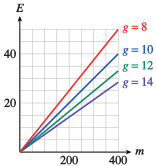
- Sketch a graph of as a function of for , , , and .
- Sketch a graph of as a function of for , , , and .
- Direct variation: In each row, for some constant that depends on the row.
- Inverse variation: In each column, for some constant that depends on the column.
- miles/gallon
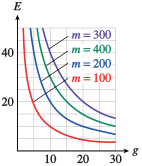
The table shows the productivity, , of a manufacturing plant as a function of the number of items produced, , and the hours of labor used, . Values of are rounded to tenths where necessary.
| Productivity | ||||||||
| Labor (hours) | ||||||||
| Items produced | ||||||||
- Choose one row of the table and decide if varies directly with or inversely with . Explain your method.
- Choose one column of the table and decide if varies directly with or inversely with . Explain your method.
- Find the constant of variation and write as a function of and . What are the units of ?
- Sketch a graph of as a function of for , , , and .
- Sketch a graph of as a function of for , , , and .
The water gushing out of a fire hose exerts a backward force that the firefighter must control. This force, called the nozzle reaction, , is a function of the diameter, , of the nozzle and the water pressure, , at the nozzle.
| Nozzle Reaction (lb) | ||||||
| Water pressure (psi) | ||||||
| Nozzle diameter (in) | ||||||
- Show that varies directly with .
- Show that varies directly with a power of . What is the power?
- Find the constant of variation and write a formula for as a function of and .
- A typical fire hose has nozzle diameter inches and nozzle pressure psi. Use your formula to calculate the nozzle reaction.
- In each row, for some constant that depends on the row.
- In each column, for some constant that depends on the column.
- pounds: When we keep constant and double , is multiplied by a factor of . So the value at , should be times the value at , .
The resistance, , of a wire depends on its length, , and diameter, . The table shows the resistance of copper wires of gauges from to . The diameters of the wires are given in mils, where .
| Resistance (ohms) | ||||||
| Diameter (mils) | ||||||
| Length (ft) | ||||||
- Show that varies directly with .
- Show that varies inversely with a power of . What is the power?
- Find the constant of variation and write a formula for as a function of and .
- Household current uses 12-gauge wire, with a diameter of 0.081 inches. Use your formula to calculate the resistance of a 100-foot length of 12-gauge wire, and verify with the table.
In 2005, Popular Mechanics tested the acceleration from rest for eight sports cars.
| Car | Time (sec) | Distance (ft) | Acceleration (ft/sec ) |
|---|---|---|---|
| Mercedes-Benz E55 AMG | |||
| Lamborghini Gallardo | |||
| Chevrolet Corvette Z06 | |||
| Mercedes-Benz SL600 | |||
| Porsche 911 GT2 | |||
| Dodge Viper SRT-10 | |||
| Saleen S7 Competition | |||
| Ford Gran Torino |
- Acceleration, , varies directly with distance, , and inversely with a power of time, . Use the information in the table to write as a function of and .
- Use your formula to compute the acceleration of the other five cars.
- Use your formula to plot against for , , , and seconds.
- Use your formula to plot against for , , , and feet.
- Mercedes-Benz: , Porsche: , Dodge: , Saleen: , Ford:
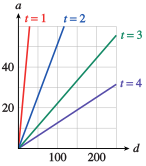
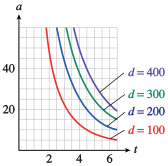
The rate of water flow, , through a fire hose is a function of the diameter, , of the nozzle and the nozzle pressure, .
| Water flow (gal/min) | ||||||
| Water pressure (psi) | ||||||
| Nozzle diameter (in) | ||||||
- Plot as a function of for , , , and . Which basic function do your graphs resemble?
- Plot as a function of for , , , and . Which basic function do your graphs resemble?
- Write a formula for as a function of and , and find the constant of variation. Check your formula against the table.
Railroad engineers use a transition curve between straight sections of track and bends, which are designed as arcs of circles. The length, , of the transition curve varies directly with the cube of the train's speed, , and inversely with the radius, , of the circular arc.
- On a section of track where the speed limit is mph, a circular bend has a radius of feet, and the transition curve is feet long. Find the constant of variation and write a formula for as a function of and .
- If the speed limit is increased by , how is the length of the transition curve affected?
- If the radius of the bend is increased by , how is the length of the transition curve affected?
- Increased by
- Decreased by
The density, , of a planet varies directly with its mass, , and inversely with the cube of its radius, .
| Planet | Radius (km) | Mass () | Density () |
|---|---|---|---|
| Mercury | |||
| Venus | |||
| Earth | |||
| Mars | |||
| Jupiter | |||
| Saturn | |||
| Uranus | |||
| Neptune | |||
| Pluto |
- Use the data for Earth to find the constant of variation, then write a formula for as a function of and .
- Calculate the densities of the other planets.
- The planets are composed of three broad categories of materials: rocky materials, icy materials (including water), and the materials that dominate the sun, namely hydrogen and helium. The density of rock varies from to . Which of the planets could be composed mainly of rock?
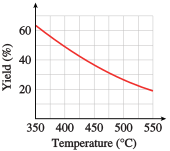
Ammonia has many uses in industry and agriculture, including the production of fertilizers. It is produced in the laboratory from nitrogen and hydrogen, but the process requires high pressure and temperature for significant yield. The graph illustrates the relationship. (Source: Hunt and Sykes, 1984)
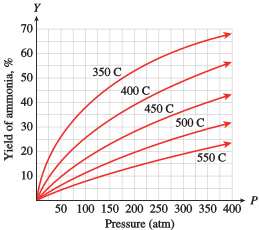
- Complete the table showing the yield of ammonia, as a percent of the gas mixture leaving the reactor, at various pressures and temperatures.
Percent Ammonia Pressure (atmospheres) Temperature
(C) - What happens to the yield of ammonia if the pressure is held constant but the temperature is increased beyond C?
- Sketch a graph of the yield of ammonia as a function of temperature when the pressure is atmospheres.
Percent Ammonia Pressure (atmospheres) Temperature
(C)- The ammonia yield decreases.
The graph shows the heat index, which combines air temperature and relative humidity to determine an apparent temperature, or what the temperature actually feels like. (Source: Ahrens, 1998)
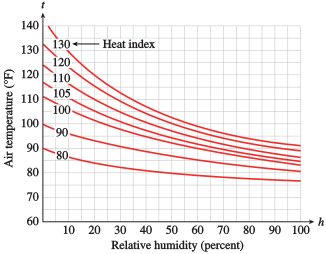
- Complete the table showing the heat index for various combinations of air temperature and relative humidity.
Heat Index Relative humidity () Air
temperature
(F) - Complete the table showing the relative humidity at which the heat index is equal to the actual air temperature.
Air Temperature (F) Relative humidity () - Sketch a graph of the heat index as a function of air temperature if the relative humidity is .
Modeling, Functions, and Graphs by Katherine Yoshiwara (yoshiwarabooks.org), GNU Free Documentation License 1.2 or later. Adapted for the XYZ HTML edition with the authors' permission (recorded 2026-07-04). License: GFDL-1.2-or-later.