
3.3 Roots and Radicals
In Integer Exponents we saw that inverse variation can be expressed as a power function by using negative exponents. We can also use exponents to denote square roots and other radicals.
th Roots
Recall that is a square root of if , and is a cube root of if . In a similar way, we can define the fourth, fifth, or sixth root of a number. For instance, the fourth root of is a number whose fourth power is . In general, we make the following definition.
We use the symbol to denote the th root of . An expression of the form is called a radical, is called the radicand, and is called the index of the radical.
Evaluate each radical.
- _____
- _____
Evaluate each radical.
Exponential Notation for Radicals
A convenient notation for radicals uses fractional exponents. Consider the expression . What meaning can we attach to an exponent that is a fraction? The third law of exponents says that when we raise a power to a power, we multiply the exponents together:
Therefore, if we square the number , we get
Thus, is a number whose square is . But this means that is a square root of , or
In general, any nonnegative number raised to the power is equal to the positive square root of the number, or
Evaluate each power.
- _____
- _____
- _____
- _____
Evaluate each power.
The same reasoning works for roots with any index. For instance, is the cube root of , because
In general, we make the following definition for fractional exponents.
Write each power with radical notation, and then evaluate.
- is
_____
_____ - is
_____
_____
Write each power with radical notation, and then evaluate.
Of course, we can use decimal fractions for exponents as well. For example,
Which of the following expressions is not equivalent to the other three?
_____
is not equivalent to the other three expressions.
Which of the following expressions is not equivalent to the other three?
Write each power with radical notation, and then evaluate.
- is
_____
_____ - is
_____
_____
Write each power with radical notation, and then evaluate.
Explain why is a reasonable notation for .
_____
Explain why is a reasonable notation for .
Irrational Numbers
What about th roots such as and that cannot be evaluated easily? These are examples of irrational numbers. We can use a calculator to obtain decimal approximations for irrational numbers. For example, you can verify that
It is not possible to write down an exact decimal equivalent for an irrational number, but we can find an approximation to as many decimal places as we like.
Working with Fractional Exponents
Fractional exponents simplify many calculations involving radicals. You should learn to convert easily between exponential and radical notation. Remember that a negative exponent denotes a reciprocal.
Convert each radical to exponential notation.
- _____
- _____
Convert each radical to exponential notation.
- Convert to exponential notation.
_____ - Convert to radical notation.
_____
- Convert to exponential notation.
- Convert to radical notation.
Which of the following statements is true?
_____
Which of the following statements is true?
Using Fractional Exponents to Solve Equations
In Chapter 2, we learned that raising to powers and taking roots are inverse operations, that is, each operation undoes the effects of the other. This relationship is especially easy to see when the root is denoted by a fractional exponent. For example, to solve the equation
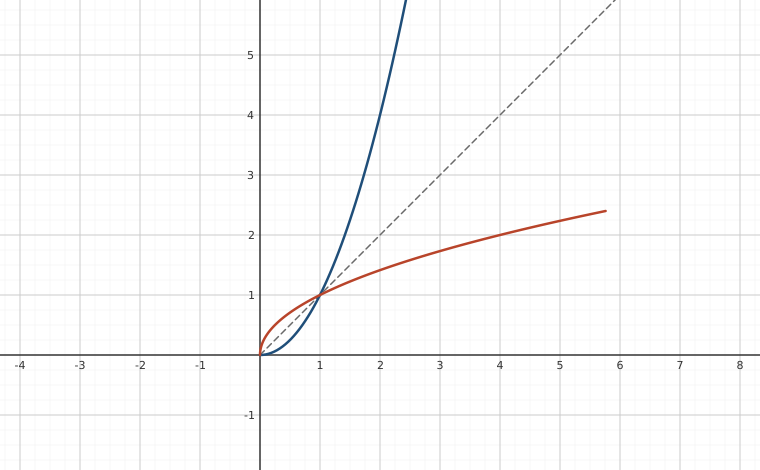
we would take the fourth root of each side. But instead of using radical notation, we can raise both sides of the equation to the power :
The third law of exponents tells us that , so
We evaluate the right side to find or .
In general, to solve an equation involving a power function , we first isolate the power, then raise both sides to the exponent .
A spherical fish tank in the lobby of the Atlantis Hotel holds about 905 cubic feet of water. What is the radius of the fish tank?
Answer: About _____ feet
Solve to find that the radius is about feet
A spherical fish tank in the lobby of the Atlantis Hotel holds about 905 cubic feet of water. What is the radius of the fish tank?
Solve to find that the radius is about feet.
Power Functions
The basic functions and are power functions of the form , and the graphs of all such functions have shapes similar to those two, depending on whether the index of the root is even or odd.
Figure (a) shows the graphs of
Figure (b) shows the graphs of
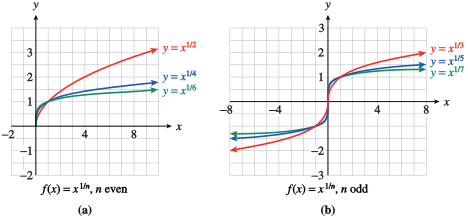
We cannot take an even root of a negative number. (See A Note on Roots of Negative Numbers at the end of this section.) Hence, if is even, the domain of is restricted to nonnegative real numbers, but if is odd, the domain of is the set of all real numbers.
We will also encounter power functions with negative exponents. For example, an animal's heart rate is related to its size or mass, with smaller animals generally having faster heart rates. The heart rates of mammals are given approximately by the power function
where is the animal's mass and is a constant.
Many properties relating to the growth of plants and animals can be described by power functions of their mass. The study of the relationship between the growth rates of different parts of an organism, or of organisms of similar type, is called allometry. An equation of the form
used to describe such a relationship is called an allometric equation.
Of course, power functions can be expressed using any of the notations we have discussed. For example, the function in Example can be written as
- Complete the table of values for the power function .
_____ _____ _____ _____ _____ _____ _____ _____ _____ _____ - Sketch the graph of .
- Write the formula for with a decimal exponent, and with radical notation.
is
_____
and also, is
_____
- A graph is below.
- ,
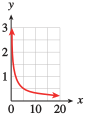
- Complete the table of values for the power function .
- Sketch the graph of .
- Write the formula for with a decimal exponent, and with radical notation.
- ,
Describe the differences in the graphs of for positive and negative, for .
_____
Describe the differences in the graphs of for positive and negative, for .
Solving Radical Equations
A radical equation is one in which the variable appears under a square root or other radical. The radical may be denoted by a fractional exponent. For example, the equation
is a radical equation because . To solve the equation, we first isolate the power to get
Then we raise both sides of the equation to the reciprocal of , or .
Which law of exponents do we use when solving ?
_____
Which law of exponents do we use when solving ?
In Example, we found the heart-rate function, .
What would be the mass of an animal whose heart rate is beats per minute?
Answer: _____ kg
We solve to find kg
What would be the mass of an animal whose heart rate is beats per minute?
We solve to find kg.
A Note on Roots of Negative Numbers
You already know that is not a real number, because there is no real number whose square is . Similarly, is not a real number, because there is no real number for which . (Both of these radicals are complex numbers. Complex numbers are discussed in Chapter 7.) In general, we cannot find an even root (square root, fourth root, and so on) of a negative number.
On the other hand, every positive number has two even roots that are real numbers. For example, both and are square roots of . The symbol refers only to the positive, or principal root, of . If we want to refer to the negative square root of , we must write . Similarly, both and are fourth roots of , because and . However, the symbol refers to the principal, or positive, fourth root only. Thus,
Things are simpler for odd roots (cube roots, fifth roots, and so on). Every real number, whether positive, negative, or zero, has exactly one real-valued odd root. For example,
Here is a summary of our discussion.
The same principles apply to powers with fractional exponents. Thus
but is not a real number. On the other hand,
because the exponent applies only to , and the negative sign is applied after the root is computed.
Which of the following is undefined for negative ?
_____
is undefined for negative .
Which of the following is undefined for negative ?
Evaluate each power, if possible. Enter "DNE" if it is not possible to evaluate.
- _____
- _____
- _____
- _____
- undefined
Evaluate each power, if possible. Enter "DNE" if it is not possible to evaluate.
- undefined
What is the domain of the function , and why?
_____
What is the domain of the function , and why?
Section Summary
Vocabulary
Look up the definitions of new terms in the Glossary.
- th root
- Radical
- Radical equation
- Radical notation
- Index
- Exponential notation
- Radicand
- Allometric equation
- Irrational number
CONCEPTS
- th roots: is called an th root of if .
- Exponential notation: For any integer and for , .
- We cannot write down an exact decimal equivalent for an irrational number, but we can approximate an irrational number to as many decimal places as we like.
- We can solve the equation by raising both sides to the power.
- An allometric equation is a power function of the form .
- We can solve the equation by raising both sides to the th power.
STUDY QUESTIONS
- Use an example to illustrate the terms radical, radicand, index, and principal root.
- Explain why is a reasonable notation for .
- What does the notation mean?
- Express each of the following algebraic notations in words; then evaluate each for :
- How is the third law of exponents, useful in solving equations?
SKILLS
Practice each skill in the Homework problems listed.
- Evaluate powers and roots: #1–8, 17–20
- Convert between radical and exponential notation: #9–16, 21 and 22
- Solve radical equations: #23–38, 59 and 60
- Graph and analyze power functions: #39–58
- Work with fractional exponents: #61–68
Homework 3.3
For Problems 1–4, find the indicated root without using a calculator; then check your answers.
For Problems 5–8, find the indicated power without using a calculator; then check your answers.
For Problems 9–12, write each expression in radical form.
For Problems 13–16, write each expression in exponential form.
For Problems 17–18, simplify.
For Problems 19–20, use a calculator to approximate each irrational number to the nearest thousandth.
For Problems 21–22, write each expression as a power function.
For Problems 23–30, solve.
For Problems 31–38, solve for the indicated variable.
for
for
for
for
for
for
for
for
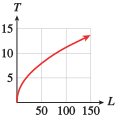
The period of a pendulum is the time it takes for the pendulum to complete one entire swing, from left to right and back again. The greater the length, , of the pendulum, the longer its period, . In fact, if is measured in feet, then the period is given in seconds by
- Write the formula for as a power function in the form .
- Suppose you are standing in the Convention Center in Portland, Oregon, and you time the period of its Foucault pendulum (the longest in the world). Its period is approximately seconds. How long is the pendulum?
- Choose a reasonable domain for the function and graph the function.
- feet
If you are flying in an airplane at an altitude of miles, on a clear day you can see a distance of miles to the horizon, where
- Write the formula for as a power function in the form .
- Choose a reasonable domain for the function and graph the function.
- At what altitude will you be able to see for a distance of miles? How high is that in feet?
If you walk in the normal way, your maximum speed, , in meters per second, is limited by the length of your legs, , according to the formula
where the constant is approximately meters per second squared. (Source: Alexander, 1992)
- A typical adult man has legs about meter long. How fast can he walk?
- A typical four-year-old has legs meter long. How fast can she walk?
- Graph maximum walking speed as a function of leg length.
- Race-walkers can walk as fast as meters per second by rotating their hips so that the effective length of their legs is increased. What is that effective length?
- On the Moon the value of is meters per second squared. How fast can a typical adult man walk on the Moon?
- meters per second
- meters per second
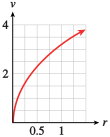
- meters
- meters per second
When a ship moves through the water, it creates waves that impede its own progress. Because of this resistance, there is an upper limit to the speed at which a ship can travel, given, in knots, by
where is the length of the vessel, in feet. (Source: Gilner, 1972)
- Graph maximum speed as a function of vessel length.
- The world's largest ship, the oil tanker Jahre Viking, is feet long. What is its top speed?
- As a ship approaches its maximum speed, the power required increases sharply. Therefore, most merchant ships are designed to cruise at speeds no higher than . Graph on the same axes with .
- What is the cruising speed of the Jahre Viking? What percent of its maximum speed is that?
A rough estimate for the radius of the nucleus of an atom is provided by the formula
where is the mass number of the nucleus and centimeter.
- Estimate the radius of the nucleus of an atom of iodine-127, which has mass number . If the nucleus is roughly spherical, what is its volume?
- The nuclear mass of iodine-127 is gram. What is the density of the nucleus? (Density is mass per unit volume.)
- Complete the table of values for the radii of various radioisotopes.
Element Carbon Potassium Cobalt Technetium Radium Mass
number,Radius, - Sketch a graph of as a function of . (Use units of centimeter on the vertical axis.)
- cm;
Element Carbon Potassium Cobalt Technetium Radium Mass
number,Radius,
( cm)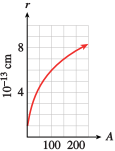
In the sport of men's crew racing, the best times vary closely with the number of men in the crew, according to the formula
where is the number of men in the crew and is the winning time, in minutes, for a -meter race.
- If the winning time for the -man crew was minutes, estimate the value of .
- Complete the table of values of predicted winning times for the other racing classes.
Size of crew, Winning time, - Sketch a graph of as a function of .
In Problems 45–48, one quantity varies directly with the square root of the other, that is, .
- Find the value of and write a power function relating the variables.
- Use your function to answer the question.
- Graph your function and verify your answer to part (b) on the graph.
The stream speed necessary to move a granite particle is a function of the diameter of the particle; faster river currents can move larger particles. The table shows the stream speed necessary to move particles of different sizes. What speed is needed to carry a particle with diameter centimeter?
| Diameter, (cm) | Speed, (cm/sec) |
|---|---|
- cm/sec
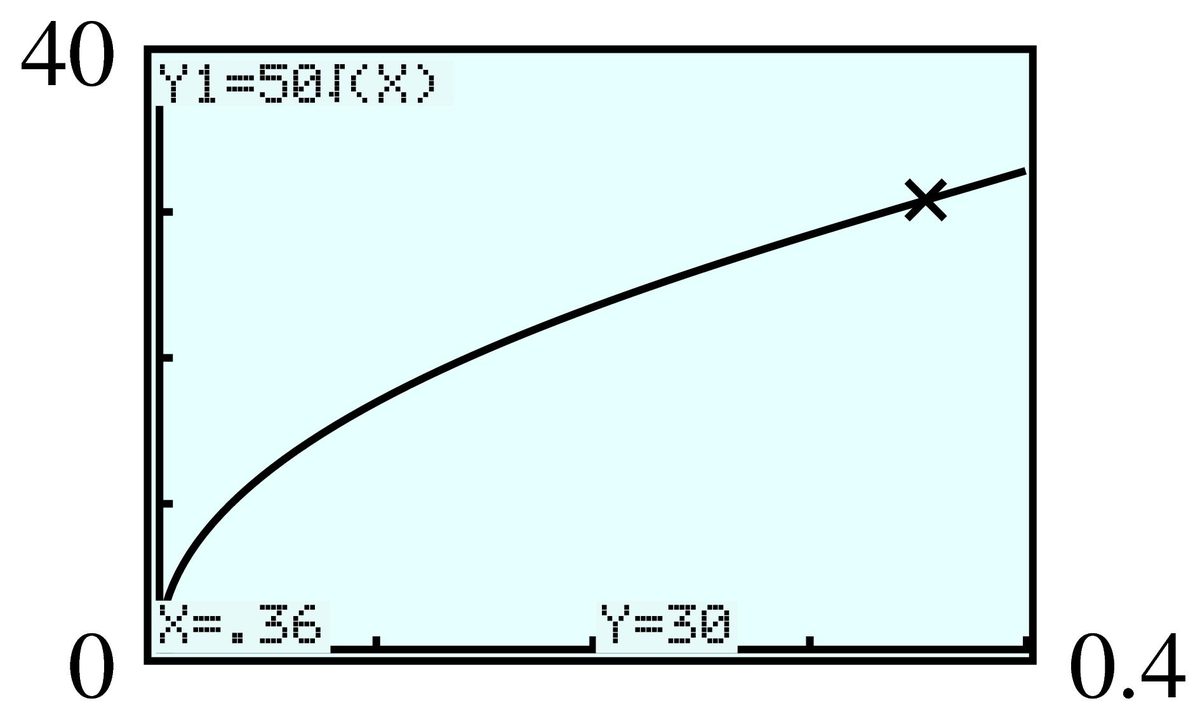
The speed at which water comes out of the spigot at the bottom of a water jug is a function of the water level in the jug; it slows down as the water level drops. The table shows different water levels and the resulting flow speeds. What is the flow speed when the water level is at inches?
| Level, (in) | Speed, (gal/min) |
|---|---|
The rate, , in feet per second, at which water flows from a fire hose is a function of the water pressure, , in psi (pounds per square inch). What is the rate of water flow at a typical water pressure of psi?
| (psi) | ||||
|---|---|---|---|---|
| (ft/sec) |
- ft/sec
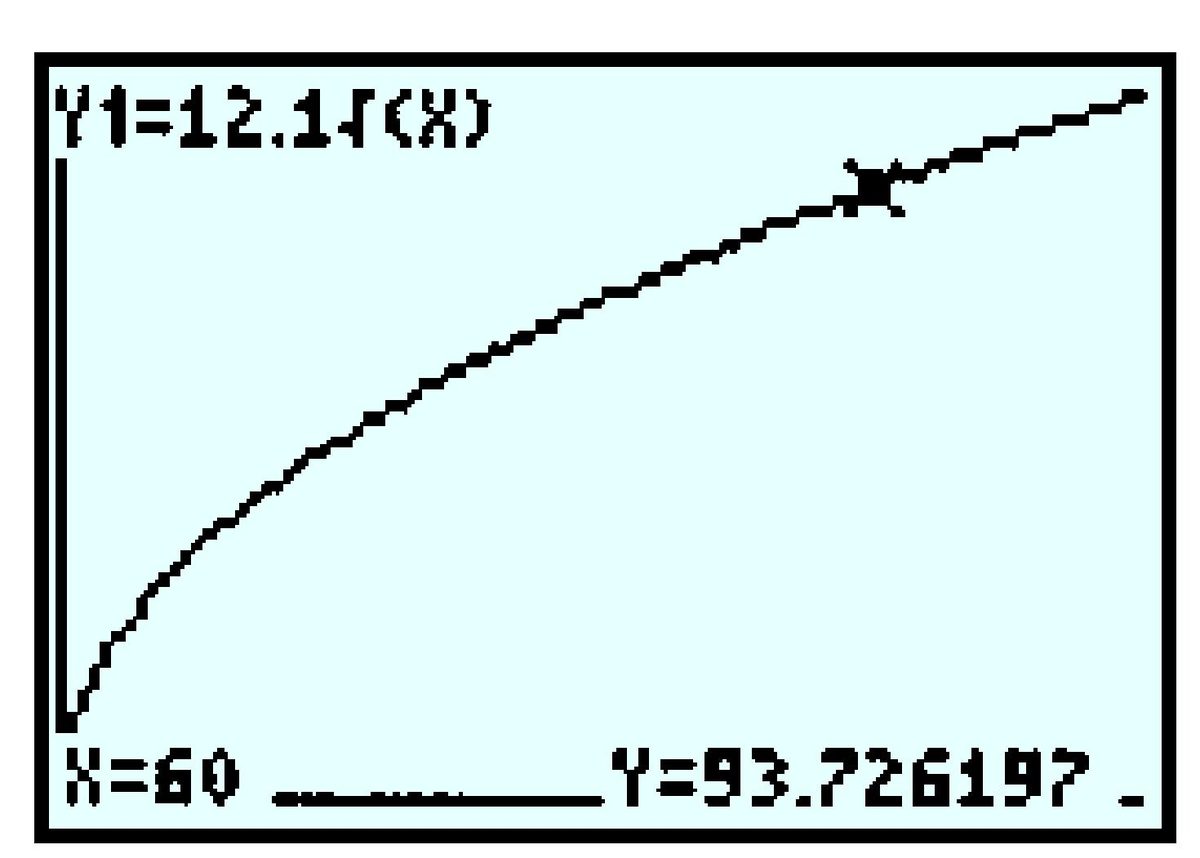
When a layer of ice forms on a pond, the thickness of the ice, , in centimeters, is a function of time, , in minutes. How thick is the ice after hours?
| (min) | ||||
|---|---|---|---|---|
| (cm) |
Membership in the County Museum has been increasing since it was built in . The number of members is given by the function
where is the number of years since .
- How many members were there in ? In ?
- In what year will the museum have members? If the membership continues to grow according to the given function, when will the museum have members?
- Graph the function . How would you describe the growth of the membership over time?
- ;
- ;
- The membership grows rapidly at first but is growing less rapidly with time.
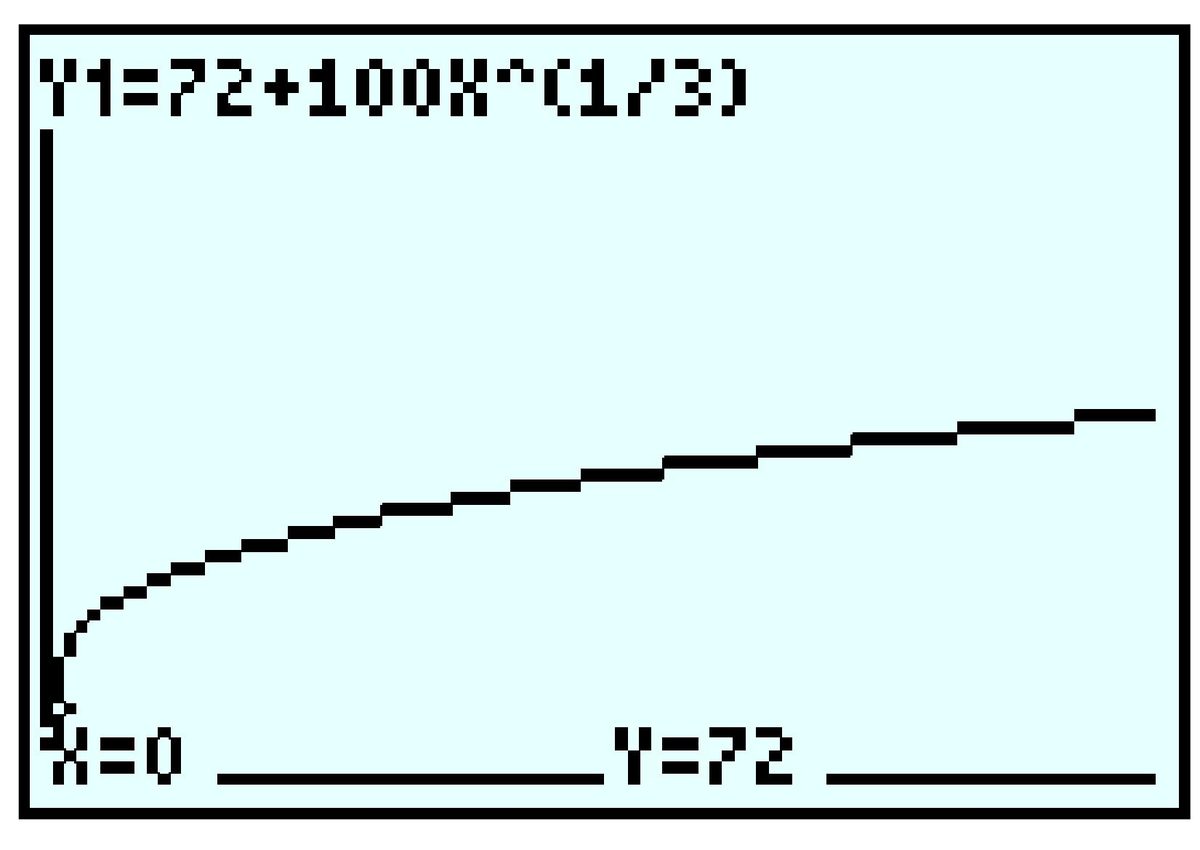
Due to improvements in technology, the annual electricity cost of running most major appliances has decreased steadily since . The average annual cost of running a refrigerator is given, in dollars, by the function
where is the number of years since .
- How much did it cost to run a refrigerator in ? In ?
- When was the cost of running a refrigerator half of the cost in ? If the cost continues to decline according to the given function, when will it cost $ per year to run a refrigerator?
- Graph the function . Do you think that the cost will continue to decline indefinitely according to the given function? Why or why not?
Match each function with the description of its graph in the first quadrant.
- Increasing and concave up
- Increasing and concave down
- Decreasing and concave up
- Decreasing and concave down
- I
- III
- II
- none
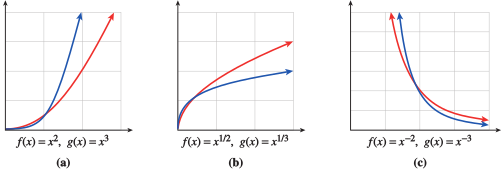
In each pair, match the functions with their graphs.
- Graph the functions in the window What do you observe?
- Use your graphs to evaluate , , , and .
- Use your calculator to evaluate for , , and . What happens when gets large?
- The graphs of become closer and closer to horizontal when increases (for ).
- ; the values decrease towards .
- Graph the functions in the window What do you observe?
- Use your graphs to evaluate , , , and .
- Use your calculator to evaluate for , , and . What happens when gets large?
For Problems 55–58, graph each set of functions in the given window. What do you observe?
The graphs of and are symmetric about .
The graphs of and are symmetric about .
- Graph the functions and in the window
- Use the graph to solve the equation .
- Solve the equation algebraically.
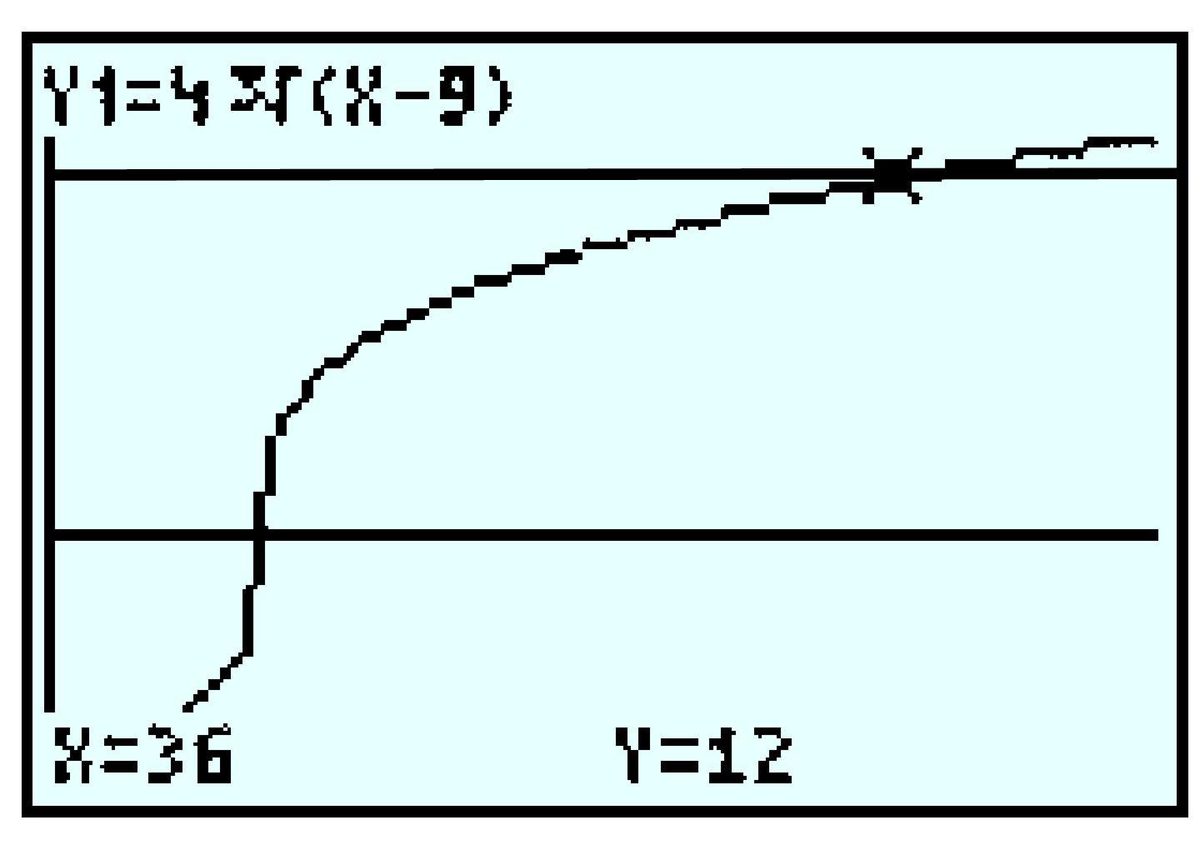
- Graph the functions and in the window
- Use the graph to solve the equation .
- Solve the equation algebraically.
- Write with a fractional exponent.
- Write with fractional exponents.
- Use the laws of exponents to show that .
- Write with a fractional exponent.
- Write with a fractional exponents.
- Use the laws of exponents to show that .
For Problems 63–68, write the expression as a sum of terms of the form .
Modeling, Functions, and Graphs by Katherine Yoshiwara (yoshiwarabooks.org), GNU Free Documentation License 1.2 or later. Adapted for the XYZ HTML edition with the authors' permission (recorded 2026-07-04). License: GFDL-1.2-or-later.